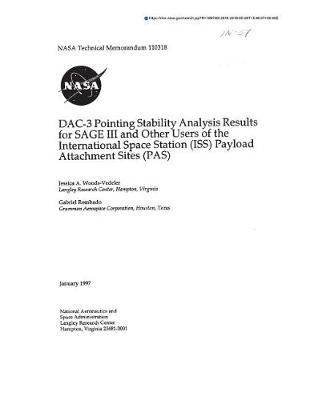
Dac-3 Pointing Stability Analysis Results for Sage 3 and Other Users of the International Space Station (Iss) Payload Attachment Sites (Pas)

Author:   National Aeronaut Administration (Nasa)
Publisher:   Createspace Independent Publishing Platform
ISBN:  

9781722981365


Pages:   104
Publication Date:   17 July 2018
Format:   Paperback
Availability:   Available To Order   Availability explained
We have confirmation that this item is in stock with the supplier. It will be ordered in for you and dispatched immediately.

Our Price $79.17 Quantity:  
Add to Cart

Share |

Dac-3 Pointing Stability Analysis Results for Sage 3 and Other Users of the International Space Station (Iss) Payload Attachment Sites (Pas)


Overview

The purpose of this paper is to provide final results of a pointing stability analysis for external payload attachment sites (PAS) on the International Space Station (ISS). As a specific example, the pointing stability requirement of the SAGE III atmospheric science instrument was examined in this paper. The instrument requires 10 arcsec stability over 2 second periods. SAGE 3 will be mounted on the ISS starboard side at the lower, outboard FIAS. In this engineering analysis, an open-loop DAC-3 finite element model of ISS was used by the Microgravity Group at Johnson Space Flight Center to generate transient responses at PAS to a limited number of disturbances. The model included dynamics up to 50 Hz. Disturbance models considered included operation of the solar array rotary joints, thermal radiator rotary joints, and control moment gyros. Responses were filtered to model the anticipated vibration attenuation effects of active control systems on the solar and thermal radiator rotary joints. A pointing stability analysis was conducted by double integrating acceleration transient over a 2 second period. Results of the analysis are tabulated for ISS X, Y, and Z Axis rotations. These results indicate that the largest excursions in rotation during pointing occurred due to rapid slewing of the thermal radiator. Even without attenuation at the rotary joints, the resulting pointing error was limited to less than 1.6 arcsec. With vibration control at the joints, to a maximum 0.5 arcsec over a 2 second period. Based on this current level of model definition, it was concluded that between 0 - 50 Hz, the pointing stability requirement for SAGE 3 will not be exceeded by the disturbances evaluated in this study. Woods-Vedeler, Jessica A. and Rombado, Gabriel Langley Research Center INTERNATIONAL SPACE STATION; MICROGRAVITY; GRAVITATIONAL EFFECTS; VIBRATION EFFECTS; VIBRATION DAMPING; STABILITY TESTS; FINITE ELEMENT METHOD; MATHEMATICAL MODELS; TRANSIENT RESPONSE; SOLAR ARRAYS; PA...

Full Product Details

Author:   National Aeronaut Administration (Nasa)
Publisher:   Createspace Independent Publishing Platform
Imprint:   Createspace Independent Publishing Platform
Dimensions:   Width: 21.60cm , Height: 0.60cm , Length: 27.90cm
Weight:   0.263kg
ISBN:  

9781722981365


ISBN 10:   1722981369
Pages:   104
Publication Date:   17 July 2018
Audience:   General/trade ,  General
Format:   Paperback
Publisher's Status:   Active
Availability:   Available To Order   Availability explained
We have confirmation that this item is in stock with the supplier. It will be ordered in for you and dispatched immediately.

Table of Contents

Reviews

Author Information

Tab Content 6

Author Website:  

Countries Available

All regions
Latest Reading Guide

April RG 26_2


Shopping Cart
Your cart is empty
Shopping cart
Mailing List