Overview
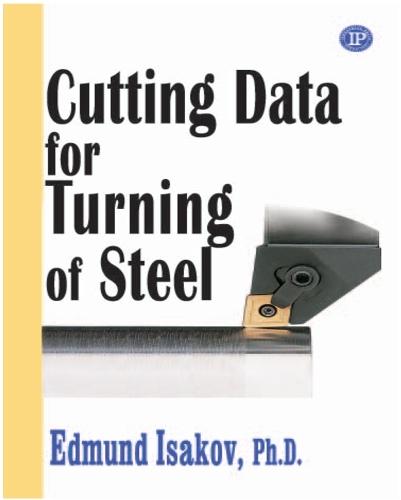
Mechanical Properties of Steel Hardness Carbon Steels Alloy Steels Stainless Steels Tool Steels Cutting Tools Materials High Speed Steels Cemented Carbides Cermets Ceramics Polycrystalline Cubic Boron Nitride (PCBN) Machining Recommendations Depth of Cut and Feed Rate Cutting Speeds for Carbon Steels Cutting Speeds for Alloy Steels Cutting Speeds for Stainless Steels Cutting Speeds for Tool Steels Machining Power Metal Removal Rate Unit Power and Power Constant Calculating Required Machining Power Appendix 1: Hardness Conversion Appendix 2: Carbon Steels Appendix 3: Alloy Steels Appendix 4: Stainless Steels Appendix 5: Tool Steels Machining is one of the most important manufacturing processes, which remove unwanted material in the form of chips from a workpiece. Material removal operations are among the most expensive; in the U.S. alone, more than $100 billion were spent on machining in 1999. These high costs put tremendous economic pressures on production managers and engineers as they struggle to find ways to increase productivity. Machining recommendations provided in this book cover turning since it allows removing more material per unit of time and consuming more power at the roughing operations than end milling, boring or drilling. Machining recommendations relate to cutting speeds, feed rates, and depth of cuts. Such recommendations depend on the workpiece material properties and the cutting tool material. Workpiece materials described in this book are the most commonly used grades of carbon, alloy, stainless, tool, and maraging steels. Cutting tool materials are cemented carbides, cermets, and ceramics. Describes hardness, tensile strength, and machinability of steels-the major mechanical properties. These properties are taken into consideration when selecting machining parameters.Features machining recommendations for turning that provide the cutting speed values based on Brinell hardness numbers, the depth of cut, and feed rate in relationships with the type of steel. Summarizes numerous calculations in five appendices.
Full Product Details
Author: Edmund Isakov
Publisher: Industrial Press Inc.,U.S.
Imprint: Industrial Press Inc.,U.S.
Edition: 2nd edition
Dimensions:
Width: 20.80cm
, Height: 2.50cm
, Length: 25.90cm
Weight: 0.930kg
ISBN: 9780831133146
ISBN 10: 0831133147
Pages: 328
Publication Date: 31 October 2008
Audience:
Professional and scholarly
,
Professional & Vocational
Format: Hardback
Publisher's Status: Active
Availability: Awaiting stock

The supplier is currently out of stock of this item. It will be ordered for you and placed on backorder. Once it does come back in stock, we will ship it out for you.
Author Information
Dr. Edmund Isakov. Ph.D., has enjoyed a long and distinguished career in metalworking. He earned his Doctor of Philosophy degree in Mechanical Engineering at the V. Bakul Institute for Superhard Materials (Kiev, Ukraine). He is known for his work in research, development and applications of cuttting tools for milling, turning and boring. Dr. Isakov has authored Mechanical Properties of Work Materials and numerous articles and papers on metalcutting. He holds several U.S. patents and numerous U.S.S.R Inventor's Certificates pertaining to carbide and diamond tools. during nearly two decades at Kennametal, Inc., he became a noted authority on the technical analysis of cutting tools. Dr. Isakov is now an independent consulant and manufacturing sciences writer based in Florida. He is a senior member of SME.