Overview
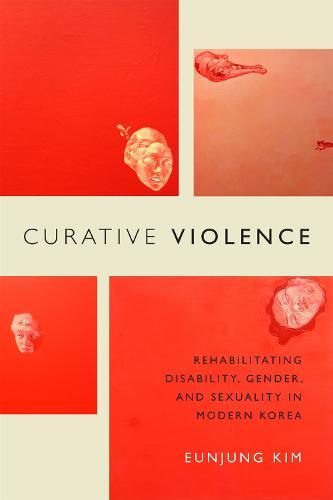
In Curative Violence Eunjung Kim examines what the social and material investment in curing illnesses and disabilities tells us about the relationship between disability and Korean nationalism. Kim uses the concept of curative violence to question the representation of cure as a universal good and to understand how nonmedical and medical cures come with violent effects that are not only symbolic but also physical. Writing disability theory in a transnational context, Kim tracks the shifts from the 1930s to the present in the ways that disabled bodies and narratives of cure have been represented in Korean folktales, novels, visual culture, media accounts, policies, and activism. Whether analyzing eugenics, the management of Hansen's disease, discourses on disabled people's sexuality, violence against disabled women, or rethinking the use of disabled people as a metaphor for life under Japanese colonial rule or under the U.S. military occupation, Kim shows how the possibility of life with disability that is free from violence depends on the creation of a space and time where cure is seen as a negotiation rather than a necessity.
Full Product Details
Author: Eunjung Kim
Publisher: Duke University Press
Imprint: Duke University Press
Dimensions:
Width: 15.20cm
, Height: 2.00cm
, Length: 22.90cm
Weight: 0.567kg
ISBN: 9780822362777
ISBN 10: 0822362775
Pages: 312
Publication Date: 20 January 2017
Audience:
Professional and scholarly
,
Professional & Vocational
Format: Hardback
Publisher's Status: Active
Availability: In Print

This item will be ordered in for you from one of our suppliers. Upon receipt, we will promptly dispatch it out to you. For in store availability, please contact us.
Reviews
Kim interrogates the intersections of disability, illness, gender, sexuality, and cure by analyzing Korean cultural representations of disability from the past century. She makes a compelling case for understanding cure as 'based on complicated social and familial negotiations that occur beyond an individual's desire or volition.' . . . The cultural representations Kim analyzes are sweeping in their scope, and she narrates them with sensitivity and a theoretical rigour that lays bare societal divisions and power hierarchies. -- Celeste L. Arrington * Pacific Affairs * In this brilliant and necessary book, Eunjung Kim analyzes the deployment of illness and disability in modern Korea, carefully tracing how cure and rehabilitation are used in the service of the nation. Kim's concepts of curative violence and cure by proxy describe the violent effects of cure and rehabilitation broadly defined, revealing the integral and mutually constitutive role of gender, disability, and sexuality norms in cure ideology and practices. From start to finish, Curative Violence is an exceptional work of transnational feminist disability studies scholarship, and is essential reading not only for those interested in disability studies, but also for anyone studying transnational feminist theory, postcolonial studies, gender and sexual violence, and women's and gender studies more broadly. -- 2017 Alison Piepmeier Award Committee From its opening pages, Eunjung Kim's book is both striking and demanding. Ambitious in its analytical breadth and topical scope, it impressively delivers on its elaboration of curative violence. Kim's examination of South Korean biopolitical conditions in relation to cure sets an excellent example for transnational disability studies at large, and has lessons for an impressively broad range of readers. -- Mel Y. Chen, author of * Animacies: Biopolitics, Racial Mattering, and Queer Affect * Eunjung Kim helps us imagine a future that embraces disability not simply as something to fix, but as an intrinsic and even beautiful part of humanity-a critical approach encouraging Koreans and others around the world to reorient our inherited notions of 'health' and 'well-being.' With theoretical vigor and clarity, Curative Violence makes a bold, unique, and well-articulated intervention into disability studies, Korean studies, gender and sexuality studies, and beyond. -- Todd A. Henry, author of * Assimilating Seoul: Japanese Rule and the Politics of Public Space in Colonial Korea, 1910-1945 *
From its opening pages, Eunjung Kim's book is both striking and demanding. Ambitious in its analytical breadth and topical scope, it impressively delivers on its elaboration of curative violence. Kim's examination of South Korean biopolitical conditions in relation to cure sets an excellent example for transnational disability studies at large, and has lessons for an impressively broad range of readers. --Mel Y. Chen, author of Animacies: Biopolitics, Racial Mattering, and Queer Affect
Author Information
Eunjung Kim is Assistant Professor of Women's and Gender Studies and Disability Studies at Syracuse University.