Overview
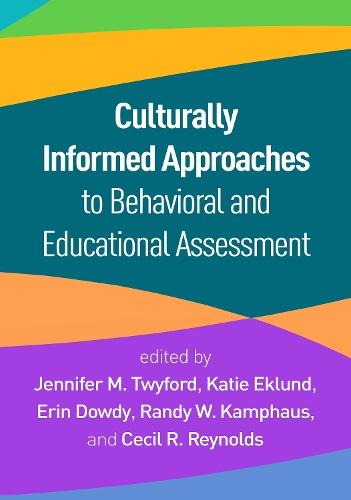
Grounded in state-of-the-art research, this book provides comprehensive guidance for equitable behavioral and educational assessment of children and adolescents across school and clinical settings. Noted scholars weave an emphasis on ecological context, diversity, equity, inclusion, and social justice into each chapter. Key assessment strategies, methods, and measures are discussed and best practices reviewed for culturally responsive evaluation of high-incidence mental health, behavioral, and developmental disorders. Practical pointers and examples throughout the volume illustrate effective ways to improve the fairness of assessment procedures and interpretations.
Full Product Details
Author: Jennifer M. Twyford (Lewis and Clark College, United States) , Katie Eklund (University of Wisconsin–Madison, United States) , Erin Dowdy (University of California, United States) , Randy W. Kamphaus (Georgia State University, United States)
Publisher: Guilford Publications
Imprint: Guilford Press
ISBN: 9781462561285
ISBN 10: 1462561284
Pages: 444
Publication Date: 11 May 2026
Audience:
Professional and scholarly
,
Professional & Vocational
Format: Hardback
Publisher's Status: Forthcoming
Availability: Not yet available 
This item is yet to be released. You can pre-order this item and we will dispatch it to you upon its release.
Table of Contents
I. Foundational Considerations 1. Reflections on Changes, Trends, and Current Issues in the Psychological Assessment of Youth, Jennifer M. Twyford, Katie Eklund, & Erin Dowdy 2. Test and Assessment Fairness in Historical Perspective, Randy W. Kamphaus & Cecil R. Reynolds 3. Culturally Responsive Behavior Assessment, Janine Jones 4. Assessment within a Public Health Paradigm, Katie Eklund, Jennifer Twyford, Erin Dowdy, Jared T. Izumi, & Ellen Anderson 5. Assessment within a Dual-Factor Framework, Stephanie A. Moore, Brittany N. Zakszeski, Viviana E. Padilla, Kezia Gopaul-Knights, & Heather E. Orniston 6. Assessment for Schools and Clinical Settings, Ellen W. Rowe, Nicole M. Beadles, & Danielle R. Palmer 7. Assessment from an Ecological Approach, Lindsay M. Fallon, Staci Ballard, & Emily Romero 8. Assessing Implementation Outcomes within Multi-Tiered Systems of Support, Melissa A. Collier-Meek, Alexandra M. Pierce, & Sarina H. Alavi 9. Directly Observing and Recording Behaviors, Christopher H. Skinner & Keri A. Keller II. Assessment Strategies 10. Culturally Informed Interviewing in the Psychological Assessment of Children and Adolescents, Taylor A. Miller, Paul J. Frick, & Courtney M. Goetz 11. Comprehensive Rating Scales, Annmary S. Abdou, Amy Jane Griffiths, Jared T. Izumi, & Rachel Torres 12. Screening Measures and Methods, Bridget V. Dever, Emily K. Gallagher, Kristen F. Stack, Jessica Lathrop, & Nathan Kirk 13. Progress Monitoring within a Culturally Responsive Evaluation Framework, Stephen P. Kilgus, Evan H. Dart, Ishan Vengurlekar, & Aileen Kangavary III. Assessment of Various Disorders 14. Assessment of Autism, Anna Krasno, Julia Juechter, & Kaylin Russell 15. Assessment of Attention-Deficit/Hyperactivity Disorder, Nadia Bounoua, Hong NT Bui, Nicholas Marsh, Daria Taubin, & Andrea Chronis-Tuscano 16. Assessment of Intellectual Disabilities, Lindsay M. McCary & Kathryn Smith 17. Assessment of Depression, Katie Eklund, Madeline Wadington, & Temma Levis 18. Assessment of Anxiety and Related Disorders, Leandra Parris & Celeste Malone 19. Assessment of Disruptive Behavior Disorders, Cody Gion 20. Assessment of Bipolar and Related Disorders, Shelley R. Hart 21. Assessment of Trauma, Kirby L. Wycoff & Kelly N. Moore IV. Special Considerations 22. Twice-Exceptionality, Jon W. Goodwin & Katherine Schabilion 23. Functional Behavior Assessment, Tai A. Collins, Jakayla Fulwood, Nneka Bonner, & Joseph Lampton 24. Assessing Mindfulness with Youth, Tyler L. Renshaw, Mei-Ki Chan, Mary L. Phan, & Caleb D. Farley 25. Considering Fairness and Culture in Social and Emotional Learning Assessments, Christopher J. Anthony, Katherine E. Frye, Timothy C. Horn, Pui-Wa Lei, & James C. DiPerna 26. Early Childhood Assessment, Rachel Stein & Kizzy Albritton 27. Behavioral Threat Assessment and Management in Schools, Dewey Cornell & Jordan Kerere 28. Suicide Risk Assessment, Erik J. Reinbergs 29. Assessment of Emotional and Behavioral Disorder, Stacy-Ann A. January, Zelda Fleming, Bailey Braunstein, Kary Zarate, & Matthew C. Lambert Index
Reviews
“An invaluable and greatly needed resource that provides culturally responsive and evidence-based information on child psychological assessment in educational settings. The book is engaging and clear, with informative examples provided throughout. This handbook will be an asset to any graduate-level course on child and adolescent assessment, in particular behavioral or cognitive assessment. School and clinical psychology graduate students will benefit from the definitions of key terms, applied examples, and easy-to-read, informative tables and figures.”--Jacqueline Brown, PhD, School Psychology Program, University of Montana “Edited by preeminent, high-impact scholars, this book will doubtless become a go-to resource for child-focused assessors--from trainees to advanced practitioners--in clinical and school settings. There is no other book that combines a comprehensive review of state-of-the-art assessment strategies with an emphasis in every chapter on culturally responsive practices. This groundbreaking contribution will increase the likelihood of accurate assessment that directly translates to effective intervention for diverse child and adolescent populations.”--Mark D. Weist, PhD, Professor of Clinical–Community and School Psychology, University of South Carolina ""The book encourages readers to center the voices and perspectives of marginalized communities throughout the assessment process. It emphasizes the importance of viewing students and families as collaborative partners and honoring their conceptualization of the student’s needs. A core theme is the need to adopt a strengths-based assessment approach that takes into account the impact of systemic discrimination on student development and family functioning, and that considers both individual needs and relevant ecological phenomena. This is an excellent resource for psychologists and educators committed to making holistic, fair, and meaningful data-based decisions to support K-12 youth. The case examples help practitioners and graduate students understand how the theories and frameworks presented can be realized in day-to-day practice.""--Janise S. Parker, PhD, NCSP, School Psychology Program, William & Mary ""With contributions from an impressive group of experts, this book provides a nuanced consideration of culturally responsible assessment practices. It thoroughly describes approaches and adaptations to encourage equitable, socially just assessment of behavioral, emotional, and educational concerns.""--Jennifer A. Mautone, PhD, ABPP, Department of Child and Adolescent Psychiatry and Behavioral Sciences, Children’s Hospital of Philadelphia; Departments of Psychiatry and Pediatrics, Perelman School of Medicine, University of Pennsylvania-
“An invaluable and greatly needed resource that provides culturally responsive and evidence-based information on child psychological assessment in educational settings. The book is engaging and clear, with informative examples provided throughout. This handbook will be an asset to any graduate-level course on child and adolescent assessment, in particular behavioral or cognitive assessment. School and clinical psychology graduate students will benefit from the definitions of key terms, applied examples, and easy-to-read, informative tables and figures.”--Jacqueline Brown, PhD, School Psychology Program, University of Montana “Edited by preeminent, high-impact scholars, this book will doubtless become a go-to resource for child-focused assessors--from trainees to advanced practitioners--in clinical and school settings. There is no other book that combines a comprehensive review of state-of-the-art assessment strategies with an emphasis in every chapter on culturally responsive practices. This groundbreaking contribution will increase the likelihood of accurate assessment that directly translates to effective intervention for diverse child and adolescent populations.”--Mark D. Weist, PhD, Professor of Clinical-Community and School Psychology, University of South Carolina-
Author Information
Jennifer M. Twyford, PhD, NCSP, is Associate Professor in the School Psychology Program at Lewis & Clark College, where she serves as Co-Director of the Hybrid Track and as Assessment Coordinator. Dr. Twyford serves on the board of directors of the Oregon School Psychologists Association and on the editorial boards of several school psychology journals. She maintains a small private practice and has provided clinical services across the spectrum of school, juvenile justice, outpatient, and inpatient settings. Dr. Twyford’s research interests include systemic response and culturally responsible identification and prevention of mental health disorders. She is passionate about the training of multilingual and culturally responsible school psychologists. Katie Eklund, PhD, NCSP, is Professor in the Department of Educational Psychology at the University of Wisconsin–Madison. Prior to entering academia, Dr. Eklund worked in public education for 10 years as a school administrator, school psychologist, and school social worker. Her research focuses on school mental health, including universal screening and intervention for children with behavioral and social–emotional concerns, culturally responsive mental health interventions, social–emotional learning, and school safety. Dr. Eklund is Co-Director of the School Mental Health Collaborative, a research center focused on the social–emotional well-being of all youth. Erin Dowdy, PhD, NCSP, is Professor in the Department of Counseling, Clinical, and School Psychology at the University of California, Santa Barbara. She previously worked as a school psychologist. Dr. Dowdy’s research and publications have focused on assessment for social and emotional health and risk. She regularly supervises doctoral school psychology students in their clinical and research work and teaches courses in school based mental health. Dr. Dowdy is committed to training the next generation of school psychologists and diversifying the school mental health care workforce. Randy W. Kamphaus, PhD, is Professor Emeritus at the University of Oregon, where he previously served as Acting Executive Director of The Ballmer Institute for Children’s Behavioral Health and Dean of the College of Education. His prior positions include Dean of the College of Education and Human Development at Georgia State University and Distinguished Research Professor at the University of Georgia. Dr. Kamphaus’s research has focused on improving the measurement of psychological and educational constructs and advancing assessment practice. He has authored or coauthored books, scientific journal articles, and book chapters on these topics and has created psychological and educational tests. With Cecil R. Reynolds, Dr. Kamphaus developed the Behavior Assessment System for Children (BASC). A Fellow of the American Psychological Association (APA), he has served as editor of School Psychology, as a member of the APA’s Council of Representatives and Board of Professional Affairs, and as President of the APA Division of School Psychology. Cecil R. Reynolds, PhD, ABN, ABPdN, is Emeritus Professor of Educational Psychology, Professor of Neuroscience, and Distinguished Research Scholar at Texas A&M University. Dr. Reynolds is the author of more than 300 scholarly publications and author or editor of over 50 books and more than 50 commercially published tests, including the Behavior Assessment System for Children (BASC; with Randy W. Kamphaus), the Reynolds Intellectual Assessment Scales, and the Test of Memory and Learning. For 25 years, Dr. Reynolds maintained a clinical practice treating trauma victims and also served as Chief of the Neuropsychology Service at Sandstone Psychiatric Hospital. He has held leadership roles in national professional organizations, and is currently editor of the Journal of Pediatric Neuropsychology. Dr. Reynolds is an elected Distinguished Practitioner and Fellow of the National Academies of Practice and a recipient of the Lightner Witmer Award and the Nadine Murphy Lambert Award from Division 16 (School Psychology) of the American Psychological Association (APA), the Samuel J. Messick Award for Distinguished Scientific Contributions from APA Division 5 (Quantitative and Qualitative Methods), and the President’s Gold Medal Award from the National Academy of Neuropsychology. Dr. Reynolds continues to write and practice forensic neuroscience in Austin, Texas.
Tab Content 6
Author Website:
Countries Available
All regions
|