Overview
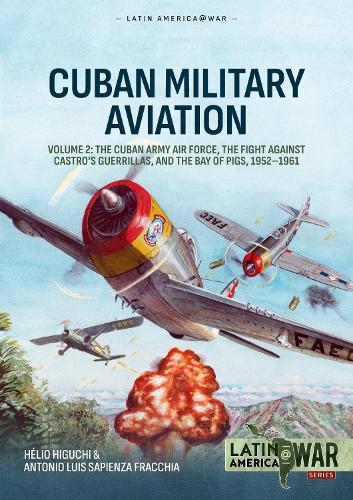
Cuban Military Aviation Volume 2: The Cuban Army Air Force, the fight against Castro's Guerrillas, and the Bay of Pigs, 19521961 continues the definitive two-part study of Cuba's air power, examining the turbulent decade that saw the island's military aviation thrust into sustained combat, political collapse, and Cold War confrontation. Following the reorganisation of the Cuerpo de Aviación del Ejército de Cuba into the Fuerza Aérea del Ejército de Cuba (FAEC) in 1952, Cuban air power expanded rapidly in response to the growing insurgency led by Fidel Castro's Movimiento 26 de Julio. Drawing on extensive archival research, rare photographs, and first-hand accounts, this volume traces how the FAEC evolved from a conventional air arm into a force heavily engaged in counterinsurgency operations, flying thousands of combat sorties against guerrilla forces in the Sierra Maestra and across the island. The book provides a detailed operational analysis of air campaigns conducted with aircraft such as the F-47 Thunderbolt, B-26 Invader, T-33 Shooting Star, and a wide array of light liaison and attack aircraft. It examines the introduction of helicopters, forward air control techniques, night operations, and the growing strains placed on personnel and matériel by an intensifying civil war, compounded by political interference, corruption, and the imposition of a US arms embargo. With the collapse of the Batista regime in January 1959, Cuban military aviation underwent a dramatic transformation. The FAEC was dissolved and replaced by the Fuerza Aérea Revolucionaria (FAR), inheriting much of its predecessor's equipment but stripped of experienced aircrew through purges, trials, imprisonment, and exile. This volume charts the chaotic reconstitution of the air force under revolutionary rule, the reliance on civilian pilots and foreign volunteers, and the difficult transition toward Soviet alignment. The final chapters offer a comprehensive account of the air war during the Bay of Pigs invasion in April 1961, analysing the decisive aerial engagements between the FAR and the exile Fuerza Aérea de Liberación, flown largely with aircraft inherited from the pre-revolutionary era. These operations marked the last combat use of many Second World Warera aircraft in Cuban service and directly shaped Havana's rapid turn to Soviet air power. Extensively illustrated with period photographs, colour profiles, maps, and detailed aircraft tables, Cuban Military Aviation Volume 2 provides the most thorough English language examination to date of Cuban air operations during revolution and regime change. Together with Volume 1, it forms an essential reference for aviation historians, military scholars, and readers interested in Latin American conflicts and early Cold War air warfare. AUTHORS: Hélio Higuchi was born in São Paulo, Brazil on 12 November 1953. He graduated in Architecture and Urban Planning, with a postgraduate degree in Marketing, and has been working in the hotel sector. His main hobby is doing research on military history and its respective equipment in Latin American countries. He is the author of several books on Latin American military aviation and armored vehicles, as well as numerous articles in specialised magazines from Brazil, the United States and England. Antonio Luis Sapienza Fracchia was born in Asunción, Paraguay on 14 May 1960. He graduated from the Catholic University of Asunción where he got a B.A. in Clinical Psychology. He also took specialized English courses at Tulane University of New Orleans, Louisiana, USA and San Diego State University in California. He is now retired but worked for nearly 40 years as an English Teacher and one of the Academic Coordinators at the Centro Cultural Paraguayo-Americano (CCPA), a binational institute in Asunción. Married with two children, he resides in the capital. He is an Aviation Historian who wrote more than 500 articles in specialized magazines and web pages on the Paraguayan Aviation history, and has given numerous lectures in schools, universities, institutes, military and civil institutions in Paraguay and abroad. Since 2004 he has been an aviation history professor in the Paraguayan Air Force (FAP). He has published thirty books since 1996, being this one his eighteenth with Helion. He received a total of seven decorations for his academic merits, two from Argentina, one from Brazil and four from his own country, Paraguay. 277 b/w photos, 18 colour profiles, 5 colour maps, 1 b/w map, 17 tables
Full Product Details
Author: Hélio Higuchi ,
Antonio Luis Sapienza Fracchia
Publisher: Helion & Company
Imprint: Helion & Company
ISBN: 9781806720378
ISBN 10: 180672037
Pages: 100
Publication Date: 03 March 2026
Audience:
Adult education
,
Further / Higher Education
Format: Paperback
Publisher's Status: Active
Availability: Not yet available

This item is yet to be released. You can pre-order this item and we will dispatch it to you upon its release.
Author Information
HÉLIO HIGUCHI hails from São Paulo, Brazil, where he was born in 1953. A hotel manager, he has degrees in Architecture and Urban Design and Marketing. A researcher of Latin American military subjects, he is a regular contributor to Brazilian periodicals Asas, Flap and Tecnologia e Defesa. He is the author of A Serviço do Generalíssimo – Os Pilotos Brasileiros na República Dominicana (In the Service of the Generalissimo – Brazilian Pilots in the Dominican Republic, 2014).