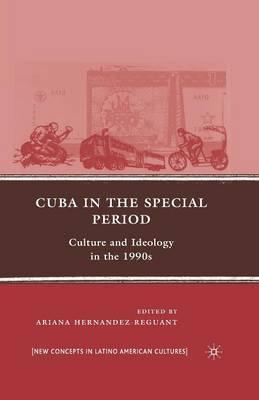
Full Product Details
Author: A. Hernandez-Reguant
Publisher: Palgrave Macmillan
Imprint: Palgrave Macmillan
Edition: 1st ed. 2009
Dimensions:
Width: 14.00cm
, Height: 1.30cm
, Length: 21.60cm
Weight: 0.454kg
ISBN: 9781349373833
ISBN 10: 1349373834
Pages: 226
Publication Date: 13 February 2009
Audience:
Professional and scholarly
,
Professional & Vocational
Format: Paperback
Publisher's Status: Active
Availability: Manufactured on demand

We will order this item for you from a manufactured on demand supplier.
Reviews
""The well-researched essays, covering topics as diverse as literature, art, Santeria, cinema, rap and issues of identity and ethnicity provide rich accounts of the key themes and contractions of the Special Period and how they affected specific groups of cultural producers and expressive communities. Linking them together is the question of how the combination of weakened state institutions, economic crisis and new access to transnational flows of capital and ideas fostered the conditions for new modes of expression and the rearticulation of identities. Each individual essay offers a detailed and . . . nuanced interpretation of the complex relationship between culture and ideology."" - The Journal of Latin American Studies ""Those readers, who, like me, lived in Cuba during the austere Special Period, will find echoes of their own experiences.However, those who have never even visited the island will also discover a great deal in the rich details of these essays. This specificity is the book's strength - in providing rich detail."" - Journal of Cuban Studies ""A necessary and welcome reflection on the Special Period in Cuba as an instance of late socialism . . . these insightful essays shed light on the changes that Cuba's opening to global markets of mass culture brought to the cultural field . . . This important collection is a valuable contribution to a long overdue and necessary dialogue."" - New West Indian Guide ""This is a first rate collection comprised of work by respected specialists who develop a collective view of a knotty issue: how Cuban socialism survived, or didn't, in the period attending the dissolution of the Soviet Union. While the express ambition of the book is to refine debates about globalization, to read Hernandez's introduction, the fate of late socialism, and other broad political and economic patterns of observation, the practice of focusing on particular cultural phenomena makes good on the ambition precisely because macro questions cede to the micro-histories of art's negotiation with particular constraints and opportunities. A strong contribution to the field."" - Doris Sommer, Ira and Jewell Williams Professor of Romance Languages and Literatures, Harvard University ""This book offers a definitive backward-glance at a contradictory threshold in Cuban history, a moment that has been celebrated and over-exposed at the level of consumption but relatively under-analyzed. Hernandez-Reguant's unprecedented collection gathers a host of thinkers who dwell critically in the culture of the Special Period and think through its contradictions with subtlety and rigor. Hernandez-Reguant and her contributors illuminate what was at stake - politically, culturally, and socially - in the Special Period, and remind us why it is important to understand both its exceptionality and its lasting effects."" - Ana Maria Dopico, Associate Professor of Comparative Literature and Spanish and Portuguese, New York University
The well-researched essays, covering topics as diverse as literature, art, Santeria, cinema, rap and issues of identity and ethnicity provide rich accounts of the key themes and contractions of the Special Period and how they affected specific groups of cultural producers and expressive communities. Linking them together is the question of how the combination of weakened state institutions, economic crisis and new access to transnational flows of capital and ideas fostered the conditions for new modes of expression and the rearticulation of identities. Each individual essay offers a detailed and ... nuanced interpretation of the complex relationship between culture and ideology. - The Journal of Latin American Studies Those readers, who, like me, lived in Cuba during the austere Special Period, will find echoes of their own experiences.However, those who have never even visited the island will also discover a great deal in the rich details of these essays. This specificity is the book's strength - in providing rich detail. - Journal of Cuban Studies A necessary and welcome reflection on the Special Period in Cuba as an instance of late socialism ... these insightful essays shed light on the changes that Cuba's opening to global markets of mass culture brought to the cultural field ... This important collection is a valuable contribution to a long overdue and necessary dialogue. - New West Indian Guide This is a first rate collection comprised of work by respected specialists who develop a collective view of a knotty issue: how Cuban socialism survived, or didn't, in the period attending the dissolution of the Soviet Union. While the express ambition of the book is to refine debates about globalization, to read Hernandez's introduction, the fate of late socialism, and other broad political and economic patterns of observation, the practice of focusing on particular cultural phenomena makes good on the ambition precisely because macro questions cede to the micro-histories of art's negotiation with particular constraints and opportunities. A strong contribution to the field. - Doris Sommer, Ira and Jewell Williams Professor of Romance Languages and Literatures, Harvard University This book offers a definitive backward-glance at a contradictory threshold in Cuban history, a moment that has been celebrated and over-exposed at the level of consumption but relatively under-analyzed. Hernandez-Reguant's unprecedented collection gathers a host of thinkers who dwell critically in the culture of the Special Period and think through its contradictions with subtlety and rigor. Hernandez-Reguant and her contributors illuminate what was at stake - politically, culturally, and socially - in the Special Period, and remind us why it is important to understand both its exceptionality and its lasting effects. - Ana Maria Dopico, Associate Professor of Comparative Literature and Spanish and Portuguese, New York University
The well-researched essays, covering topics as diverse as literature, art, Santeria, cinema, rap and issues of identity and ethnicity provide rich accounts of the key themes and contractions of the Special Period and how they affected specific groups of cultural producers and expressive communities. Linking them together is the question of how the combination of weakened state institutions, economic crisis and new access to transnational flows of capital and ideas fostered the conditions for new modes of expression and the rearticulation of identities. Each individual essay offers a detailed and . . . nuanced interpretation of the complex relationship between culture and ideology. - The Journal of Latin American Studies Those readers, who, like me, lived in Cuba during the austere Special Period, will find echoes of their own experiences.However, those who have never even visited the island will also discover a great deal in the rich details of these essays. This specificity is the book's strength - in providing rich detail. - Journal of Cuban Studies A necessary and welcome reflection on the Special Period in Cuba as an instance of late socialism . . . these insightful essays shed light on the changes that Cuba's opening to global markets of mass culture brought to the cultural field . . . This important collection is a valuable contribution to a long overdue and necessary dialogue. - New West Indian Guide This is a first rate collection comprised of work by respected specialists who develop a collective view of a knotty issue: how Cuban socialism survived, or didn't, in the period attending the dissolution of the Soviet Union. While the express ambition of the book is to refine debates about globalization, to read Hernandez's introduction, the fate of late socialism, and other broad political and economic patterns of observation, the practice of focusing on particular cultural phenomena makes good on the ambition precisely because macro questions cede to the micro-histories of art's negotiation with particular constraints and opportunities. A strong contribution to the field. - Doris Sommer, Ira and Jewell Williams Professor of Romance Languages and Literatures, Harvard University This book offers a definitive backward-glance at a contradictory threshold in Cuban history, a moment that has been celebrated and over-exposed at the level of consumption but relatively under-analyzed. Hernandez-Reguant's unprecedented collection gathers a host of thinkers who dwell critically in the culture of the Special Period and think through its contradictions with subtlety and rigor. Hernandez-Reguant and her contributors illuminate what was at stake - politically, culturally, and socially - in the Special Period, and remind us why it is important to understand both its exceptionality and its lasting effects. - Ana Maria Dopico, Associate Professor of Comparative Literature and Spanish and Portuguese, New York University
"""The well-researched essays, covering topics as diverse as literature, art, Santeria, cinema, rap and issues of identity and ethnicity provide rich accounts of the key themes and contractions of the Special Period and how they affected specific groups of cultural producers and expressive communities. Linking them together is the question of how the combination of weakened state institutions, economic crisis and new access to transnational flows of capital and ideas fostered the conditions for new modes of expression and the rearticulation of identities. Each individual essay offers a detailed and . . . nuanced interpretation of the complex relationship between culture and ideology."" - The Journal of Latin American Studies ""Those readers, who, like me, lived in Cuba during the austere Special Period, will find echoes of their own experiences.However, those who have never even visited the island will also discover a great deal in the rich details of these essays. This specificity is the book's strength - in providing rich detail."" - Journal of Cuban Studies ""A necessary and welcome reflection on the Special Period in Cuba as an instance of late socialism . . . these insightful essays shed light on the changes that Cuba's opening to global markets of mass culture brought to the cultural field . . . This important collection is a valuable contribution to a long overdue and necessary dialogue."" - New West Indian Guide ""This is a first rate collection comprised of work by respected specialists who develop a collective view of a knotty issue: how Cuban socialism survived, or didn't, in the period attending the dissolution of the Soviet Union. While the express ambition of the book is to refine debates about globalization, to read Hernandez's introduction, the fate of late socialism, and other broad political and economic patterns of observation, the practice of focusing on particular cultural phenomena makes good on the ambition precisely because macro questions cede to the micro-histories of art's negotiation with particular constraints and opportunities. A strong contribution to the field."" - Doris Sommer, Ira and Jewell Williams Professor of Romance Languages and Literatures, Harvard University ""This book offers a definitive backward-glance at a contradictory threshold in Cuban history, a moment that has been celebrated and over-exposed at the level of consumption but relatively under-analyzed. Hernandez-Reguant's unprecedented collection gathers a host of thinkers who dwell critically in the culture of the Special Period and think through its contradictions with subtlety and rigor. Hernandez-Reguant and her contributors illuminate what was at stake - politically, culturally, and socially - in the Special Period, and remind us why it is important to understand both its exceptionality and its lasting effects."" - Ana Maria Dopico, Associate Professor of Comparative Literature and Spanish and Portuguese, New York University"
Author Information
ARIANA HERNANDEZ-REGUANT is Assistant Professor of Communication at the University of California, San Diego, USA.