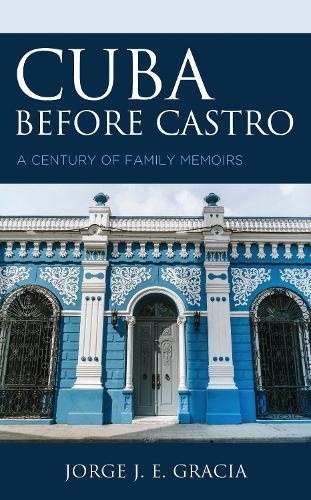
Full Product Details
Author: Jorge J. E. Gracia
Publisher: University Press of America
Imprint: Hamilton Books
Dimensions:
Width: 15.30cm
, Height: 2.60cm
, Length: 22.10cm
Weight: 0.544kg
ISBN: 9780761872139
ISBN 10: 0761872132
Pages: 362
Publication Date: 27 July 2020
Audience:
General/trade
,
General
Format: Paperback
Publisher's Status: Active
Availability: Manufactured on demand

We will order this item for you from a manufactured on demand supplier.
Reviews
In this partly biographical and partly philosophical work, Jorge Gracia, who is the current Samuel P. Capen Chair and SUNY Distinguished Professor of Philosophy and Comparative Literature University at Buffalo, provides us with an autobiographical account of his youth in Cuba prior and right after the Cuban Revolution. His is an unmatching riveting and revealing account of his life that can explain his love with philosophy, history and Hispanic/Latino culture in general. Gracia applies his personal experiences to shed light on the emerging field of Latin American philosophy broadly construed in the USA. I do not know of any other living philosopher who has contributed as much and who has helped as many young philosophers in the said field. With his broad background in the history of philosophy, especially Medieval and Latin American philosophy, Gracia has given us an exemplary account of how relevant philosophy could be for exploring challenging issues related to culture, ethnicity, and race. In sum, I think that unquestionably Jorge Gracia can be considered the living dean of Latin American philosophy in North America. -- Vicente Medina, professor of philosophy, Seton Hall University This book is of tremendous testimonial, historical and intellectual significance. Dr. Jorge Gracia, one of the most (if not the most) prominent Hispanic philosophers in the U.S. in the second half of the 20th Century and in the 21st Century, looks back at Cuba before Castro and before his migration to the U.S. Professor Gracia’s exquisite prose elegantly uses autobiographical and historical techniques to weave together a narrative that paints a complex and intriguing picture of family life, cultural life, and intellectual and socio-political life in Cuba before Castro. This is a must-read for anyone interested in Cuba, Latin American culture, and the life and thought of influential intellectuals such as Professor Gracia who have shaped Latin American thought in the 20th Century and beyond. -- José Medina, Walter Dill Scott Professor of Philosophy, Northwestern University Jorge Gracia’s Cuba before Castro: A Century of Family Memoirs is a walk back into the time before Cuba became synonymous with Fidel and a memory chronicle of what happened in the aftermath of the 1959 Cuban Revolution. Gracia’s quirky family epitomized the diverse European immigrants who came to pre-Castro Cuba looking for prosperity and new business opportunities. Successful after initial struggles, these mixed European immigrants formed a significant segment of Cuban society and it was their descendants who fled Cuba and arrived in the U.S. and Canada as refugees in the 1960s and ongoing. These new North Americans became a force within their communities of settlements. In Gracia’s case, his academic interests as philosopher, art collector, and avid traveler have combined to produce a biographical, yet analytical, retrospective analysis of his life. His assessment of his life as a Cuban, as a refugee, as a philosopher and as the founder, with his wife, Norma, of a Gracia family, living in Canada and the United States, provides personal and academic perspectives on the experience of escape from a fascist regime, establishing a new life and prospering in a new world of possibilities provided by exile. This book will be of interest to anyone who shares these experiences, as well as to a range of individuals who work in academic disciplines where human experience is the subject of interest. Written in a lively and personal style, Gracia’s memoir is an invitation to share in his life as he recounts its many passages to the present. -- Lynette Bosch, professor of art history, SUNY Geneseo
In this partly biographical and partly philosophical work, Jorge Gracia, who is the current Samuel P. Capen Chair and SUNY Distinguished Professor of Philosophy and Comparative Literature University at Buffalo, provides us with an autobiographical account of his youth in Cuba prior and right after the Cuban Revolution. His is an unmatching riveting and revealing account of his life that can explain his love with philosophy, history and Hispanic/Latino culture in general. Gracia applies his personal experiences to shed light on the emerging field of Latin American philosophy broadly construed in the USA. I do not know of any other living philosopher who has contributed as much and who has helped as many young philosophers in the said field. With his broad background in the history of philosophy, especially Medieval and Latin American philosophy, Gracia has given us an exemplary account of how relevant philosophy could be for exploring challenging issues related to culture, ethnicity, and race. In sum, I think that unquestionably Jorge Gracia can be considered the living dean of Latin American philosophy in North America.--Vicente Medina, professor of philosophy, Seton Hall University Jorge Gracia's Cuba before Castro: A Century of Family Memoirs is a walk back into the time before Cuba became synonymous with Fidel and a memory chronicle of what happened in the aftermath of the 1959 Cuban Revolution. Gracia's quirky family epitomized the diverse European immigrants who came to pre-Castro Cuba looking for prosperity and new business opportunities. Successful after initial struggles, these mixed European immigrants formed a significant segment of Cuban society and it was their descendants who fled Cuba and arrived in the U.S. and Canada as refugees in the 1960s and ongoing. These new North Americans became a force within their communities of settlements. In Gracia's case, his academic interests as philosopher, art collector, and avid traveler have combined to produce a biographical, yet analytical, retrospective analysis of his life. His assessment of his life as a Cuban, as a refugee, as a philosopher and as the founder, with his wife, Norma, of a Gracia family, living in Canada and the United States, provides personal and academic perspectives on the experience of escape from a fascist regime, establishing a new life and prospering in a new world of possibilities provided by exile. This book will be of interest to anyone who shares these experiences, as well as to a range of individuals who work in academic disciplines where human experience is the subject of interest. Written in a lively and personal style, Gracia's memoir is an invitation to share in his life as he recounts its many passages to the present.--Lynette Bosch, professor of art history, SUNY Geneseo This book is of tremendous testimonial, historical and intellectual significance. Dr. Jorge Gracia, one of the most (if not the most) prominent Hispanic philosophers in the U.S. in the second half of the 20th Century and in the 21st Century, looks back at Cuba before Castro and before his migration to the U.S. Professor Gracia's exquisite prose elegantly uses autobiographical and historical techniques to weave together a narrative that paints a complex and intriguing picture of family life, cultural life, and intellectual and socio-political life in Cuba before Castro. This is a must-read for anyone interested in Cuba, Latin American culture, and the life and thought of influential intellectuals such as Professor Gracia who have shaped Latin American thought in the 20th Century and beyond.--Jose Medina, Walter Dill Scott Professor of Philosophy, Northwestern University
Author Information
Jorge J. E. Gracia is distinguished professor of philosophy and comparative literature at the University at Buffalo, State University of New York.