Overview
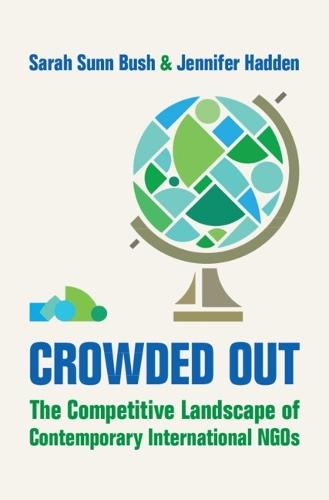
Crowded Out delves into the complex landscape of international non-governmental organizations (INGOs). Bush and Hadden trace INGOs' rise to prominence at the end of the twentieth century and three significant but overlooked recent trends: a decrease in new INGO foundings, despite persistent global need; a shift toward specialization, despite the complexity of global problems; and a dispersal of INGO activities globally, despite potential gains from concentrating on areas of acute need. Assembling a wealth of new data on INGO foundings, missions, and locations, Bush and Hadden show how INGOs are being crowded out of dense organizational environments. They conduct case studies of INGOs across issue areas, relying on dozens of interviews and a large-scale survey to bring practitioners' voices to the study of INGOs. To effectively address today's global challenges, organizations must innovate in a crowded world. This title is also available as open access on Cambridge Core.
Full Product Details
Author: Sarah Sunn Bush (University of Pennsylvania) ,
Jennifer Hadden (Brown University)
Publisher: Cambridge University Press
Imprint: Cambridge University Press
Dimensions:
Width: 15.20cm
, Height: 1.60cm
, Length: 22.90cm
Weight: 0.520kg
ISBN: 9781009557368
ISBN 10: 100955736
Pages: 248
Publication Date: 15 May 2025
Audience:
College/higher education
,
Postgraduate, Research & Scholarly
Format: Hardback
Publisher's Status: Active
Availability: Manufactured on demand

We will order this item for you from a manufactured on demand supplier.
Reviews
'By integrating key concepts such as population density from organizational ecology to International Relations, Bush and Hadden offer a fresh perspective on the evolution of the non-profit sector both in the US and globally. Their meticulous research provides insightful answers to fundamental questions, such as why certain organizations lean toward hyper-specialization and under what conditions NGOs are more likely to compete with, rather than collaborate with, like-minded organizations in crucial areas of global governance.' Alexander Cooley, Barnard College, Columbia University 'This ambitious and superbly readable book demonstrates how growing population density and competition influence both the founding of new INGOs, the focus of their work, choice of strategies, and overall performance. Interrogating the complex interplay between individual organizational goals and ecological pressures, Bush and Hadden explain why-even when it comes to 'doing good'-more isn't always better. An absolute must-read for students and scholars of transnational advocacy and organizational ecology.' Mette Eilstrup-Sangiovanni, Department of Politics and International Studies, University of Cambridge 'In this theoretically and empirically rich analysis, Bush and Hadden provide a much-needed examination of the landscape of NGOs since World War II. The book's interdisciplinary theory and multi-method research design are only two of its many strengths. A must-read for scholars of organizational theory, international institutions, and global civil society.' Jon C. W. Pevehouse, Vilas Distinguished Achievement Professor of Political Science, University of Wisconsin-Madison 'Crowded Out offers a path-breaking account of INGOs in contemporary world politics. Combining compelling theoretical innovation and impressive empirical research, Bush and Hadden demonstrate how population dynamics shape key trends in the founding, specialization, and location of INGOs - with powerful implications for their capacity to meet urgent needs.' Jonas Tallberg, Professor of Political Science, Stockholm University
'By integrating key concepts such as population density from organizational ecology to International Relations, Bush and Hayden offer a fresh perspective on the evolution of the non-profit sector both in the US and globally. Their meticulous research provides insightful answers to fundamental questions, such as why certain organizations lean toward hyper-specialization and under what conditions NGOs are more likely to compete with, rather than collaborate with, like-minded organizations in crucial areas of global governance.' Alexander Cooley, Barnard College, Columbia University 'This ambitious and superbly readable book demonstrates how growing population density and competition influence both the founding of new INGOs, the focus of their work, choice of strategies, and overall performance. Interrogating the complex interplay between individual organizational goals and ecological pressures, Bush and Hadden explain why-even when it comes to 'doing good'-more isn't always better. An absolute must-read for students and scholars of transnational advocacy and organizational ecology.' Mette Eilstrup-Sangiovanni, Department of Politics and International Studies, University of Cambridge 'In this theoretically and empirically rich analysis, Bush and Hadden provide a much-needed examination of the landscape of NGOs since World War II. The book's interdisciplinary theory and multi-method research design are only two of its many strengths. A must-read for scholars of organizational theory, international institutions, and global civil society.' Jon C. W. Pevehouse, Vilas Distinguished Achievement Professor of Political Science, University of Wisconsin-Madison 'Crowded Out offers a path-breaking account of INGOs in contemporary world politics. Combining compelling theoretical innovation and impressive empirical research, Bush and Hadden demonstrate how population dynamics shape key trends in the founding, specialization, and location of INGOs - with powerful implications for their capacity to meet urgent needs.' Jonas Tallberg, Professor of Political Science, Stockholm University
Author Information
Sarah Sunn Bush is Associate Professor of Political Science at the University of Pennsylvania. She is the author of two previous books with Cambridge University Press: Monitors and Meddlers: How Foreign Actors Influence Local Trust in Elections (2022) and The Taming of Democracy Assistance: Why Democracy Promotion Does Not Confront Dictators (2015). Jennifer Hadden is an Associate Professor in the Department of Political Science and at the Watson Institute for Public and International Affairs at Brown University. Her previous book with Cambridge University Press Networks in Contention: The Divisive Politics of Climate Change (2015) received four book awards from the American Political Science Association and the International Political Science Association.