Overview
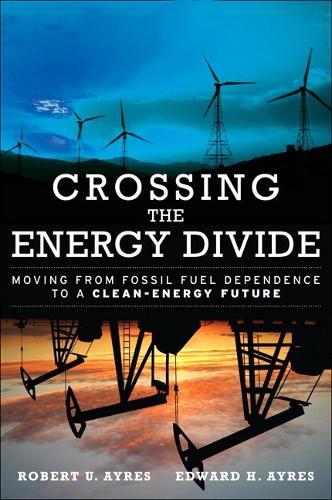
If we continue our highly inefficient, dangerous energy usage, we’re headed for both economic and environmental catastrophe. However, the hard truth is that alternative fuels can’t fully replace fossil fuels for decades. What’s more, new research indicates that energy inefficiencies are retarding economic growth even more than most experts ever realized. Crossing the Energy Divide is about solving all these problems at once. The authors, two leading experts in energy and environmental economics, show how massive improvements in energy efficiency can bridge the global economy until clean renewables can fully replace fossil fuels. Robert and Edward Ayres demonstrate how we can radically reform the way we manage our existing energy systems to double the amount of “energy service” we get from every drop of fossil fuel we use. These techniques require no scientific breakthroughs: Many companies and institutions are applying them right now, but tens of thousands more could. This book offers a strategic guide for using them to solve the energy crisis once and for all—reducing carbon emissions, achieving true energy security, and reigniting economic growth for decades to come. More energy, without more emissions Recapturing lost energy from today’s fossil fuels There is such a thing as a free lunch Mitigating climate disaster and improving prosperity at the same time The future of electricity Reforming tomorrow’s electrical system: smarter, more productive, and more reliable The implications for cities, transportation, business, and government Making the decisions that prepare you for a high-cost energy future
Full Product Details
Author: Robert U. Ayres ,
Edward H. Ayres
Publisher: Pearson Education (US)
Imprint: Financial TImes Prentice Hall
Dimensions:
Width: 15.60cm
, Height: 2.20cm
, Length: 23.80cm
Weight: 0.470kg
ISBN: 9780137015443
ISBN 10: 0137015445
Pages: 256
Publication Date: 21 January 2010
Audience:
Professional and scholarly
,
Professional & Vocational
Format: Hardback
Publisher's Status: Out of Print
Availability: In Print

Limited stock is available. It will be ordered for you and shipped pending supplier's limited stock.
Author Information
Robert U. Ayres is a physicist and economist noted for his work on the role of thermodynamics in the economic process, and more recently for his investigation of the role of energy in economic growth. He is Emeritus Professor of Economics and Technology at the international business school INSEAD, in France, where he has continued his lifelong, pioneering studies of materials/energy flows in the global economy. He originated the concept of industrial metabolism, which has since become a field of study explored by the Journal of Industrial Ecology. Ayres was trained as a physicist at the University of Chicago, University of Maryland, and Kings College London (Ph.D. in Mathematical Physics). He was Professor of Engineering and Public Policy at Carnegie-Mellon University in Pittsburgh from 1979 until 1992, when he was appointed Professor of Environment and Management at INSEAD. He is also an Institute Scholar at the International Institute for Applied Systems Analysis (IIASA) in Austria. Ayres is author or coauthor of 18 books and more than 200 journal articles and book chapters. His books range from Alternatives to the Internal Combustion Engine, with Richard A. McKenna (Johns Hopkins Press, 1972), to Turning Point: The End of the Growth Paradigm (Earthscan, 1998) to The Economic Growth Engine: How Energy and Work Drive Material Prosperity, with Benjamin Warr (Edward Elgar, 2009). He and his wife reside in Paris. Edward (Ed) H. Ayres was Editorial Director at the Worldwatch Institute in Washington, D.C. (publisher of the annual State of the World and bi-annual Vital Signs) from 1994 through 2005. He also served as editor of the bimonthly World Watch magazine during this period. World Watch articles and essays by Ayres were distributed to the global media by the Los Angeles Times Syndicate. His writing has also appeared in Time magazine in its series “Beyond 2000: Your Health, Our Planet”; Utne Reader; The Ecologist; and other publications. Ayres has pursued a lifelong interest in the relationships between individual human health and endurance and the sustainability of human societies. He was the third-place finisher in the first New York Marathon in 1970, and today continues to write and run long distances in the mountains of California, where he and his wife have built an eco-friendly house.