Overview
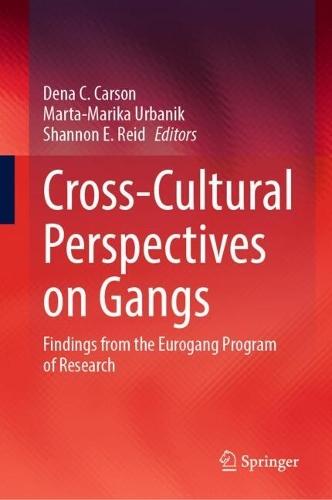
This book offers a comprehensive exploration of gangs as a global phenomenon, moving beyond the traditional American-centric perspective. It delves into the study of gangs worldwide as well as factors that aid in prevention and intervention. Compiled by members of the Eurogang Program of Research, this volume presents cutting-edge findings from recent academic studies. The book is structured into four key areas: Innovative methodologies for studying gangs. Factors and behaviors leading to gang membership. Group dynamics influencing gang behavior. Community responses to gang violence. Each section provides a detailed analysis, utilizing diverse research methods and theoretical frameworks. The insights offered in this volume are invaluable for academics, students, and practitioners aiming to understand gangs in varied cultural and social contexts. This volume is an essential resource for those engaged in criminology, sociology, and urban studies, providing a thorough understanding of the complexities of gang behavior and community interactions.
Full Product Details
Author: Dena C. Carson ,
Marta-Marika Urbanik ,
Shannon E. Reid
Publisher: Springer Nature Switzerland AG
Imprint: Springer Nature Switzerland AG
ISBN: 9783032198242
ISBN 10: 3032198240
Pages: 295
Publication Date: 22 May 2026
Audience:
Professional and scholarly
,
College/higher education
,
Professional & Vocational
,
Postgraduate, Research & Scholarly
Format: Hardback
Publisher's Status: Forthcoming
Availability: Not yet available

This item is yet to be released. You can pre-order this item and we will dispatch it to you upon its release.
Author Information
Dena C. Carson is an associate professor in the Paul H. O’Neill School of Public and Environmental Affairs at Indiana University Indianapolis. Her appointment followed her Ph.D. and post-doctoral work at the University of Missouri-St. Louis. Dr. Carson’s broad research interests includes youth violence and gangs, but, more specifically, her work focuses on the role of group processes in gangs and delinquent peer groups, gang disengagement, as well as the impact of gangs in the school setting. Her recent publications have appeared in Youth Violence and Juvenile Justice, Justice Quarterly, and the Journal of Developmental and Life-Course Criminology. She also serves on the editorial boards of Criminal Justice and Behavior, Journal of Crime & Justice, and Youth Violence and Juvenile Justice. Dr. Marta-Marika Urbanik is an Associate Professor at the Centre for Criminological Research in the Department of Sociology at the University of Alberta. An urban ethnographer, Dr. Urbanik’s expertise lies in examining the intersections between marginalized neighbourhoods, poverty, drugs, violence, homelessness, and social media, with a particular focus on gangs. Her work appears in Social Problems, the British Journal of Criminology, the International Journal of Drug Policy, and Qualitative Sociology. Dr. Urbanik routinely serves as an expert witness for gang involved and/or gang adjacent homicides, and shares her work with the mass media. Dr. Shannon Reid is an Associate Professor in the Department of Criminal Justice and Criminology and the School of Data Science at the University of North Carolina at Charlotte. Dr. Reid received her Ph.D. in Criminology, Law, and Society from the University of California, Irvine in 2013. Her research interests are focused on street gangs, white power youth, youth and adults in the correctional system, and the integration of AI technology into public safety. This includes the development and patenting of team-developed visual AI focused on anomaly and action detection, path prediction, object identification, and boundary creation for public safety and security. Her work has been published in Criminology, the Journal of Interpersonal Violence, Homicide Studies, Journal of Youth Studies, Legal and Criminal Psychology, and Deviant Behavior. Her research has been funded by the National Science Foundation, the Office of Juvenile Justice and Delinquency Prevention, and the Army Research Office.