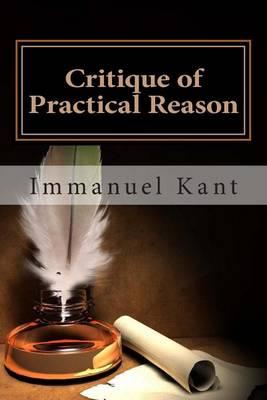
Critique of Practical Reason

Author:   Immanuel Kant (University of California, San Diego, University of Pennsylvania)
Publisher:   Createspace
ISBN:  

9781463641351


Pages:   136
Publication Date:   20 June 2011
Format:   Paperback
Availability:   Available To Order   Availability explained
We have confirmation that this item is in stock with the supplier. It will be ordered in for you and dispatched immediately.

Our Price $23.73 Quantity:  
Add to Cart

Share |

Critique of Practical Reason


Overview

The Critique of Practical is the second of Immanuel Kant's three critiques, first published in 1788. It follows on from his Critique of Pure Reason and deals with his moral philosophy. The second Critique exercised a decisive influence over the subsequent development of the field of ethics and moral philosophy, beginning with Fichte's Doctrine of Science and becoming, during the 20th century, the principal reference point for every moral philosophy of a deontological stamp.

Full Product Details

Author:   Immanuel Kant (University of California, San Diego, University of Pennsylvania)
Publisher:   Createspace
Imprint:   Createspace
Dimensions:   Width: 15.20cm , Height: 0.70cm , Length: 22.90cm
Weight:   0.191kg
ISBN:  

9781463641351


ISBN 10:   1463641354
Pages:   136
Publication Date:   20 June 2011
Audience:   General/trade ,  General
Format:   Paperback
Publisher's Status:   Active
Availability:   Available To Order   Availability explained
We have confirmation that this item is in stock with the supplier. It will be ordered in for you and dispatched immediately.

Table of Contents

Reviews

Author Information

Immanuel Kant (1724-1804) was a German philosopher, researching, lecturing and writing on philosophy and anthropology during and at the end of the 18th Century Enlightenment. At the time, there were major successes and advances in physical science (for example, Isaac Newton, Robert Boyle) using reason and logic. But this stood in sharp contrast to the skepticism and lack of agreement or progress in empiricist philosophy. Kant's magnum opus, the Critique of Pure Reason, aimed to unite reason with experience to move beyond what he took to be failures of traditional philosophy and metaphysics. He hoped to end an age of speculation where objects outside experience were used to support what he saw as futile theories, while opposing the skepticism and idealism of thinkers such as Descartes, Berkeley and Hume. He said that 'it always remains a scandal of philosophy and universal human reason that the existence of things outside us ... should have to be assumed merely on faith, and that if it occurs to anyone to doubt it, we should be unable to answer him with a satisfactory proof'. Kant proposed a 'Copernican Revolution', saying that 'Up to now it has been assumed that all our cognition must conform to the objects; but ...let us once try whether we do not get farther with the problems of metaphysics by assuming that the objects must conform to our cognition'.

Tab Content 6

Author Website:  

Countries Available

All regions
Latest Reading Guide

NOV RG 20252


Shopping Cart
Your cart is empty
Shopping cart
Mailing List