Overview
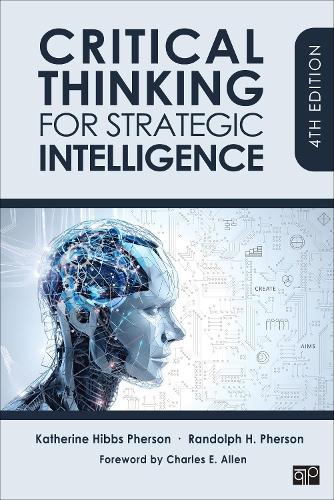
A highly regarded, easy-to-use handbook for developing core critical thinking skills and analytic techniques.
Full Product Details
Author: Katherine H. Pherson ,
Randolph H. Pherson
Publisher: Sage Publications Inc Ebooks
Imprint: SAGE Publications Inc
Edition: 4th Revised edition
Weight: 0.740kg
ISBN: 9781071902288
ISBN 10: 1071902288
Pages: 560
Publication Date: 19 March 2026
Audience:
College/higher education
,
Tertiary & Higher Education
Format: Paperback
Publisher's Status: Active
Availability: In Print

This item will be ordered in for you from one of our suppliers. Upon receipt, we will promptly dispatch it out to you. For in store availability, please contact us.
Reviews
Critical Thinking for Strategic Intelligence is the go-to book for current and aspiring intelligence analysts. -- John Comiskey * Review * No one has given more thought to the improvement and the teaching of analytic techniques than Kathy and Randy Pherson. The fourth edition of Critical Thinking for Strategic Intelligence is a welcome update of their now–must-have book. Dealing with an increasing flow of incoming information and creating from that well-written, thoughtful analysis is a daunting challenge. This book is well organized, extremely accessible, and profusely illustrated with useful figures. It will continue to benefit analysts—in all fields, not just intelligence—as well as managers of analysts and those who teach courses on analysis. -- Mark Lowenthal * Blurb * Kathy and Randy Pherson artfully weave together scholarship and experience in this update to their foundational work. The book reveals—not answers—something much more important: how to ask questions. It provides readers the skills they need to navigate the ocean of the often-conflicting, irrelevant, and incorrect information in which we all live today. -- Alan Wade * Blurb * In Critical Thinking for Strategic Intelligence, the Phersons have provided an invaluable road map for anyone seeking to improve the ability to conceptualize, research, and write compelling analysis. It stands apart from other literature in making a persuasive case for critical thinking up front to pave the way for clarity of message and rigor in argumentation. It is simply a must-read for any serious student of intelligence analysis. -- Fran Moore * Blurb * The fourth edition of Critical Thinking for Strategic Intelligence provides significant updates and remains a ""must have"" for any student of the nature and process of effective intelligence analysis. Highly recommended for the classroom, for those new to the profession of intelligence research and analysis and for anyone seeking to produce more effect reports and presentations. -- Gregory Moore * Review * Critical Thinking for Strategic Intelligence is an effective compliment to methods literature. The book′s perspective on communicating persuasively defines important objectives that need to be accomplished in research designs. -- Charles Mitchell * Review *
In Critical Thinking for Strategic Intelligence, the Phersons have provided an invaluable road map for anyone seeking to improve the ability to conceptualize, research, and write compelling analysis. It stands apart from other literature in making a persuasive case for critical thinking up front to pave the way for clarity of message and rigor in argumentation. It is simply a must-read for any serious student of intelligence analysis. -- Fran Moore * Blurb * Critical Thinking for Strategic Intelligence is the go-to book for current and aspiring intelligence analysts. -- John Comiskey * Review * No one has given more thought to the improvement and the teaching of analytic techniques than Kathy and Randy Pherson. The fourth edition of Critical Thinking for Strategic Intelligence is a welcome update of their now–must-have book. Dealing with an increasing flow of incoming information and creating from that well-written, thoughtful analysis is a daunting challenge. This book is well organized, extremely accessible, and profusely illustrated with useful figures. It will continue to benefit analysts—in all fields, not just intelligence—as well as managers of analysts and those who teach courses on analysis. -- Mark Lowenthal * Blurb * Kathy and Randy Pherson artfully weave together scholarship and experience in this update to their foundational work. The book reveals—not answers—something much more important: how to ask questions. It provides readers the skills they need to navigate the ocean of the often-conflicting, irrelevant, and incorrect information in which we all live today. -- Alan Wade * Blurb * The fourth edition of Critical Thinking for Strategic Intelligence provides significant updates and remains a ""must have"" for any student of the nature and process of effective intelligence analysis. Highly recommended for the classroom, for those new to the profession of intelligence research and analysis and for anyone seeking to produce more effect reports and presentations. -- Gregory Moore * Review * Critical Thinking for Strategic Intelligence is an effective compliment to methods literature. The book′s perspective on communicating persuasively defines important objectives that need to be accomplished in research designs. -- Charles Mitchell * Review *
Author Information
Katherine Hibbs Pherson, President of Globalytica, LLC, consults with government and private industry on building strong analytic communities, the use of structured analytic techniques, and security issues. She teaches certificate courses on structured thinking and presentation for the security association ASIS International and in the Intelligence Masters program at Universidad Rey Juan Carlos in Madrid, Spain. As Vice Chair of the Intelligence and National Security Association (INSA)’s Security Policy Reform Council, she was primary drafter of its white paper titled “Next Steps for Security Reform: Industry Proposals to Enhance Efficiency and Reduce Costs in National Security Contracts,” which has generated a series of productive exchanges among government and industry. Ms. Pherson is also Chief Executive Officer of Pherson Associates, LLC, and a founding Director of the Forum Foundation for Analytic Excellence, a nonprofit established in 2011 to promote the effective use of critical thinking skills and structured analytic techniques by teaching, certifying, and applying these skills in universities in the United States and Europe. She retired from the Central Intelligence Agency in 2000 after a twenty-seven-year career in intelligence and security analysis and resource management. Her leadership in the security arena led to the adoption of a risk management methodology, the strengthening of overseas security countermeasures, and improvements in dealing with unsolicited contacts. As head of the Director of Central Intelligence’s Center for Security Evaluation, she managed the Intelligence Community’s involvement in rebuilding the penetrated US Embassy in Moscow. She is a recipient of the CIA’s Distinguished Career Intelligence Medal and the Intelligence Community’s National Distinguished Service Medal. She received her AB from Vassar College, an MA in Spanish linguistics and Latin American studies from the University of Illinois, and an MA in Randolph H. Pherson is president of Pherson Associates, LLC; CEO of Globalytica, LLC; and a founding director of the nonprofit Forum Foundation for Analytic Excellence. He teaches advanced analytic techniques and critical thinking skills to analysts in the government and private sector. Mr. Pherson collaborated with Richards Heuer Jr. in developing and launching use of Analysis of Competing Hypotheses, and he developed several analytic techniques for the CIA’s Sherman Kent School, many of which were incorporated in his Handbook of Analytic Tools and Techniques. He coauthored Critical Thinking for Strategic Intelligence with Katherine Hibbs Pherson, Cases in Intelligence Analysis: Structured Analytic Techniques in Action with Sarah Miller Beebe, and several other guides for analysts on writing, briefing, indicators, and managing the production process. Mr. Pherson completed a twenty-eight-year career in the Intelligence Community in 2000, last serving as National Intelligence Officer (NIO) for Latin America. Previously at the CIA, Mr. Pherson managed the production of intelligence analysis on topics ranging from global instability to Latin America, served on the Inspector General’s staff, and was chief of the CIA’s Strategic Planning and Management Staff. He is the recipient of the Distinguished Intelligence Medal for his service as NIO and the Distinguished Career Intelligence Medal. Mr. Pherson received his B.A. from Dartmouth College and an M.A. in international relations from Yale University.