Overview
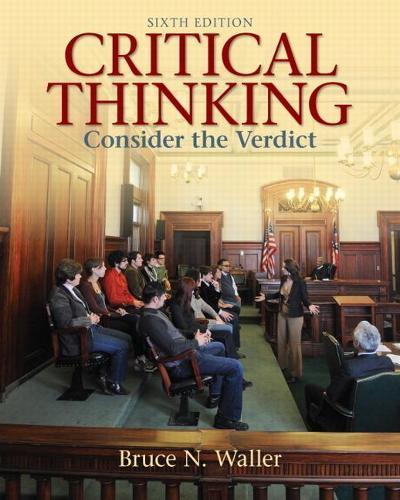
Integrating Logic Skills into the Critical Decision-Making Process Organised around lively and authentic examples drawn from jury trials, contemporary political and social debate, and advertising, Critical Thinking: Consider the Verdict shows students how to detect fallacies and how to examine and construct cogent arguments. Accessible and reader friendly—yet thorough and rigorous—Critical Thinking: Consider the Verdict shows students how to integrate all logic skills into the critical decision-making process, and construct arguments from examples gained through the study of contemporary and historic debates, both legal and popular.
Full Product Details
Author: Bruce Waller
Publisher: Pearson Education (US)
Imprint: Pearson
Edition: 6th edition
Dimensions:
Width: 20.30cm
, Height: 24.00cm
, Length: 25.40cm
Weight: 0.950kg
ISBN: 9780205158669
ISBN 10: 0205158668
Pages: 480
Publication Date: 13 December 2011
Audience:
Adult education
,
Further / Higher Education
Format: Paperback
Publisher's Status: Active
Availability: In Print

This item will be ordered in for you from one of our suppliers. Upon receipt, we will promptly dispatch it out to you. For in store availability, please contact us.
Reviews
“Excellent: explanations are very clear; end of section exercises reinforce the material in the text very effectively; diagrams and inset examples are also helpful” —Victoria Rogers, Indiana University- Perdue University Indianapolis “I really liked the way Waller uses a court of law to organize this text.” —Eli Kanon, University of North Florida “I have been using Waller's book (4th and 5th editions) for years and I find it is an excellent way to introduce critical thinking to students and to show the importance of it in daily life. I especially like how he reasons out in words truth table reasoning rather than simply teaching it as a plug and chug methods.” —Jean Miller, Virginia Tech “I like the pedagogy of the book. Having used it in the past, it worked quite well.” —Glenn Sanford, Sam Houston State University “The first half of the text focuses on how to recognize and construct a good argument, while the second half of the text deals with how to recognize and avoid bad arguments."" —Chris Clayton, Portland Community College
Excellent: explanations are very clear; end of section exercises reinforce the material in the text very effectively; diagrams and inset examples are also helpful -Victoria Rogers, Indiana University- Perdue University Indianapolis I really liked the way Waller uses a court of law to organize this text. -Eli Kanon, University of North Florida I have been using Waller's book (4th and 5th editions) for years and I find it is an excellent way to introduce critical thinking to students and to show the importance of it in daily life. I especially like how he reasons out in words truth table reasoning rather than simply teaching it as a plug and chug methods. -Jean Miller, Virginia Tech I like the pedagogy of the book. Having used it in the past, it worked quite well. -Glenn Sanford, Sam Houston State University The first half of the text focuses on how to recognize and construct a good argument, while the second half of the text deals with how to recognize and avoid bad arguments. -Chris Clayton, Portland Community College
Excellent: explanations are very clear; end of section exercises reinforce the material in the text very effectively; diagrams and inset examples are also helpful --Victoria Rogers, Indiana University- Perdue University Indianapolis I really liked the way Waller uses a court of law to organize this text. --Eli Kanon, University of North Florida I have been using Waller's book (4th and 5th editions) for years and I find it is an excellent way to introduce critical thinking to students and to show the importance of it in daily life. I especially like how he reasons out in words truth table reasoning rather than simply teaching it as a plug and chug methods. --Jean Miller, Virginia Tech I like the pedagogy of the book. Having used it in the past, it worked quite well. --Glenn Sanford, Sam Houston State University The first half of the text focuses on how to recognize and construct a good argument, while the second half of the text deals with how to recognize and avoid bad arguments. --Chris Clayton, Portland Community College
Author Information
Dr. Bruce N. Waller is Chair of the Department of Philosophy and Religious Studies at Youngstown State University. He received his Ph.D. in 1979 from the University of North Carolina at Chapel Hill. His other works include Consider Ethics: Theory, Readings, and Contemporary Issues, Critical Thinking: Consider the Verdict, You Decide! Current Debates in Criminal Justice, You Decide! Current Debates in Contemporary Moral Problems, You Decide! Current Debates in Introductory Philosophy, You Decide! Current Debates in Ethics, Coffee and Philosophy: A Conversational Introduction to Philosophy with Readings, and Against Moral Responsibility.