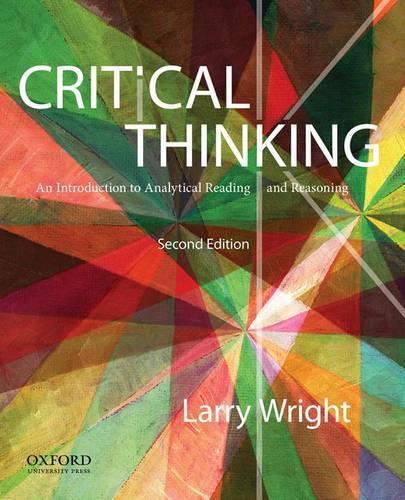
Full Product Details
Author: Larry Wright (Professor of Philosophy, Professor of Philosophy, University of California, Riverside)
Publisher: Oxford University Press Inc
Imprint: Oxford University Press Inc
Edition: 2nd Revised edition
Dimensions:
Width: 23.10cm
, Height: 2.00cm
, Length: 18.80cm
Weight: 0.635kg
ISBN: 9780199796229
ISBN 10: 019979622
Pages: 416
Publication Date: 23 June 2016
Audience:
Professional and scholarly
,
Professional & Vocational
Format: Paperback
Publisher's Status: Active
Availability: To order

Stock availability from the supplier is unknown. We will order it for you and ship this item to you once it is received by us.
Reviews
"""This is the best critical-thinking book on the market. Its strengths are its originality, thoughtfulness, attention to scholarship in informal logic/critical thinking, focus on the importance of critical-reading skills, and practical application to the kinds of reasoning we do every day through a remarkably careful discussion of inference to the best explanation.""--Dale Turner, Cal Poly Pomona ""I have seen students understand what they are reading and evaluate arguments in a meaningful way in classes where this text is being used. This in itself motivates me to use it.""--Sharon Crasnow, Norco College, Riverside Community College District ""Critical Thinking constitutes a unified approach to a whole trajectory of intellectual development; that is, it can take someone from 'able to read' all the way to 'able to think analytically and creatively about reasoning.'""--Chris Campolo, Hendrix College"
<br> This is the best critical-thinking book on the market. Its strengths are its originality, thoughtfulness, attention to scholarship in informal logic/critical thinking, focus on the importance of critical-reading skills, and practical application to the kinds of reasoning we do every day through a remarkably careful discussion of inference to the best explanation. --Dale Turner, Cal Poly Pomona<p><br> I have seen students understand what they are reading and evaluate arguments in a meaningful way in classes where this text is being used. This in itself motivates me to use it. --Sharon Crasnow, Norco College, Riverside Community College District<p><br> Critical Thinking constitutes a unified approach to a whole trajectory of intellectual development; that is, it can take someone from 'able to read' all the way to 'able to think analytically and creatively about reasoning.' --Chris Campolo, Hendrix College<p><br>
Author Information
Larry Wright is Professor of Philosophy at the University of California, Riverside, where he has taught since 1970. He is the author of Practical Reasoning (1989), Better Reasoning: Techniques for Handling Argument, Evidence & Abstraction (1982), and Teleological Explanations: An Etiological Analysis of Goals and Functions (1976).