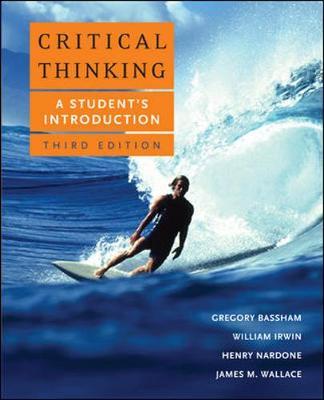
Critical Thinking: A Student's Introduction

Author:   Gregory Bassham ,  William Irwin ,  Henry Nardone ,  James Wallace
Publisher:   McGraw-Hill Education - Europe
Edition:   3rd edition
ISBN:  

9780073407340


Pages:   544
Publication Date:   16 June 2007
Replaced By:   0073407437
Format:   Paperback
Availability:   In Print   Availability explained
Limited stock is available. It will be ordered for you and shipped pending supplier's limited stock.

Our Price $249.98 Quantity:  
Add to Cart

Share |

Critical Thinking: A Student's Introduction


Overview

This clear, learner-friendly text helps today's students bridge the gap between everyday culture and critical thinking. The text covers all the basics of critical thinking, beginning where students are, not where we think they should be. Its comprehensiveness allows instructors to tailor the material to their individual teaching styles, resulting in an exceptionally versatile text.

Full Product Details

Author:   Gregory Bassham ,  William Irwin ,  Henry Nardone ,  James Wallace
Publisher:   McGraw-Hill Education - Europe
Imprint:   McGraw-Hill Professional
Edition:   3rd edition
Dimensions:   Width: 18.50cm , Height: 2.10cm , Length: 23.10cm
Weight:   0.783kg
ISBN:  

9780073407340


ISBN 10:   0073407348
Pages:   544
Publication Date:   16 June 2007
Audience:   College/higher education ,  Tertiary & Higher Education
Replaced By:   0073407437
Format:   Paperback
Publisher's Status:   Out of Print
Availability:   In Print   Availability explained
Limited stock is available. It will be ordered for you and shipped pending supplier's limited stock.

Table of Contents

Chapter 1: Introduction to Critical Thinking What Is Critical Thinking?Critical Thinking StandardsThe Benefits of Critical ThinkingBarriers to Critical ThinkingCharacteristics of a Critical Thinker Chapter 2: Recognizing Arguments What Is an Argument?Identifying Premises and ConclusionsWhat Is Not an Argument? Chapter 3: Basic Logical ConceptsDeduction and InductionHow Can We Tell Whether an Argument is Deductive or Inductive?Common Patterns of Deductive Reasoning Common Patterns of Inductive Reasoning Deductive Validity Inductive Strength Chapter 4: Language Finding the Right Words: The Need for Precision The Importance of Precise Definitions Emotive Language: Slanting the Truth Euphemisms and Political Correctness Chapter 5: Logical Fallacies-1 The Concept of Relevance Fallacies of Relevance Chapter 6: Logical Fallacies-2 Fallacies of Insufficient Evidence Chapter 7: Analyzing Arguments Diagramming Short ArgumentsSummarizing Longer Arguments Chapter 8: Evaluating Arguments When Is an Argument a Good One?When Is It Reasonable to Accept a Premise? Appendix: Sample Critical Essay Chapter 9: A Little Categorical Logic Categorical StatementsTranslating into Standard Categorical FormCategorical Syllogisms Chapter 10: A Little Propositional Logic Conjunction Conjunction and ValidityNegationDeeper Analysis of Negation and ConjunctionDisjunctionConditional Statements Chapter 11: Inductive Reasoning Introduction to InductionInductive GeneralizationsStatistical ArgumentsInduction and AnalogyInduction and Causal ArgumentsA Few Words about Probability Chapter 12: Finding, Evaluating, and Using Sources Finding SourcesEvaluating Sources Taking NotesUsing Sources Chapter 13: Writing Argumentative Essays Writing a Successful ArgumentBefore you WriteWriting the First DraftAfter the First Draft Chapter 14: Thinking Critically about the Media The Mass MediaThe News MediaGetting Us to Pay Attention: What Really Drives the Media Keeping Our Interest: The News as EntertainmentMedia Literacy Advertising Chapter 15: Science and Pseudoscience The Basic Pattern of Scientific ReasoningThe Limitations of ScienceHow to Distinguish Science from PseudoscienceTwo Case Studies in Pseudoscience and the Paranormal Notes Answers to Selected Exercises Credits Glossary / Index

Reviews

Author Information

"Gregory Bassham is Director of the Center for Ethics and Public Life and Chair of the Philosophy Department at King's College (Pa.). He is the co-editor of The Lord of the Rings and Philosophy (Open Court, 2003), author of Original Intent and the Constitution: A Philosophical Study (Rowman & Littlefield, 1992), and co-editor of Powerweb: Critical Thinking (McGraw-Hill, 2003-2004). William Irwin is Associate Professor of Philosophy at King's College and Series Editor of Open Court's Popular Culture and Philosophy. Co-editor of The Simpsons and Philosophy (Open Court, 2001), his most recent book, The Matrix and Philosophy, was a New York Times Bestseller. Henry Nardone is Professor of Philosophy at King's College. His publications include scholarly articles on critical thinking and aesthetics. James M. Wallace is Professor of English at King's College. Author of Parallel Lives: A Novel Way to Learn Thinking and Writing (1999), Jim's essay, ""A (Karl Not Groucho) Marxist in Springfield,"" appeared in The Simpsons and Philosophy (Open Court, 2001)."

Tab Content 6

Author Website:  

Countries Available

All regions
Latest Reading Guide

NOV RG 20252


Shopping Cart
Your cart is empty
Shopping cart
Mailing List