|
Overview
Full Product Details
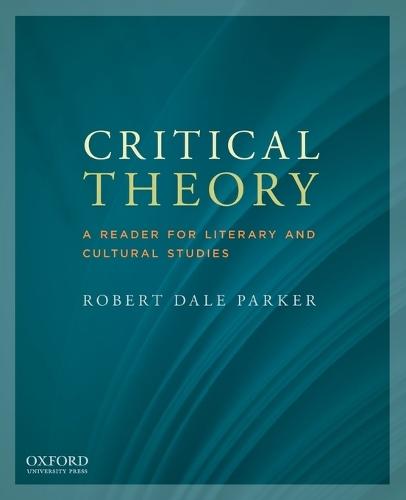
Author: Parker
Publisher: Oxford University Press Inc
Imprint: Oxford University Press Inc
Dimensions:
Width: 18.80cm
, Height: 4.60cm
, Length: 23.40cm
Weight: 1.497kg
ISBN: 9780199797776
ISBN 10: 0199797773
Pages: 896
Publication Date: 24 January 2012
Audience:
College/higher education
,
Tertiary & Higher Education
Format: Paperback
Publisher's Status: Active
Availability: Available To Order 
We have confirmation that this item is in stock with the supplier. It will be ordered in for you and dispatched immediately.
Table of Contents
Introduction New Criticism Cleanth Brooks, The Language of Paradox Cleanth Brooks, The Formalist Critics W. K. Wimsatt, The Concrete Universal See also selections by Strier and Wolfson Structuralism Ferdinand de Saussure, Course in General Linguistics Victor Shklovsky, Art as Technique V. Propp, Morphology of the Folktale Roman Jakobson, The Metaphoric and Metonymic Poles Roman Jakobson, Linguistics and Poetics Claude Levi-Straus, The Structural Study of Myth Roland Barthes, The Death of the Author See also selections by Hall ( Encoding/Decoding ), Hayles, Mulvey, and White Deconstruction Friedrich Nietzsche, On Truth and Lying in a Non-Moral Sense Jacques Derrida, The End of the Book and the Beginning of Writing Roland Barthes, From Work to Text J. Hillis Miller, Stevens' Rock and Criticism as Cure, II Paul de Man, Semiology and Rhetoric Diana Fuss, Essentialism in the Classroom bell hooks, Essentialism and Experience N. Katherine Hayles, Speech, Writing, Code: Three Worldviews See also selections by Bauman, Chow, Cixous, Hall ( Cultural Identity and Cinematic Representation ), Koshy, and Spivak Psychoanalysis Sigmund Freud, Psycho-analysis Jacques Lacan, Seminar on 'The Purloined Letter' Slavoj Zizek, Why Does a Letter Always Arrive at Its Destination?: Imaginary, Symbolic, Real See also selections by Cixous, Irigaray, Mulvey, Sedgwick, and Wittig Feminism Laura Mulvey, Visual Pleasure and Narrative Cinema Helene Cixous, The Laugh of the Medusa Luce Irigaray, This Sex Which Is Not One Toril Moi, 'Images of Women Criticism bell hooks, The Oppositional Gaze: Black Female Spectators See also selections by Anzaldua, Bauman, Butler, Fuss, McRobbie, Mohanty, Nussbaum, Rich, Sedgwick, Smith, Spivak, and Wittig Queer Studies Adrienne Rich, Compulsory Heterosexuality and Lesbian Existence Monique Wittig, The Straight Mind Eve Kosofsky Sedgwick, Gender Asymmetry and Erotic Triangles Judith Butler, Gender Trouble: Feminism and the Subversion of Identity Martha C. Nussbaum, The Professor of Parody: The Hip Defeatism of Judith Butler Robert McRuer, Compulsory Able-Bodiedness and Queer/Disabled Existence Judith Halberstam, Queer Temporalities and Postmodern Geographies See also selections by Anzaldua and Dollimore Marxism Karl Marx, from the preface to A Contribution to the Critique of Political Economy Karl Marx, The Fetishism of Commodities and the Secret Thereof Karl Marx, The Working Day Walter Benjamin, The Work of Art in the Age of Its Mechanical Reproducibility Max Horkheimer and Theodor W. Adorno, from The Culture Industry: Enlightenment as Mass Deception Bertolt Brecht, Short Description of a New Technique of Acting Which Produces an Alienation Effect Louis Althusser, Ideology and Ideological State Apparatuses (Notes Towards an Investigation) Raymond Williams, Dominant, Residual, and Emergent Fredric Jameson, Cognitive Mapping See also selections by Barthes ( The Death of the Author ), Fanon, and Dollimore Historicism and Cultural Studies Hayden White, The Historical Text as Literary Artifact Michel Foucault, Panopticism Dick Hebdige, Subculture: The Meaning of Style Angela McRobbie, from Jackie Magazine: Romantic Individualism and the Teenage Girl Stuart Hall, Cultural Identity and Cinematic Representation Stephen Greenblatt, The Circulation of Social Energy Jonathan Dollimore, The Politics of Containment Tricia Rose, The Contradictory Politics of Popular Culture: Resisting, Selling Out, and 'Hot Sex' Lawrence Buell, The Emergence of Environmental Criticism Richard Strier, How Formalism Became a Dirty Word, and Why We Can't Do Without It Susan J. Wolfson, Reading for Form See also selections by Hall ( Encoding/Decoding ), Haraway, hooks ( The Oppositional Gaze ), Koshy, and Williams Postcolonial Studies and Race Studies Frantz Fanon, On National Culture Ngugi wa Thiong'o, The Language of African Literature Homi K. Bhabha, On Mimicry and Man: The Ambivalence of Colonial Discourse Gayatri C. Spivak, Can the Subaltern Speak?: Speculations on Widow Sacrifice Chandra Talpade Mohanty, Under Western Eyes: Feminist Scholarship and Colonial Discourses Edward Said, Narrative and Social Space Gloria Anzaldua, Borderlands / La Frontera: The New Mestiza Henry Louis Gates, Jr., Talking Black: Critical Signs of the Times Renato Rosaldo, Imperialist Nostalgia Ann duCille, Discourse and Dat Course: Postcoloniality and Afrocentricity Susan Koshy, The Fictions of Asian American Literature Rey Chow, The Interruption of Referentiality: Poststructuralism and the Conundrum of Critical Multiculturalism See also selections by Bauman, Hall ( Cultural Identity and Cinematic Representation ), hooks ( Essentialism and Experience and The Oppositional Gaze ), Jameson, and Rose Reader Response Stuart Hall, Encoding/Decoding Barbara Herrnstein Smith, Value/Evaluation (1990, 1995) Stanley Fish, Introduction: Or How I Stopped Worrying and Learned to Love Interpretation, from Is There a Text in This Class? H-Dirksen L. Bauman, Towards a Poetics of Vision, Space, and the Body: Sign Language and Literary Theory Lisa Zunshine, Theory of Mind and Experimental Representations of Fictional Consciousness See also selection by Barthes ( The Death of the Author ), Brecht, hooks ( The Oppositional Gaze ), and Mulvey Glossary Index
Reviews
This anthology reverses the trend toward bigger, bulkier collections without sacrificing the coverage and selections needed for a responsible theory course. The selections are thoughtfully chosen, artfully focused, and reflect the scope of contemporary theory today. --Steven J. Venturino, Loyola University Chicago Critical Theory would make a welcome addition to anyone's bookshelf. I know from experience that Robert Dale Parker's How to Interpret Literature has been incredibly helpful to my theory students. He makes sense of difficult theoretical positions, and he's an enjoyable read. Parker is acutely aware of the many difficulties of assembling such an anthology and he has put a great deal of thought into the choices he has made, both in regard to his selections and his organization--it is fresh and new, but not unfamiliar. --David Ben-Merre, Buffalo State College
<br> This anthology reverses the trend toward bigger, bulkier collections without sacrificing the coverage and selections needed for a responsible theory course. The selections are thoughtfully chosen, artfully focused, and reflect the scope of contemporary theory today. <br>--Steven J. Venturino, Loyola University Chicago<p><br> Critical Theory would make a welcome addition to anyone's bookshelf. I know from experience that Robert Dale Parker's How to Interpret Literature has been incredibly helpful to my theory students. He makes sense of difficult theoretical positions, and he's an enjoyable read. Parker is acutely aware of the many difficulties of assembling such an anthology and he has put a great deal of thought into the choices he has made, both in regard to his selections and his organization--it is fresh and new, but not unfamiliar. <br>--David Ben-Merre, Buffalo State College<p><br>
This anthology reverses the trend toward bigger, bulkier collections without sacrificing the coverage and selections needed for a responsible theory course. The selections are thoughtfully chosen, artfully focused, and reflect the scope of contemporary theory today. --Steven J. Venturino, Loyola University Chicago Critical Theory would make a welcome addition to anyone's bookshelf. I know from experience that Robert Dale Parker's How to Interpret Literature has been incredibly helpful to my theory students. He makes sense of difficult theoretical positions, and he's an enjoyable read. Parker is acutely aware of the many difficulties of assembling such an anthology and he has put a great deal of thought into the choices he has made, both in regard to his selections and his organization--it is fresh and new, but not unfamiliar. --David Ben-Merre, Buffalo State College This anthology reverses the trend toward bigger, bulkier collections without sacrificing the coverage and selections needed for a responsible theory course. The selections are thoughtfully chosen, artfully focused, and reflect the scope of contemporary theory today. --Steven J. Venturino, Loyola University Chicago Critical Theory would make a welcome addition to anyone's bookshelf. I know from experience that Robert Dale Parker's How to Interpret Literature has been incredibly helpful to my theory students. He makes sense of difficult theoretical positions, and he's an enjoyable read. Parker is acutely aware of the many difficulties of assembling such an anthology and he has put a great deal of thought into the choices he has made, both in regard to his selections and his organization--it is fresh and new, but not unfamiliar. --David Ben-Merre, Buffalo State College
Author Information
Robert Dale Parker is James M. Benson Professor of English at the University of Illinois at Urbana-Champaign.
Tab Content 6
Author Website:
Countries Available
All regions
|