Overview
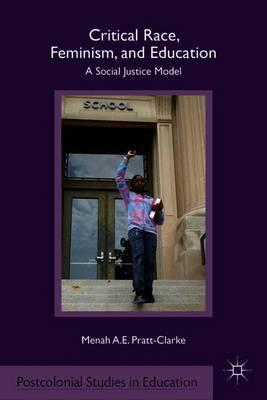
Critical Race, Feminism, and Education provides a transformative next step in the evolution of critical race and Black feminist scholarship. Focusing on praxis, the relationship between the construction of race, class, and gender categories and social justice outcomes is analyzed. An applied transdisciplinary model - integrating law, sociology, history, and social movement theory - demonstrates how marginalized groups are oppressed by ideologies of power and privilege in the legal system, the education system, and the media. Pratt-Clarke documents the effects of racism, patriarchy, classism, and nationalism on Black females and males in the single-sex school debate.
Full Product Details
Author: M. Pratt-Clarke
Publisher: Palgrave Macmillan
Imprint: Palgrave Macmillan
Dimensions:
Width: 14.00cm
, Height: 1.50cm
, Length: 21.60cm
Weight: 0.405kg
ISBN: 9780230109575
ISBN 10: 0230109578
Pages: 206
Publication Date: 19 January 2011
Audience:
College/higher education
,
Postgraduate, Research & Scholarly
Format: Hardback
Publisher's Status: Active
Availability: In Print

This item will be ordered in for you from one of our suppliers. Upon receipt, we will promptly dispatch it out to you. For in store availability, please contact us.
Reviews
Menah Pratt-Clarke's study represents one of the most thorough integrations of the law, feminism, sociology and African American Studies; her approach is a roadmap for implementing more equitable educational and public policy. Let's hope those who institute such policies are savvy enough to pick up this book, read it, and go about the urgent business of reshaping America's future. --Denean Sharpley-Whiting, Distinguished Professor, Vanderbilt University, and author of Pimps Up, Ho's Down We are experiencing a unique moment. For the first time in America's history, African American women and girls live in the White House as the first family. It is clear, though, that their place is no watershed for the majority of the sisters, aunts, mothers, and grandmothers who live the everyday lives and circumstances of African Americans in the nation. Pratt-Clarke reminds us and demands from us a careful scrutiny of the meaning of racial-gender justice for black girls and women. Justice and equal access, as she reveals, is a right that has yet to be provided to most black girls in America. In fact, the barriers to these full freedoms are defined by attitudes and practices from both within and external to African American communities. Her work takes us a long way in the struggle to better understand how culture, educational policy, law, and practice work to maintain varied and entangled oppressions. It takes us still further in thinking through how to holistically create a world of greater equity for black girls and women. --Jennifer F. Hamer, Department of African American Studies, University of Illinois at Urbana-Champaign; Editor of Black Women, Gender and Families It is now common knowledge that the educational system has failed black boys. Pratt-Clarke's important volume demarginalizes the plight of black girls, who are severely threatened as well. The future, if not the very existence, of a vibrant African-American community in the twenty-first century, wil
<p> Menah Pratt-Clarke's study represents one of the most thorough integrations of the law, feminism, sociology and African American Studies; her approach is a roadmap for implementing more equitable educational and public policy. Let's hope those who institute such policies are savvy enough to pick up this book, read it, and go about the urgent business of reshaping America's future. --Denean Sharpley-Whiting, Distinguished Professor, Vanderbilt University, and author of Pimps Up, Ho's Down <p> We are experiencing a unique moment. For the first time in America's history, African American women and girls live in the White House as the first family. It is clear, though, that their place is no watershed for the majority of the sisters, aunts, mothers, and grandmothers who live the everyday lives and circumstances of African Americans in the nation. Pratt-Clarke reminds us and demands from us a careful scrutiny of the meaning of racial-gender justice for black girls and women. Justice
Author Information
Menah A.E. Pratt-Clarke is Assistant Provost and Associate Director of the Office of Equal Opportunity and Access at the University of Illinois at Urbana-Champaign, USA.