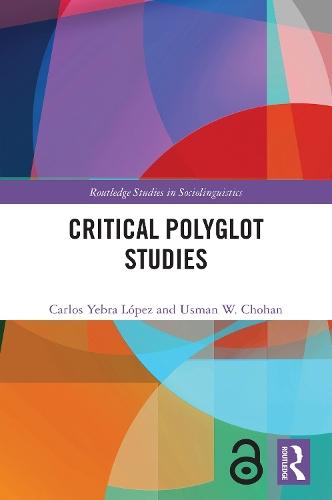
Critical Polyglot Studies

Author:   Carlos Yebra López ,  Usman W. Chohan
Publisher:   Taylor & Francis Ltd
ISBN:  

9781032697758


Pages:   214
Publication Date:   21 May 2026
Format:   Paperback
Availability:   Not yet available   Availability explained
This item is yet to be released. You can pre-order this item and we will dispatch it to you upon its release.

Our Price $119.00 Quantity:  
Pre-Order

Share |

Critical Polyglot Studies


Overview

Full Product Details

Author:   Carlos Yebra López ,  Usman W. Chohan
Publisher:   Taylor & Francis Ltd
Imprint:   Routledge
ISBN:  

9781032697758


ISBN 10:   103269775
Pages:   214
Publication Date:   21 May 2026
Audience:   College/higher education ,  Tertiary & Higher Education
Format:   Paperback
Publisher's Status:   Forthcoming
Availability:   Not yet available   Availability explained
This item is yet to be released. You can pre-order this item and we will dispatch it to you upon its release.

Table of Contents

Contents List of Tables List of Figures List of Acronyms Preface Chapter 1: Introduction Introduction Exposing the Colonial Origins and Mediation of Mainstream Polyglossia Rethinking Polyglossia as a North Atlantic Universal Enter the Polyglot Community The (D)evolution of the Polyglot Community into the Polyglot Industry-cum-Matrix The Case for Critical Polyglot Studies CPS’ Theoretical, Methodological and Normative Commitments * Theory Ontology Epistemology Methodology Normativity Outline of this Book Chapter Division Part 1: The Polyglot Industry: A Cartography Chapter 2: The Polyglot Community: Genealogy and Nature Introduction Enter Polyglossia: Commoditizing an Ethnonational Identity Marker (Neo)colonial/Ethnonational Rationality The (Neo)colonial/Ethnonational Partial Shift towards and Overlap with Neoliberalism Enter The Polyglot Community: General Normative Idea and Material Conditions The Mid-to-Late 1990s: From Internet Relay Chat to the World The 2000s: The Early YouTube ‘Polyglots’ and the Tension between Showmanship and Community Building The 2010s: The Road to ‘Global’ Hybridity Conclusion Chapter 3: The Polyglot Industry: Experts and Institutions Understanding the Polyglot Industry: When, Why, and How it Works Commercializing the Polyglot Community’s Attention The rise of the attention economy The Fourth Screen: Web 2.0 and the Smartphones (2010s to Present) Social networks YouTube Facebook Italki X (Twitter) Language Learning Platforms Duolingo Glossika uTalk How Language Learning Platforms and Social Networks Converge 'Polyglot' Gatherings Polyglot Events (annual) Polyglot Meetings (weekly) How Polyglot Gatherings Converge with Social Networks, Language Learning Apps and Print Media Print Media 1950 to 1995: Polyglossia avant la lettre Mid 1990s-2005: Early Recognition and Exploration 2005-2015: The Rise and Consolidation of Print Media as a Polyglot Industry Sector 2015 to present: Diversity, Inclusion, Hyperpolyglossia and AI Conclusion: Saving the Polyglot Community from the Language-Industrial Complex Chapter 4: The Polyglot Matrix: The Ideology of the Polyglot Industry Introduction Polyglot Matrix Myths Myth #1: (Non)nativespeakerism (Neo)colonialism/Ethnonationalism Performativity Beyond (Non)native-speakerism L1 Speakers as Role Models, L1+n Speakers as Deficient Myth #2: Accentism Myth #3: Foreignness Myth # 4: Thinking in Languages Myth # 5: Languages as Countable Myth # 6: Code-switching Myth # 7: Neo-Whorfianism Myth # 8: Flaggism Myth # 9: Multilingual exceptionalism Myth # 10: Causation Between Polyglossia and Tolerance Conclusion Part 2: Critical Polyglot Studies: A Roadmap Chapter 5: Programmatic Points and Best Practices Programmatic Points Theory Ontology Epistemology Methodology Political Economy Normativity Best Practices Social Networks Language Learning Applications Polyglot Meetings Print Media Conclusion Chapter 6: Institutional Case Studies The Hyperpolyglot Activist Introduction Positioning vis-à-vis the Hegemonic Rationalities Polyglot Industry Intervention Polyglot Matrix Intervention HYPIA: The International Association of Hyperpolyglots Introduction Positioning vis-à-vis the Hegemonic Rationalities Polyglot Industry Intervention Polyglot Matrix Intervention Final Words Index

Reviews

Author Information

Carlos Yebra López is Assistant Professor of Spanish Linguistics at California State University, Fullerton. He is also founder of The Hyperpolyglot Activist and Ladino 21 Community Interest Company, and the Director of Research at The International Association of Hyperpolyglots (HYPIA). Usman W. Chohan is an international academic who serves as Advisor on Economic Affairs and National Development at the Centre for Aerospace & Security Studies (CASS), one of Pakistan’s premier research-based think tanks, where he was a founding director. He is also the founder and serves as President of the International Association of Hyperpolyglots (HYPIA), the largest association of hyperpolyglot language speakers in the world.

Tab Content 6

Author Website:  

Countries Available

All regions
Latest Reading Guide

April RG 26_2


Shopping Cart
Your cart is empty
Shopping cart
Mailing List