Overview
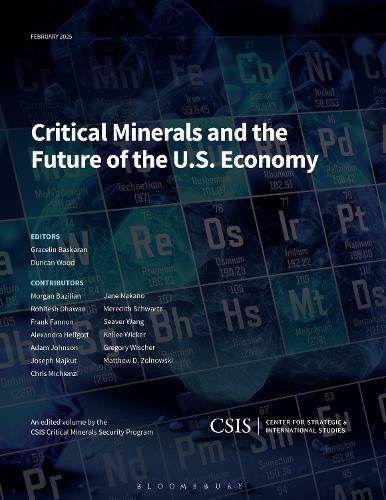
Safeguarding the minerals supply chains for advanced technologies in strategic industries is an economic and national security imperative. Yet significant vulnerabilities continue to exist in the supply chain, despite the ongoing efforts by government and businesses to address them. Policymakers now face the immense task of fortifying supplies of everything from lithium and graphite for advanced battery chemistries to tungsten and rare earth elements for the next generation of warfighting technologies. The United States will need to strengthen both its mission clarity and its execution with a comprehensive strategy focused on domestic resource development, advanced processing and recycling technologies, international partnerships, and sustainable practices. This edited volume brings together the analysis and policy recommendations of 15 experts, led by editors Dr. Gracelin Baskaran and Dr. Duncan Wood, to bolster U.S. competitiveness and leadership in these areas. It is intended to be a resource for policymakers in the new U.S. administration and Congress. The volume shows that resilient mineral chains have never been more important for U.S. security than at this critical juncture.
Full Product Details
Author: Gracelin Baskaran , Duncan Wood
Publisher: Bloomsbury Publishing Plc
Imprint: Bloomsbury Academic
Dimensions:
Width: 21.20cm
, Height: 1.60cm
, Length: 27.80cm
Weight: 0.460kg
ISBN: 9798765198360
Pages: 168
Publication Date: 30 April 2026
Audience:
Professional and scholarly
,
Professional & Vocational
Format: Paperback
Publisher's Status: Forthcoming
Availability: Manufactured on demand 
Table of Contents
Chapter 1. Introduction Gracelin Baskaran, Center for Strategic and International Studies (CSIS), USA SECTION 1: Crucial Industries Rely on Critical Minerals to Remain Competitive Chapter 2. Powering Technology: Critical Minerals for the Semiconductor Industry Gracelin Baskaran, Center for Strategic and International Studies (CSIS), USA and Meredith Schwartz, Center for Strategic and International Studies (CSIS), USA Chapter 3. Securing the Nation: Mineral Needs for the Defense Industrial Base Matthew D. Zolnowski, Greyfriars LLC, USA Chapter 4. Driving Innovation: Critical Minerals and the Automotive Industry Duncan Wood, Pacific Council of International Policy, USA and Alexandra Helfgott, Yale Jackson School of Global Affairs, USA Chapter 5. Fueling the Transition: The Role of Critical Minerals in Renewable Energy Joseph Majkut, Center for Strategic and International Studies (CSIS), USA SECTION 2: Progress Under the Biden Administration: Important but Incomplete Chapter 6. An Evaluation of the Inflation Reduction Act Gracelin Baskaran, Center for Strategic and International Studies (CSIS), USA and Meredith Schwartz, Center for Strategic and International Studies (CSIS), USA Chapter 7. An Evaluation of the CHIPS and Science Act Kellee Wicker, Wilson Center, USA Chapter 8. An Evaluation of the Defense Production Act Chris Michienzi, MMR Defense Solutions LLC, USA Chapter 9. An Evaluation of the Minerals Security Partnership Jane Nanako, Center for Strategic and International Studies (CSIS), USA SECTION 3: Addressing Challenges and Outstanding Questions in the Critical Minerals Industry Chapter 10. Modernizing Mine Permitting in the United States Morgan Bazilian, Payne Institute, USA, and Gregory Wischer, Dei Gratia Minerals, USA Chapter 11. Closing the Midstream Gap in U.S. Critical Minerals Supply Chains Adam Johnson, Principal Mineral, USA Chapter 12. A Strategy for Minerals Diplomacy in Emerging Markets Gracelin Baskaran, Center for Strategic and International Studies (CSIS), USA Chapter 13. Mining the Deep Sea: A New Minerals Frontier Seaver Wang, Breakthrough Institute, USA Chapter 14. Pursuing Responsible Mining for a Brighter Future Rohitesh Dhawan, International Council on Mining and Metals, UK Chapter 15. A Comprehensive U.S. Critical Minerals Plan Frank Fannon, Fannon Global Advisors, US Chapter 16. Conclusion Gracelin Baskaran, Center for Strategic and International Studies (CSIS), USA and Duncan Wood, Pacific Council of International Policy, USA About the Editors About the Contributors Endnotes
Reviews
Author Information
Dr. Gracelin Baskaran is the director of the Critical Minerals Security Program at the Center for Strategic and International Studies (CSIS) and a bye-fellow in economics at the University of Cambridge. She is a mining economist, and her primary expertise is in critical minerals and trade. She began her career in South Africa’s platinum belt. She later spent five years at the World Bank in South Africa, where she coauthored the book Africa’s Resource Future: Harnessing Natural Resources for Economic Transformation during the Low-Carbon Transition. She was a Fulbright Scholar and has also held positions at the University of Cambridge, University of London, and University of Cape Town. Dr. Baskaran is now writing a book on an international strategy for critical minerals engagement for the United States. She has been cited as an expert in the The Economist, Financial Times, Wall Street Journal, Washington Post, Bloomberg, Foreign Policy, and the U.S. International Trade Commission, among others. She has also published over 150 op-eds and columns, policy reports, and white papers and published research in the Mineral Economics journal. She has testified before the U.S. Congress and is a regular speaker at leading international mining and energy conferences, universities, and policymaker forums. Dr. Baskaran holds a doctorate from the University of Cambridge. Dr. Duncan Wood is president and CEO of the Pacific Council of International Policy. He was previously the vice president for srategy and new initiatives at the Wilson Center, where he worked on supply chain policy, critical minerals, electric vehicles, and geopolitics of the energy transition. From 2013 to 2020, he was director of the Wilson Center’s Mexico Institute and served as a senior advisor to the institute. He regularly gives testimony to the U.S. Congress, is a widely quoted media source, and has published extensively on a wide range of global issues. He is the author or editor of 12 books and more than 30 chapters and articles. He is a board member of Transparency International, Signos Vitales (a Mexican public policy research organization) and Foreign Affairs Latinoamerica, and is an editorial advisor to El Universal newspaper. Over the past decade he has served as co-chair of the World Economic Forum (WEF)’s Global Future Council on Transparency and Anti-Corruption and has worked closely with the WEF on energy policy. From 1996 to 2012, he was a professor and the director of the International Relations Program at the Instituto Tecnologico Autonomo de Mexico (ITAM) in Mexico City. Over the course of his 30-year career, he has been a Fulbright Scholar and a visiting fellow at the Center for Strategic and International Studies (CSIS). He holds a doctorate from Queen’s University.
Tab Content 6
Author Website:
Countries Available
All regions
|