Overview
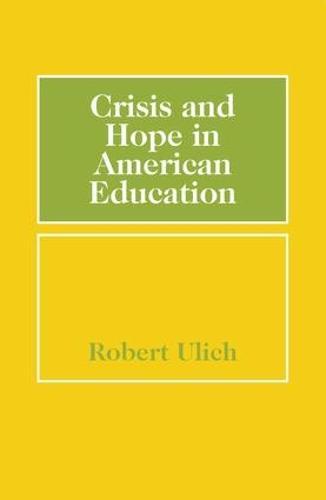
This book evaluates the educational system of the United States from schools for the young up to universities and various forms of adult education. It is not confined to the evaluation of intellectual achievement. Rather it tries to arrive at some judgment as to whether schools help people acquire the degree of maturity necessary for participation in the work of a nation called upon to assume world responsibilities. Education, rightly conceived, is the process by which a growing person, according to his individual capacity, is prepared to understand himself, his place in society, his relation to the universe, and to act upon this understanding. A nation, to whatever extent it can afford to do so, should help future generations to strive for such achievements. But although this obligation is generally accepted by the American citizen, its practical requirements are still not fully understood. A classic soon after its original publication, this book is timelier today than ever. The author convincingly articulates the view that all our efforts at raising the intellectual and moral standards in our high schools are doomed to failure unless we boldly pair the right subject with the right talent. He demonstrates how we can achieve this without rejecting the precious heritage that is our tradition of free secondary schooling for all who can profit by it: his goal is nothing less than the creative combination of quality and justice in education. Ulich's prescriptions for education are bold and prac1/4tical. The boldness is best characterized by his contro1/4versial suggestion that the emotional sphere serves as the means of unifying the highly diverse American society. We see the influence of modern theory and its disenchantment with the merely intellectual theory as a basis for understanding, communication, and meaning. The institution that Ulich proposes is an ""ideal"" one, but it is described in considerable detail. Its buildings, facilities, curriculum, and informal programs are designed to provide shared emotional experiences while retaining the need for intellectual differentiation.
Full Product Details
Author: Robert Ulich
Publisher: Taylor & Francis Inc
Imprint: AldineTransaction
Dimensions:
Width: 15.20cm
, Height: 1.40cm
, Length: 22.90cm
Weight: 0.317kg
ISBN: 9780202309842
ISBN 10: 0202309843
Pages: 256
Publication Date: 15 January 2008
Audience:
Professional and scholarly
,
Professional & Vocational
Format: Paperback
Publisher's Status: Active
Availability: In Print

This item will be ordered in for you from one of our suppliers. Upon receipt, we will promptly dispatch it out to you. For in store availability, please contact us.
Reviews
<p> This work examines the broad problem of American education as a whole. Professor Ulich's personal experience with education in pre-Nazi Germany and, since 1934, in the United States, puts him in a position to see parallels not so readily apparent to others.... While the author finds much to praise in American education, and he generously gives credit where credit is due, he also shows a talent for detecting the subtle weaknesses in the educational picture. <p> --Aaron J. Ihde, Isis
-This work examines the broad problem of American education as a whole. Professor Ulich's personal experience with education in pre-Nazi Germany and, since 1934, in the United States, puts him in a position to see parallels not so readily apparent to others.... While the author finds much to praise in American education, and he generously gives credit where credit is due, he also shows a talent for detecting the subtle weaknesses in the educational picture.- --Aaron J. Ihde, Isis ""This work examines the broad problem of American education as a whole. Professor Ulich's personal experience with education in pre-Nazi Germany and, since 1934, in the United States, puts him in a position to see parallels not so readily apparent to others.... While the author finds much to praise in American education, and he generously gives credit where credit is due, he also shows a talent for detecting the subtle weaknesses in the educational picture."" --Aaron J. Ihde, Isis ""This work examines the broad problem of American education as a whole. Professor Ulich's personal experience with education in pre-Nazi Germany and, since 1934, in the United States, puts him in a position to see parallels not so readily apparent to others.... While the author finds much to praise in American education, and he generously gives credit where credit is due, he also shows a talent for detecting the subtle weaknesses in the educational picture."" --Aaron J. Ihde, Isis
This work examines the broad problem of American education as a whole. Professor Ulich's personal experience with education in pre-Nazi Germany and, since 1934, in the United States, puts him in a position to see parallels not so readily apparent to others.... While the author finds much to praise in American education, and he generously gives credit where credit is due, he also shows a talent for detecting the subtle weaknesses in the educational picture. </p> --Aaron J. Ihde, <em>Isis</em></p>
Author Information
Robert Ulich (1890-1977) was James Bryant Conant Professor Emeritus of Philosophy of Education, Harvard University. He is the author of many books, including Philosophy of Education, and The Human Career. Before coming to Harvard University he served as assistant director of Leipzig Public Libraries, counselor in charge at Saxon University, and professor of philosophy at Dresden Institute of Technology.