Overview
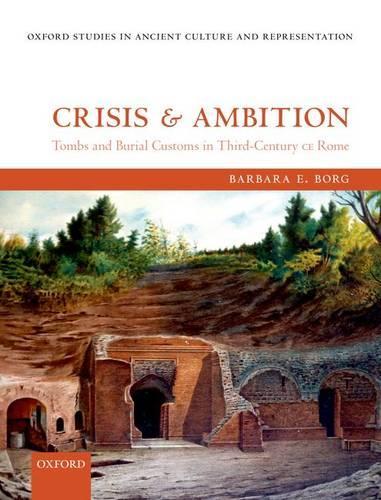
Tombs and burial customs are an exquisite source for social history, as their commemorative character inevitably expresses much of the contemporaneous ideology of a society. This book presents, for the first time, a holistic view of the funerary culture of Rome and its surroundings during the third century AD. While the third century is often largely ignored in social history, it was a transitional period, an era of major challenges - political, economic, and social - which inspired creativity and innovation, and paved the way for the new system of late antiquity.Barbara Borg argues that during this time there was, in many ways, a return to practices known from the Late Republic and early imperial period, with spectacular monuments for the rich, and a large-scale reappearance of collective burial spaces. Through a study of terraced tombs, élite monuments, the catacomb nuclei, sarcophagi, and painted image decoration, this volume explores how the third century was an exciting period of experimentation and creativity, a time when non-Christians and Christians shared fundamental ideas, needs, and desires as well as cemeteries, tombs, and hypogea. Ambition continued to be a driving force and a determining factor in all social classes, who found innovative solutions to the challenges they encountered.
Full Product Details
Author: Barbara E. Borg (Professor of Classical Archaeology, University of Exeter)
Publisher: Oxford University Press
Imprint: Oxford University Press
Dimensions:
Width: 19.50cm
, Height: 2.50cm
, Length: 24.90cm
Weight: 0.952kg
ISBN: 9780199672738
ISBN 10: 0199672733
Pages: 330
Publication Date: 03 October 2013
Audience:
College/higher education
,
Professional and scholarly
,
Tertiary & Higher Education
,
Professional & Vocational
Format: Hardback
Publisher's Status: Active
Availability: To order

Stock availability from the supplier is unknown. We will order it for you and ship this item to you once it is received by us.
Reviews
In this important new study Borg shows the importance of the much neglected thirdcentury to the study of classical archaeology. By a meticulous examination of the periods tombs and burial customs she throws new light on some of the most fundamental concerns of the study of Roman material culture, from how to analyse sarcophagus iconography to the possible iconographical interpretations of catacomb decoration... This book will be essential reading not only for specialists in the field of Roman archaeology but also for graduates and undergraduates. Helen Ackers, Pegasus
In this important new study Borg shows the importance of the much neglected thirdcentury to the study of classical archaeology. By a meticulous examination of the periods tombs and burial customs she throws new light on some of the most fundamental concerns of the study of Roman material culture, from how to analyse sarcophagus iconography to the possible iconographical interpretations of catacomb decoration... This book will be essential reading not only for specialists in the field of Roman archaeology but also for graduates and undergraduates. Helen Ackers, Pegasus a thoughtful re-assessment which draws together a vast range of scholarship to present a holistic picture. Zahra Newby, Sehepunkte This ambitious and daring monograph on a deserving subject is likely to stimulate discussion among specialists in Roman funerary culture and imperial history, but it also provides a welcome synthesis for graduate students and scholars who look for an immersion in the funerary monuments and artistic conventions of the time period. Dorian Borbonus, Bryn Mawr Classical Review
The thorough treatment of surviving evidence ensures that this study will endure as the primary point of reference for its subject. * John Pearce, Gnomon Vol.90 * In this important new study Borg shows the importance of the much neglected thirdcentury to the study of classical archaeology. By a meticulous examination of the periods tombs and burial customs she throws new light on some of the most fundamental concerns of the study of Roman material culture, from how to analyse sarcophagus iconography to the possible iconographical interpretations of catacomb decoration... This book will be essential reading not only for specialists in the field of Roman archaeology but also for graduates and undergraduates. * Helen Ackers, Pegasus * a thoughtful re-assessment which draws together a vast range of scholarship to present a holistic picture. * Zahra Newby, Sehepunkte * This ambitious and daring monograph on a deserving subject is likely to stimulate discussion among specialists in Roman funerary culture and imperial history, but it also provides a welcome synthesis for graduate students and scholars who look for an immersion in the funerary monuments and artistic conventions of the time period. * Dorian Borbonus, Bryn Mawr Classical Review *
This ambitious and daring monograph on a deserving subject is likely to stimulate discussion among specialists in Roman funerary culture and imperial history, but it also provides a welcome synthesis for graduate students and scholars who look for an immersion in the funerary monuments and artistic conventions of the time period. * Dorian Borbonus, Bryn Mawr Classical Review * a thoughtful re-assessment which draws together a vast range of scholarship to present a holistic picture. * Zahra Newby, Sehepunkte * In this important new study Borg shows the importance of the much neglected thirdcentury to the study of classical archaeology. By a meticulous examination of the periods tombs and burial customs she throws new light on some of the most fundamental concerns of the study of Roman material culture, from how to analyse sarcophagus iconography to the possible iconographical interpretations of catacomb decoration... This book will be essential reading not only for specialists in the field of Roman archaeology but also for graduates and undergraduates. * Helen Ackers, Pegasus * The thorough treatment of surviving evidence ensures that this study will endure as the primary point of reference for its subject. * John Pearce, Gnomon Vol.90 *
Author Information
Barbara E. Borg is Professor of Classical Archaeology at the University of Exeter. She has worked on a wide range of topics, often linking her core subject Greek and Roman art and archaeology with neighbouring disciplines such as Egyptology, Classical Literature, Ancient History, and Geology.