Overview
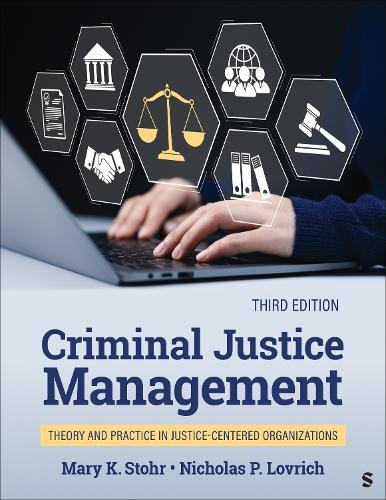
Criminal Justice Management: Theory & Practice in Justice-Centered Organizations, Third Edition bridges the gap between theory and practice, guiding students through the complexities of managing within the criminal justice field.
Full Product Details
Author: Mary K. Stohr , Nicholas Lovrich
Publisher: Sage Publications Inc Ebooks
Imprint: SAGE Publications Inc
ISBN: 9781071926512
ISBN 10: 1071926519
Pages: 344
Publication Date: 14 April 2026
Audience:
College/higher education
,
Undergraduate
Format: Paperback
Publisher's Status: Active
Availability: In Print 
This item will be ordered in for you from one of our suppliers. Upon receipt, we will promptly dispatch it out to you. For in store availability, please contact us.
Table of Contents
Foreword Preface About the Authors Chapter 1: Criminal Justice Management: The Big, the Bad, and the Beautiful Introduction Scope and Purpose of the Book: The Evidence-Based Practices Route Fundamental Concepts in Core Criminal Justice Agencies: Police, Courts, and Corrections Conclusions Discussion Questions Key Terms Web Link Cases Cited References Chapter 2: Surveying the Landscape of Criminal Justice Management Introduction Key Terms and Concepts Open and Closed Organizations Competing Values of Government Operation Government Service Is Different Conclusions Discussion Questions Web Links Key Terms References Chapter 3: Managing Ethical Challenges With Best Practice Solutions Introduction Public Distrust Deviance Explained Two Insidious Types of Abuse Ethics Defined and Discussed A Warning Sign: Too Much Focus on Ends Over Means The “Ethics” Remedy to Minimize Abuse, Deviance, Corruption, and Harassment Conclusions Exercise: The Student’s Ethics Quiz Discussion Questions Key Terms Notes Appendix: The Ethics Instrument Version for Jails References Chapter 4: The Administrative State and Management Theories in Perspective Introduction The Administrative State Management Theories Insights From the Field of Behavioral Economics Motivating the Creative Class Conclusions Exercise: Taylor’s Pig Iron Story Discussion Questions Key Terms Note References Chapter 5: Communications: What You Say and Do Is What They Think You Mean Introduction The Purpose and Modes of Communication Communication Within and Across Organizational Boundaries and Complaints Barriers to Effective Communication Improving Communications Other Solutions: Grievance Procedures and Whistleblowing Programs Technology, Inside and Outside Research and Organization Change Procedural Justice in the Courts How Trauma-Informed, Workplace Wellness, and Self-Care Messages Apply to Criminal Justice Agencies How Emotional Intelligence Can Improve Communications Conclusions Exercise: The Space Invader Discussion Questions Web Links Key Terms References Chapter 6: Socialization, Roles, and Power Issues Introduction Socialization The Criminal Justice Role Power and Authority Conclusions Exercise: The Role: Ordering People About Discussion Questions Key Terms Appendix Note References Chapter 7: Leadership and Criminal Justice Organizations Introduction Leadership Defined Leadership Theories Change and Maintenance Leadership and Leadership Styles The Responsibilities of Leadership Teaming as a Means of Sharing Group Leadership Responsibilities The Role of Emotions in Leadership The Relative Job Satisfaction and Self-Perceived Status of Criminal Justice Leaders/Managers and Supervisors Criminal Justice Leaders: Success, Failure, and the Dangers of Groupthink Conclusions Exercise: The American (leadership) Idols Discussion Questions Key Terms Note References Chapter 8: Personnel Processes and Practices Introduction Selection Typical Selection Practices Selection From the Applicant’s Perspective On the Job, the Selection Process Continues Training Performance Appraisals Retention Strategies Conclusions Exercise: Job Design Discussion Questions Key Terms References Chapter 9: Selection Issues: Workforce for the 21st Century, Diversity, and Affirmative Action Introduction Workforce 2000 and 21st Century Work Selection Processes: Who Wants to Work in Criminal Justice? Qualifications Civil Rights Legislation Intentional Discrimination Conclusions Exercise: Tracking Criminal Justice Employment Discussion Questions Key Terms Cases Cited and Laws/Statutes Note References Chapter 10: Reaching Beyond the Expected: Introduction Implementation and Its Challenges Treatment Programming Use of Force Standards and Accreditation Conclusions Exercise: Take an Informal Poll Discussion Questions Key Terms Notes References Chapter 11: Strategic Planning and Budgeting Introduction Strategic Planning: Definition, Benefits, and the Difficulties of Implementation What Is a Budget? Recent History of Budgeting and Planning Budget Strategies Conclusions Exercise: Develop a Criminal Justice Budget Discussion Questions Key Terms References Chapter 12: Decision Making and Prediction Introduction Decisions, Decisions, Decisions: What They Are and Who Makes Them (the decision makers) Obstacles to Good Decision Making: Let Us Count the Ways Logical Fallacies Biology and Cognition (social intelligence): A Possible Undue Influence The Effect of Trauma on Decision Making and the Benefits of Self-Care Prediction Ways to Improve Decision Making Conclusions Exercise: The False Argument Discussion Questions Key Terms References Chapter 13: Model Management Practices Introduction Salvation Through Consilience Communication, Leadership, and Culture Change It Is the People and Their Goals That Matter It Is the People and Their Goals That Matter Conclusions Discussion Questions Key Terms References
Reviews
This textbook was a refreshing take on covering criminal justice administration material. It is a good blend of research and practical material that many other texts are missing. -- Dr. Paul “PK” Klenowski The author brings experience and knowledge which is imparted in a simple to understand, yet rich in depth and breadth of the topical information. The text provides a solid base for any instructor to use a guide in fostering discussions, encouraging further research as well analysis by students, along with good discussion questions in each chapter. -- Dr. Jeffrey Schwartz
Author Information
Mary K. Stohr is a professor in the Department of Criminal Justice at Washington State University. She earned her PhD in political science, with specializations in criminal justice and public administration, from Washington State University. Previously she worked at Missouri State, Boise State, and New Mexico State Universities for a total of 23 years. Before entering academe Stohr, worked in an adult male prison in Washington state as a correctional officer (for less than a year) and as a correctional counselor (for about two years). Stohr has published seven books and a total of over 150 other academic works of one sort or another in the areas of correctional organizations and operation, correctional personnel, client needs and assessment, program evaluation, drug policy and victimization. She is both a Founders and Fellows Award winner from the Academy of Criminal Justice Sciences. Nicholas P. Lovrich is an Emeritus Regent Professor in the School of Politics, Philosophy and Public Affairs at Washington State University. He earned his PhD in Political Science (public administration specialization) at the University of California, Los Angeles (UCLA). He has held academic appointments at Metropolitan State University, the University of Denver, and DePauw University before going to Washington State University in 1977 to assume the position of Director of the Division of Governmental Studies and Services. For 25 years he taught courses in public administration and evaluation research and included many graduate students in political science and criminal justice in applied policy and program research on police, corrections, and court agencies in Washington and federal agencies. He supervised the PhD dissertations of 30 students, most of whom developed dissertation projects from work done in DGSS. Among his former students are many academics and leaders in police, corrections, and court agencies. He has published over 200 peer-reviewed articles in journals in political science, public administration, and criminal justice.
Tab Content 6
Author Website:
Countries Available
All regions
|