Overview
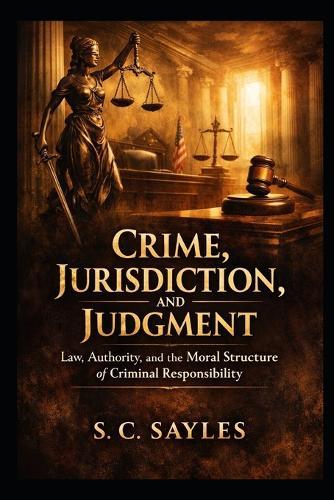
Crime, Jurisdiction, and Judgment Law, Authority, and the Moral Structure of Criminal Responsibility Modern societies possess vast systems of criminal law, powerful policing institutions, and complex courts designed to administer justice. Yet the deeper foundations of criminal responsibility are rarely examined. Why is an act a crime rather than merely prohibited behaviour? What gives courts the authority to judge? And why do societies treat certain violations-such as theft, fraud, violence, and deception-as intolerable threats to social order? In Crime, Jurisdiction, and Judgment, S. C. Sayles argues that crime cannot be understood merely as behaviour, pathology, or social construction. Crime is a jurisdictional violation within a moral order. Every criminal act represents the breaking of an obligation grounded in legitimate authority. That violation introduces disorder into the relational structure that allows society to function, and it therefore requires authoritative judgment to restore order. Drawing from Sayles's wider philosophical corpus-including Jurisdictionalism, Philosophical Jurisdiction, Propositional Ethics, Marriage Before Law, The War Against Reality, and The Crisis of Trust-this book develops a unified philosophy of crime and justice. It shows that criminal law is not merely a technical system of rules but a moral architecture linking authority, obligation, violation, judgment, and restoration. At the heart of the work lies a simple but powerful insight: Crime is the violation of rightful authority that introduces disorder into the moral structure of society and therefore requires legitimate judgment to restore order. Through this framework, Sayles reinterprets the foundations of criminal law, showing that: Crime presupposes jurisdiction-a legitimate authority capable of judgment. Criminal acts violate covenantal obligations embedded in human relationships. These violations introduce moral disorder into the structure of society. Courts exist to exercise authoritative judgment that restores rightful order. The book examines the philosophical foundations of law, the covenantal origins of obligation, the nature of crime as social disorder, the role of courts in restoring justice, and the growing crisis of legitimacy facing modern criminal justice systems. It also critiques dominant theories in criminology and legal philosophy, arguing that many contemporary approaches explain criminal behaviour without explaining crime itself. Crime, Jurisdiction, and Judgment ultimately offers a new framework for understanding the architecture of justice. It integrates philosophy, ethics, jurisprudence, criminology, and political legitimacy into a single structure that explains why societies require law, courts, and judgment in order to survive. Provocative, rigorous, and deeply interdisciplinary, this book presents a bold thesis: justice is not merely the enforcement of rules, but the restoration of moral order after violation. For readers interested in philosophy of law, criminology, political theory, and the foundations of justice, Crime, Jurisdiction, and Judgment offers a powerful rethinking of what crime really is-and why judgment is indispensable to the survival of society.
Full Product Details
Author: S C Sayles
Publisher: Independently Published
Imprint: Independently Published
Dimensions:
Width: 15.20cm
, Height: 1.40cm
, Length: 22.90cm
Weight: 0.349kg
ISBN: 9798251524406
Pages: 258
Publication Date: 10 March 2026
Audience:
General/trade
,
General
Format: Paperback
Publisher's Status: Active
Availability: Available To Order

We have confirmation that this item is in stock with the supplier. It will be ordered in for you and dispatched immediately.