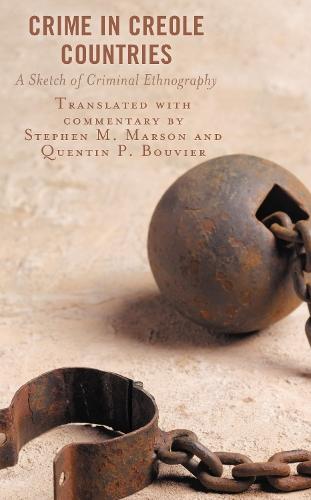
Full Product Details
Author: Stephen M. Marson ,
Quentin P. Bouvier ,
Armand Corre
Publisher: Bloomsbury Publishing Plc
Imprint: Lexington Books
Dimensions:
Width: 16.20cm
, Height: 1.70cm
, Length: 24.10cm
Weight: 0.435kg
ISBN: 9781793633125
ISBN 10: 1793633126
Pages: 164
Publication Date: 17 December 2020
Audience:
Professional and scholarly
,
Professional & Vocational
Format: Hardback
Publisher's Status: Active
Availability: Manufactured on demand

We will order this item for you from a manufactured on demand supplier.
Reviews
Crime in Creole Countries is a complex yet inviting work, made all the more so by the current social upheavel in the United States that is largely centerd on calls for racial and social justice. Significantly, any historical work needs to be understood within the social and cultural context of where (and when) it was written -- and that is where Dr. Marson and Mr. Bouvier excel. The insights and commentary that they provide into early efforts at constructing a criminology of relevance are what make this book stand out from others that take an historical approach to the field. --Frank Schmalleger, Ph.D., The University of North Carolina at Pembroke The work of A. Corre, originally published in 1889, offers to the researcher a unique snapshot of how crimes in the colonies were understood, represented, and explained by French officials sent to the colonies. It palliates to a certain extent to missing archives, by providing detailed statistics of crimes, which could be useful to researchers in Caribbean and Colonial Studies. More importantly, this translation of Corre's book into English comes in a timely manner: it gives the opportunity for more scholars to decipher the historical construction of a biased and racist relational system between French citizens who, in theory, should have been equal before the law. --Marion Pluskota, Leiden University, The Netherlands
""Crime in Creole Countries is a complex yet inviting work, made all the more so by the current social upheavel in the United States that is largely centerd on calls for racial and social justice. Significantly, any historical work needs to be understood within the social and cultural context of where (and when) it was written -- and that is where Dr. Marson and Mr. Bouvier excel. The insights and commentary that they provide into early efforts at constructing a criminology of relevance are what make this book stand out from others that take an historical approach to the field."" --Frank Schmalleger, Ph.D., The University of North Carolina at Pembroke ""The work of A. Corre, originally published in 1889, offers to the researcher a unique snapshot of how crimes in the colonies were understood, represented, and explained by French officials sent to the colonies. It palliates to a certain extent to missing archives, by providing detailed statistics of crimes, which could be useful to researchers in Caribbean and Colonial Studies. More importantly, this translation of Corre's book into English comes in a timely manner: it gives the opportunity for more scholars to decipher the historical construction of a biased and racist relational system between French citizens who, in theory, should have been equal before the law."" --Marion Pluskota, Leiden University, The Netherlands
The work of A. Corre, originally published in 1889, offers to the researcher a unique snapshot of how crimes in the colonies were understood, represented, and explained by French officials sent to the colonies. It palliates to a certain extent to missing archives, by providing detailed statistics of crimes, which could be useful to researchers in Caribbean and Colonial Studies. More importantly, this translation of Corre's book into English comes in a timely manner: it gives the opportunity for more scholars to decipher the historical construction of a biased and racist relational system between French citizens who, in theory, should have been equal before the law.--Marion Pluskota, Leiden University, The Netherlands Crime in Creole Countries is a complex yet inviting work, made all the more so by the current social upheavel in the United States that is largely centerd on calls for racial and social justice. Significantly, any historical work needs to be understood within the social and cultural context of where (and when) it was written -- and that is where Dr. Marson and Mr. Bouvier excel. The insights and commentary that they provide into early efforts at constructing a criminology of relevance are what make this book stand out from others that take an historical approach to the field.--Frank Schmalleger, Ph.D., The University of North Carolina at Pembroke
Crime in Creole Countries is a complex yet inviting work, made all the more so by the current social upheavel in the United States that is largely centerd on calls for racial and social justice. Significantly, any historical work needs to be understood within the social and cultural context of where (and when) it was written -- and that is where Dr. Marson and Mr. Bouvier excel. The insights and commentary that they provide into early efforts at constructing a criminology of relevance are what make this book stand out from others that take an historical approach to the field. The work of A. Corre, originally published in 1889, offers to the researcher a unique snapshot of how crimes in the colonies were understood, represented, and explained by French officials sent to the colonies. It palliates to a certain extent to missing archives, by providing detailed statistics of crimes, which could be useful to researchers in Caribbean and Colonial Studies. More importantly, this translation of Corre's book into English comes in a timely manner: it gives the opportunity for more scholars to decipher the historical construction of a biased and racist relational system between French citizens who, in theory, should have been equal before the law.
Author Information
Stephen M. Marson is professor emeritus at the University of North Carolina at Pembroke. Quentin Bouvier is PhD student at the University of North Carolina at Chapel Hill.