Overview
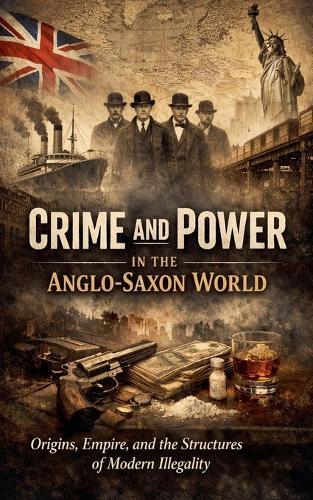
Crime and Power in the Anglo-Saxon World - Volume I: Origins and Structures is a historical and analytical essay that examines the emergence of organized crime as a structural phenomenon embedded within the development of modern institutions, empire, and capitalism. Organized crime is often portrayed as a marginal force-an underworld operating in opposition to the State. This reassuring narrative suggests that crime is an external anomaly, disconnected from the normal functioning of society. This book challenges that assumption. Through a rigorous historical approach, it shows that many forms of organized crime did not arise despite modern institutions, but precisely because of them. Focusing on the Anglo-Saxon world, this volume explores how specific historical contexts created durable criminal structures capable of integrating violence, economic rationality, and institutional tolerance. The analysis begins in 19th-century Britain, where rapid industrialization, urban poverty, and weak regulatory frameworks fostered the emergence of territorial gangs and informal systems of control. It then expands to London's imperial ports, where global trade networks, administrative complexity, and tacit complicity enabled organized predation on a systemic scale. The book also examines the British Empire's hybrid structures, including colonial governance and chartered companies, as historical laboratories of legalized economic violence. In Ireland and Australia, it analyzes how repression, famine, penal systems, and institutional coercion generated forms of political and criminal organization that blurred the boundaries between resistance, crime, and governance. The American experience marks a decisive turning point. Prohibition transformed crime into an industry, accelerating its rationalization through logistics, hierarchy, corruption, and financial management. The structures developed during this period did not disappear with the return of legality; they adapted, diversified, and became enduring components of modern organized crime. Rather than focusing on sensational figures or moral condemnation, this work proposes a structural typology of criminal organizations-gangs, mafias, networks, and hybrid forms-highlighting their recurring characteristics: hierarchy, territorial or market control, negotiated relationships with power, and adaptive resilience. This volume does not argue that institutions are inherently criminal. Instead, it demonstrates how certain legal, economic, and political configurations create gray zones in which organized crime can thrive. Crime, in this sense, is not merely a deviation from modern order, but one of its revealing by-products. Written for readers interested in history, geopolitics, criminology, and political economy, Crime and Power in the Anglo-Saxon World lays the foundations for a broader investigation into the continuities between historical criminal structures and contemporary forms of institutional and financial illegality.
Full Product Details
Author: William Kergroach
Publisher: William Kergroach
Imprint: William Kergroach
Dimensions:
Width: 12.70cm
, Height: 0.40cm
, Length: 20.30cm
Weight: 0.068kg
ISBN: 9798233648533
Pages: 60
Publication Date: 19 January 2026
Audience:
General/trade
,
General
Format: Paperback
Publisher's Status: Active
Availability: Available To Order

We have confirmation that this item is in stock with the supplier. It will be ordered in for you and dispatched immediately.