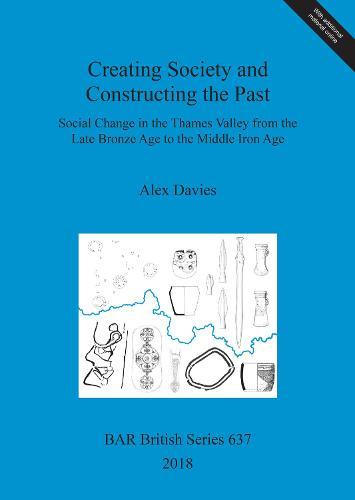
Creating Society and Constructing the Past: Social Change in the Thames Valley from the Late Bronze Age to the Middle Iron Age

Author:   Alex Davies
Publisher:   BAR Publishing
ISBN:  

9781407316062


Pages:   419
Publication Date:   31 May 2018
Format:   Mixed media product
Availability:   Available To Order   Availability explained
We have confirmation that this item is in stock with the supplier. It will be ordered in for you and dispatched immediately.

Our Price $191.48 Quantity:  
Add to Cart

Share |

Creating Society and Constructing the Past: Social Change in the Thames Valley from the Late Bronze Age to the Middle Iron Age


Overview

This book gives a new account of society and social change in the upper and middle Thames Valley from the Late Bronze Age to Middle Iron Age, 1150-100 BC. A model is developed from social anthropological case studies setting out expectations on how societies are structured based on certain material manifestations. Patterns are found within the wide range of types of evidence that are integrated and synthesised. This includes settlements, house forms, metalwork, pottery, human and animal remains, monuments, landscape boundaries and special deposits. The main interpretation offered is that Late Bronze Age societies were fluid and unstructured by either social status differences or lineage identities, whereas Early Iron Age communities were more concerned with ancestral genealogy and inter-generational inheritance. By the Middle Iron Age, communal aspects of ritual practice and material practice were largely replaced by local and household concerns in which smaller groups displayed increasing autonomy from each other.

Full Product Details

Author:   Alex Davies
Publisher:   BAR Publishing
Imprint:   BAR Publishing
Weight:   1.168kg
ISBN:  

9781407316062


ISBN 10:   1407316060
Pages:   419
Publication Date:   31 May 2018
Audience:   Professional and scholarly ,  Professional & Vocational
Format:   Mixed media product
Publisher's Status:   Active
Availability:   Available To Order   Availability explained
We have confirmation that this item is in stock with the supplier. It will be ordered in for you and dispatched immediately.

Table of Contents

List of Figures List of Tables List of Graphs List of Maps Abstract Chapter 1: Introduction Chapter 2: Understanding Objects, Identity and Community 2.1 Introduction 2.2 The Self and the Material World 2.2.1 Personhood and Objects - The Last 25 Years 2.3 Identity: Community and Kinship 2.3.1 Community 2.3.2 Kinship Fluidity on Two Southeast Asian Islands 2.3.3 The House and Settlement 2.4 Objects, the Dead and the Creation of Community 2.4.1 Object Retention and the Role of Ancestors 2.4.2 Object Destruction and the Role of Ancestors 2.4.3 Objects and the Role of Ancestors - Conclusion 2.4.4 Inalienable Objects 2.4.5 Exotica, Art and High Craftsmanship 2.4.6 Ancestors and Hierarchy 2.5 The Past in the Past: Recent Archaeological Perspectives 2.6 Summary 2.7 Theoretical Framework and the Later Prehistory of the Thames Valley Chapter 3: The Late Bronze Age 3.1 Introduction 3.2 Houses and Settlements 3.2.1 Settlement Longevity - Destruction and Abandonment 3.3 Special Deposits 3.3.1 Defining Special Deposits 3.3.2 Special Deposits in the Late Bronze Age 3.4 Human Remains 3.5 Field Systems and Enclosures 3.5.1 Abandoning Field Systems 3.6 Late Bronze Age Metalwork 3.6.1 Previous Work 3.6.2 Wilburton 3.6.3 Ewart Park 3.6.4 Destruction and Deposition 3.6.5 Manufacture, Form and Distribution 3.7 Regional Groups in the Thames Valley 3.7.1 The Thames - A Prehistoric Highway? 3.7.2 Carps Tongue/Boughton-Venat beyond Metalwork 3.7.3 Material Culture Patterns 3.7.4 Feasting and Middens 3.8 Discussion 3.9 Summary Chapter 4: The Late Bronze Age/Early Iron Age Transition 4.1 Introduction 4.2 Houses and Settlements 4.3 Special Deposits 4.4 Human Remains 4.5 Middens 4.6 Dividing the Landscape 4.6.1 Pit Alignments in the Upper Thames Valley 4.6.2 Parallel Ditches in the Middle Thames Valley 4.6.3 Linear Ditches on the Berkshire Downs 4.7 Hillforts and Linear Ditches 4.8 Metalworking 4.9 Metalwork 4.9.1 Hoards 4.9.2 Multi-period Hoards 4.9.3 Foreign Objects 4.10 Pottery 4.10.1 Form and Finish 4.10.2 Fabric 4.11 Summary Chapter 5: The Early Iron Age 5.1 Introduction 5.2 Houses and Settlements 5.3 Special Deposits 5.3.1 Animal Only 5.3.2 Pottery Only 5.3.3 Mixed Deposits 5.4 Animal Bones 5.5 Human Remains 5.5.1 Modified Human Remains 5.6 The Past and Material Culture 5.6.1 Metalwork 5.6.2 Old Objects, New Contexts 5.7 Foreign Exotica 5.8 Hillforts 5.8.1 Internal Occupation 5.8.2 Human Remains 5.8.3 Metalwork 5.8.4 Special Deposits 5.8.5 Decorated Pottery 5.9 Summary 5.10 Discussion Chapter 6: The Middle Iron Age 6.1 Introduction 6.2 Houses and Settlements 6.2.1 Penannular Gullies - Function and Interpretation 6.2.2 Interpreting Enclosure 6.2.3 Longevity and Replacement 6.2.4 Size, Orientation and Representation 6.2.5 Controlling Access 6.2.6 Enclosures within Settlements 6.2.7 Divisions within Settlements 6.2.8 Enclosed Settlements 6.3 Landscape Boundaries and Enclosures 6.4 Special Deposits 6.4.1 Animal Only 6.4.2 Pottery Only 6.4.3 Mixed Deposits 6.5 Human Remains 6.6 Animal Bones 6.7 Iron Smelting 6.8 Metalwork 6.9 Summary 6.10 Discussion Chapter 7: Discussion 7.1 The Late Bronze Age and Iron Age Compared 7.1.1 Houses and Settlements 7.1.2 Human Remains 7.1.3 Metalwork 7.1.4 Special Deposits 7.2 Interpreting Social Organisation - A Summary 7.3 Processes of Social Change 7.4 Causes of Social Change 7.5 Concluding Thoughts Bibliography The following appendices are available to download Appendix 1: Chronological framework Appendix 2: Reconstructing a Roundhouse Appendix 3: Reassessing Cotswold Community/Shorncote Quarry and Reading Business Park/Green Park Appendix 4: Dating Field Systems Appendix 5: Imports Appendix 6: Stone Arrowheads, Axes and Adzes from LBA or Iron Age Contexts Appendix 7: List of Houses Appendix 8: List of Human Remains Appendix 9: List of Special Deposits Appendix 10: Metalwork Notes Appendix 11: Late Bronze Age Metalwork Appendix 12: Iron Age Metalwork

Reviews

'In this exciting volume, Alex Davies demonstrates the value of looking beyond a single period to investigate change and continuity over a thousand years or so in the Thames Valley.' Edward Biddulph, Current Archaeology 346, January 2019 'A highly original and exciting approach, which opens up a new understanding of social relations in later prehistory. . Makes a huge contribution to our understanding of land use and society in British prehistory.' Prof. Mike Parker Pearson, The UCL Institute of Archaeology 'This is an exciting and welcome new study. . An original contribution, well situated in good data with fresh ideas and a new critical insight.' Dr Jodie Lewis, University of Worcester 'Very few surveys have been so comprehensively analysed and this will become a benchmark for future work on later prehistory. . It has the potential to be a major contribution with very great significance.' Prof. Niall Sharples, Cardiff University


'A highly original and exciting approach, which opens up a new understanding of social relations in later prehistory. . Makes a huge contribution to our understanding of land use and society in British prehistory.' Prof. Mike Parker Pearson, The UCL Institute of Archaeology 'This is an exciting and welcome new study. . An original contribution, well situated in good data with fresh ideas and a new critical insight.' Dr Jodie Lewis, University of Worcester 'Very few surveys have been so comprehensively analysed and this will become a benchmark for future work on later prehistory. . It has the potential to be a major contribution with very great significance.' Prof. Niall Sharples, Cardiff University


Author Information

Alex Davies completed his PhD at Cardiff University. He is interested in all aspects of the Bronze Age and Iron Age of northern and western Europe, in particular, how the combination of different types of evidence can reveal the composition of society and identity, and the use of ethnography in the interpretation of prehistory. Another research focus for him is the social and material change in the Bronze Age/Iron Age transition.

Tab Content 6

Author Website:  

Countries Available

All regions
Latest Reading Guide

April RG 26_2


Shopping Cart
Your cart is empty
Shopping cart
Mailing List