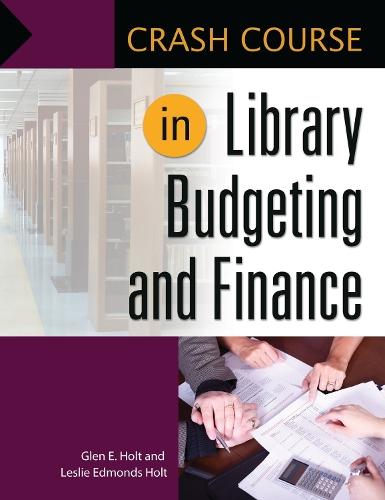
Crash Course in Library Budgeting and Finance

Author:   Leslie Edmonds Holt ,  Leslie Edmonds Holt
Publisher:   Bloomsbury Publishing Plc
ISBN:  

9781440834745


Pages:   218
Publication Date:   22 August 2016
Recommended Age:   From 7 to 17 years
Format:   Paperback
Availability:   Manufactured on demand   Availability explained
We will order this item for you from a manufactured on demand supplier.

Our Price $69.00 Quantity:  
Add to Cart

Share |

Crash Course in Library Budgeting and Finance


Overview

Concise, informative, and well-indexed, this book helps readers get the ""big picture"" as well as the considerable number of details involved in managing the finances for a library. For all libraries, money is critical to decision-making about technology, staffing, and collections. As a result, informed budgeting is critically important for any library to succeed. This book explains library finance in a practical, engaging way, using examples of real situations in different types of libraries to teach key points. Written by authors with years of experience in budgeting and financial planning within a variety of library settings and in teaching library management or fundraising at the university level, Crash Course in Library Budgeting and Finance makes it painless to learn how to properly manage money in any library environment. The book addresses the entire process of financial planning, from a general, conceptual overview of library budgeting to the details of generating and spending income, and describes best practices for implementing financial controls. Subjects covered include building construction and capital projects, fund raising, capital campaigns, moving to fee-based services, extending and developing earned income, financial best practices, and assessment and evaluation. The authors also make recommendations regarding when and how to share relevant financial information throughout the organization and with constituents throughout the book.

Full Product Details

Author:   Leslie Edmonds Holt ,  Leslie Edmonds Holt
Publisher:   Bloomsbury Publishing Plc
Imprint:   Libraries Unlimited Inc
Dimensions:   Width: 21.60cm , Height: 1.80cm , Length: 27.90cm
Weight:   0.680kg
ISBN:  

9781440834745


ISBN 10:   1440834741
Pages:   218
Publication Date:   22 August 2016
Recommended Age:   From 7 to 17 years
Audience:   Professional and scholarly ,  College/higher education ,  Professional & Vocational ,  Tertiary & Higher Education
Format:   Paperback
Publisher's Status:   Active
Availability:   Manufactured on demand   Availability explained
We will order this item for you from a manufactured on demand supplier.

Table of Contents

Illustrations Section I: Introduction Chapter 1—Introduction to Library Money What Are Your Professional Goals? Adaptation Always Involves Financial Change—and Money Action Issue Focus Making Money the Library's Servant Connect Accounting Language to Library Finance and Work Chapter 2—Financial Literacy in the United States American Money Knowledge Limited Knowledge of Financial Issues Chapter 3—Financial Aliteracy of Librarians What Librarians Say They Don't Know about Finance Librarian Scholars Agree with These Self-Perceptions Why Librarians Need to Be Financially Literate Dearth in Financial Training for Librarians Chapter 4—The National Economy and Library Continuity Library Development, 1929–1960s Federal Grants for Libraries New Funding: Gates Foundation Grants and E-Rate Public Library Inquiry Demand for Evaluation (Measurable Outcomes) Continuity in Library Finances Section II: Building Financial Infrastructure for Your Library Chapter 5—Electronic Communications: How Computers Are Changing Library Finance Paper and Computers Records Management Agile Computing in Library Finance Chapter 6—Legal Context: Basic Rules You Need to Know Federal Income Tax Status IRS 501 (C)(3) Internal Revenue Service Classification IRS 509 Classification Form 990A Government Accounting Standards Board Financial Accounting Standards Board Accountability Chapter 7—Professional Advice Accountant Legal Counsel Auditor Insurance Agent Fundraising/Communications Consultant Investments/Income Management Real Estate Agent Construction Establish an Appropriate Banking Relationship Section III: Strategic Financial Planning Chapter 8—Annual Report as a Starting Point Where to Begin Financial Planning? Elements of the Good Annual Report Chapter 9—Purpose Documents as a Starting Point for Financial Planning Vision Statement Mission Statements and Taglines Section IV: Budget Basics Chapter 10—Budget Planning Types of Budgets Chapter 11—Basic Library Budget Language What's Different about Library Budgets Double-Entry Bookkeeping—Chart of Accounts Budget Categories Budget Is an Authorization Document Budget Examples Capital Improvement Budget Debt Service Fund Financial Terms Section V: Income Chapter 12—Shifts in Library Service Demands and Income What Americans Want from Libraries Public Funding Has Not Kept Up with Library Service Possibilities Chapter 13—Primary Sources of Income Chapter 14—Ways to Increase Funding Budget Adjustments Gaining or Protecting the Library's Tax-Exempt Status Increase Revenue by Passing a Referendum Legislative Action/Government Grants Foundation Grants Chapter 15—Fundraising Why People Give Fundraising Tips An Example of a Donor Request Chapter 16—Other Sources of Donations Partnerships with Other Agencies Planned Giving Endowments Chapter 17—Earned Income Charging for Library Service Earned Income—Examples Earned Income Issues Section VI: Spending and Expenses Chapter 18—Dispelling Financial Mythologies Commonplace Financial Mythologies Other Examples of Financial Mythbusting The Bottom Line Chapter 19—Purchasing: Your Part in Spending Library Funds Purchasing Controls Insurance Liability, Directors, and Officers Insurance Practical Application of Spending Policies Summing Up Your Responsibilities: Help Legitimate Library Expenditures Chapter 20—Staff Costs All Libraries Are Staff Intensive Library Staffing Is Changing Dramatically and Will Require More Sophisticated Accounting to Control Costs Wages and Benefits Types of Compensation Items in Library Payroll Records 1099 Information Return Requirements The Importance of Payroll Records Payroll Audit of a Public Library Library Labor Unions School Librarians and Media Specialists: Special Financial Problems Budget Tools for Controlling Staff Costs Training Costs Staffing Patterns Are Changing Dramatically Controlling Staff Expenses Chapter 21—Capital Expenses Financial Management of Library Construction Americans with Disabilities Act Standards for Accessible Design Green Leadership in Energy or Environmental Design Certified Libraries Rules for Success in Capital Improvements and the Construction Zone Chapter 22—Acquisition of Materials Vendors Library Expenditures by Type Costs Chapter 23—Other Expenses Special Projects Endowments and Bequests The Mobile Library Fleet Real Estate Short Term Security Banking/Money Management Building Maintenance and Cleaning Services Computers and Information Systems Employee Funds Contract Services Section VII: Assessment and Evaluation Chapter 24—Evaluating the Budget In-House Budget Evaluation The Audit Economic Measures of Library Success Outcome Measurement Evaluation Implementation Conclusion Section VIII: Communication about Money Chapter 25—Communicating Library Financial Principles The Library Is Accountable The Library Operates Using Professional Accounting Standards The Library Budget Is Not Mysterious But Public Library Income and Spending Reported at Scheduled Times Libraries Operate Financially within Public Laws and Policies, Including the Annual Audit The Library Invests Money within a Public Investment Policy Conflict of Interest Policy The Library Practices Ethical Hiring and Promotion Policies within the Context of Affirmative Action Laws Public Lobbying Is Legal and Appropriate for Library Officials Your Library Adds Value Use Images to Help Users and Supporters See the Library in New Ways Use Electronic Communication to Relate to Library Users and Supporters Glossary Selected Bibliography Index

Reviews

This title is very broad in scope and will be an excellent resource for neophytes on rigorous accounting and finance issues. It will be most useful as a resource for smaller libraries where library staff are called on to deal with the nitty-gritty details. This will also be useful to librarians looking to prepare themselves for management and director positions. - VOYA


Author Information

Glen E. Holt, PhD, consults as a policymaking and planning consultant for historical societies, foundations, libraries, museums, and private-sector companies. Leslie Edmonds Holt, PhD, is president and CEO of Holt Consulting.

Tab Content 6

Author Website:  

Countries Available

All regions
Latest Reading Guide

NOV RG 20252


Shopping Cart
Your cart is empty
Shopping cart
Mailing List