Overview
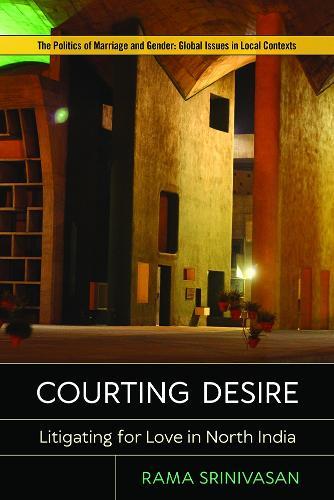
Inquiries into marital patterns can serve as an effective lens to analyze social structures and material cultures not only on the question of sexuality, but also on the nature of a private citizen's engagement with state and law. Through ethnographic research in courtrooms, community,and kinship spaces, the author outlines the transformations in material culture and political economy that have led to renewed negotiations on the institution of marriage in North India, especially in legal spaces. Tracing organically evolving notions of sexual consent and legal subjectivity, Courting Desire underlines how non-normative decisions regarding marriage become possible in a region otherwise known for high instances of honor killings and rigid kinship structures. Aspirations for consensual relationships have led to a tentative attempt to forge relationships that are non-normative but grudgingly approved after state intervention. The book traces this nascent and under-explored trend in the North Indian landscape.
Full Product Details
Author: Rama Srinivasan ,
Alissa Zarro
Publisher: Rutgers University Press
Imprint: Rutgers University Press
Dimensions:
Width: 15.20cm
, Height: 1.50cm
, Length: 22.90cm
Weight: 0.286kg
ISBN: 9781978803534
ISBN 10: 1978803532
Pages: 216
Publication Date: 17 January 2020
Recommended Age: From 18 to 99 years
Audience:
College/higher education
,
College/higher education
,
Professional and scholarly
,
Tertiary & Higher Education
,
Tertiary & Higher Education
Format: Paperback
Publisher's Status: Active
Availability: In Print

This item will be ordered in for you from one of our suppliers. Upon receipt, we will promptly dispatch it out to you. For in store availability, please contact us.
Reviews
With captivating stories of love and elopement, Rama Srinivasan offers readers a refreshing new view of shifting paradigms on marriage and consent in North India. While elopement challenges both patriarchy and kinship, the courtroom offers young couples a legal validity and a new sense of personhood. This richly woven account mixes the interplay of changing gender roles, political economies, Bollywood films, and the democratic state for a delightful, intimate read into modern India. --Erin Patrice Moore author of Gender, Law, and Resistance in India Courting Desire offers an unusual mix of ethnographic perspectives, exploring the pursuit of love and the critical role played by legal institutions in changing times. Srinivasan presents a rich canvas of messy human realities, while making a persuasive argument for the stable yet transformative value of law. --Ann Grodzins Gold author of Listening to the Heron's Words: Reimaging Gender and Kinship in North India
“Courting Desire offers an unusual mix of ethnographic perspectives, exploring the pursuit of love and the critical role played by legal institutions in changing times. Srinivasan presents a rich canvas of messy human realities, while making a persuasive argument for the stable yet transformative value of law.” “With captivating stories of love and elopement, Rama Srinivasan offers readers a refreshing new view of shifting paradigms on marriage and consent in North India. While elopement challenges both patriarchy and kinship, the courtroom offers young couples a legal validity and a new sense of personhood. This richly woven account mixes the interplay of changing gender roles, political economies, Bollywood films, and the democratic state for a delightful, intimate read into modern India.”
“Courting Desire offers an unusual mix of ethnographic perspectives, exploring the pursuit of love and the critical role played by legal institutions in changing times. Srinivasan presents a rich canvas of messy human realities, while making a persuasive argument for the stable yet transformative value of law.”— Ann Grodzins Gold, author of Listening to the Heron's Words: Reimaging Gender and Kinship in North India “With captivating stories of love and elopement, Rama Srinivasan offers readers a refreshing new view of shifting paradigms on marriage and consent in North India. While elopement challenges both patriarchy and kinship, the courtroom offers young couples a legal validity and a new sense of personhood. This richly woven account mixes the interplay of changing gender roles, political economies, Bollywood films, and the democratic state for a delightful, intimate read into modern India.”— Erin Patrice Moore, author of Gender, Law, and Resistance in India New Books Network: New Books in Gender interview with Rama Srinivasan— New Books Network: New Books in Gender “Courting Desire offers an unusual mix of ethnographic perspectives, exploring the pursuit of love and the critical role played by legal institutions in changing times. Srinivasan presents a rich canvas of messy human realities, while making a persuasive argument for the stable yet transformative value of law.”— Ann Grodzins Gold, author of Listening to the Heron's Words: Reimaging Gender and Kinship in North India New Books Network: New Books in Gender interview with Rama Srinivasan— New Books Network: New Books in Gender “With captivating stories of love and elopement, Rama Srinivasan offers readers a refreshing new view of shifting paradigms on marriage and consent in North India. While elopement challenges both patriarchy and kinship, the courtroom offers young couples a legal validity and a new sense of personhood. This richly woven account mixes the interplay of changing gender roles, political economies, Bollywood films, and the democratic state for a delightful, intimate read into modern India.”— Erin Patrice Moore, author of Gender, Law, and Resistance in India
Author Information
RAMA SRINIVASAN holds a PhD in Anthropology from Brown University in Providence, Rhode Island and currently pens articles on gender and sexuality, politics, cinema and popular culture, law and society, and immigration and diaspora issues. She lives in Frankfurt, Germany. From May 2020, she will be a Marie Skłodowska-Curie Fellow at the Department of Asian and North African Studies, Ca' Foscari University of Venice.