Overview
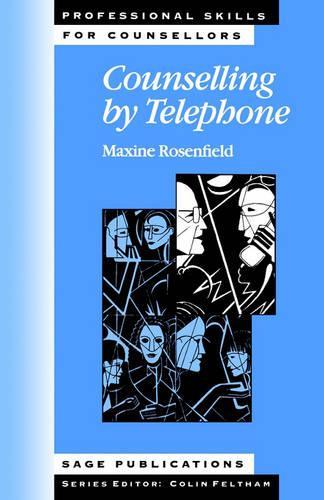
Most counsellors use the telephone to interact with clients to some degree. The potential client base which can be reached in telephone counselling is significant, and the rapid development in telecommunication technology is having a dramatic impact on the development of counselling provision. This volume explores the skills needed to carry out effective telephone counselling - such as welcoming and establishing a relationship with the client, listening and responding, understanding silences, working with transference and fantasy, and recognizing and reacting to feelings - which are necessarily very often distinct from those involved in face-to-face counselling. The book challenges the view that telephone counselling is a poor relation to face-to-face counselling, arguing that for certain clients it may in fact be the therapeutic medium of choice.
Full Product Details
Author: Maxine Rosenfield
Publisher: SAGE Publications Inc
Imprint: SAGE Publications Inc
Volume: v. 3
Dimensions:
Width: 12.90cm
, Height: 1.10cm
, Length: 19.80cm
Weight: 0.190kg
ISBN: 9780803979994
ISBN 10: 0803979991
Pages: 160
Publication Date: 25 November 1996
Audience:
Professional and scholarly
,
Professional & Vocational
Format: Paperback
Publisher's Status: Active
Availability: In Print

This item will be ordered in for you from one of our suppliers. Upon receipt, we will promptly dispatch it out to you. For in store availability, please contact us.
Reviews
'Well written, well researched... [the book] contributes to undermining ideas of professional hierarchy, in which long-term face-to-face is top of the pile, and short-term and the phone are the province of the amateur who knows not what they are up to. On the contrary, the counselling process as well as the use of counselling skills are resources that can be much more widely used than is possible if they are restricted to relatively long-term counselling. This is an excellent book covering a great deal of recent thinking about confidentiality, skills, training, quality and supervision in relation to the telephone [with] a useful chapter on its technology in relation to counselling' - Counselling and Psychotherapy, The Journal of the British Association for Counselling and Psychotherapy 'This book breaks new ground by focusing attention on the potential of the telephone as a medium for counselling. It acknowledges that many counsellors have been reluctant to embrace the potential of telephone counselling. Until recently, this reluctance has been endorsed by the counselling and therapeutic authorities. But the British Association for Counselling has now given telephone counselling recognition... The book [is] aimed at two potential groups of readers. First, it is a call for the counselling establishment to acknowledge that the forms of human communication available to counsellors are now many and varied, and that face-to-face contact is not always necessary, possible or appropriate... The second group of potential readers is individuals and agencies already committed to telephone counselling. The book will enable them to address issues of training, supervision, quality control and skills as well as theory... This is a valuable book that deserves to be read by those who are sceptical about telephone counselling as well as those who are convinced about its importance. Rosenfield has ensured through its publication that telephone counselling will be an unavoidable item on the agenda of counselling authorities' - British Journal of Guidance and Counselling 'Well written, well researched... [the book] contributes to undermining ideas of professional hierarchy, in which long-term face-to-face is top of the pile, and short-term and the phone are the province of the amateur who knows not what they are up to. On the contrary, the counselling process as well as the use of counselling skills are resources that can be much more widely used than is possible if they are restricted to relatively long-term counselling. This is an excellent book covering a great deal of recent thinking about confidentiality, skills, training, quality and supervision in relation to the telephone [with] a useful chapter on its technology in relation to counselling' - Counselling and Psychotherapy, The Journal of the British Association for Counselling and Psychotherapy 'This book breaks new ground by focusing attention on the potential of the telephone as a medium for counselling. It acknowledges that many counsellors have been reluctant to embrace the potential of telephone counselling. Until recently, this reluctance has been endorsed by the counselling and therapeutic authorities. But the British Association for Counselling has now given telephone counselling recognition... The book [is] aimed at two potential groups of readers. First, it is a call for the counselling establishment to acknowledge that the forms of human communication available to counsellors are now many and varied, and that face-to-face contact is not always necessary, possible or appropriate... The second group of potential readers is individuals and agencies already committed to telephone counselling. The book will enable them to address issues of training, supervision, quality control and skills as well as theory... This is a valuable book that deserves to be read by those who are sceptical about telephone counselling as well as those who are convinced about its importance. Rosenfield has ensured through its publication that telephone counselling will be an unavoidable item on the agenda of counselling authorities' - British Journal of Guidance and Counselling
'Well written, well researched... [the book] contributes to undermining ideas of professional hierarchy, in which long-term face-to-face is top of the pile, and short-term and the phone are the province of the amateur who knows not what they are up to. On the contrary, the counselling process as well as the use of counselling skills are resources that can be much more widely used than is possible if they are restricted to relatively long-term counselling. This is an excellent book covering a great deal of recent thinking about confidentiality, skills, training, quality and supervision in relation to the telephone [with] a useful chapter on its technology in relation to counselling' - Counselling and Psychotherapy, The Journal of the British Association for Counselling and Psychotherapy 'This book breaks new ground by focusing attention on the potential of the telephone as a medium for counselling. It acknowledges that many counsellors have been reluctant to embrace the potential of telephone counselling. Until recently, this reluctance has been endorsed by the counselling and therapeutic authorities. But the British Association for Counselling has now given telephone counselling recognition... The book [is] aimed at two potential groups of readers. First, it is a call for the counselling establishment to acknowledge that the forms of human communication available to counsellors are now many and varied, and that face-to-face contact is not always necessary, possible or appropriate... The second group of potential readers is individuals and agencies already committed to telephone counselling. The book will enable them to address issues of training, supervision, quality control and skills as well as theory... This is a valuable book that deserves to be read by those who are sceptical about telephone counselling as well as those who are convinced about its importance. Rosenfield has ensured through its publication that telephone counselling will be an unavoidable item on the agenda of counselling authorities' - British Journal of Guidance and Counselling
'Well written, well researched... [the book] contributes to undermining ideas of professional hierarchy, in which long-term face-to-face is top of the pile, and short-term and the phone are the province of the amateur who knows not what they are up to. On the contrary, the counselling process as well as the use of counselling skills are resources that can be much more widely used than is possible if they are restricted to relatively long-term counselling. This is an excellent book covering a great deal of recent thinking about confidentiality, skills, training, quality and supervision in relation to the telephone [with] a useful chapter on its technology in relation to counselling' - Counselling and Psychotherapy, The Journal of the British Association for Counselling and Psychotherapy 'This book breaks new ground by focusing attention on the potential of the telephone as a medium for counselling. It acknowledges that many counsellors have been reluctant to embrace the potential of telephone counselling. Until recently, this reluctance has been endorsed by the counselling and therapeutic authorities. But the British Association for Counselling has now given telephone counselling recognition... The book [is] aimed at two potential groups of readers. First, it is a call for the counselling establishment to acknowledge that the forms of human communication available to counsellors are now many and varied, and that face-to-face contact is not always necessary, possible or appropriate... The second group of potential readers is individuals and agencies already committed to telephone counselling. The book will enable them to address issues of training, supervision, quality control and skills as well as theory... This is a valuable book that deserves to be read by those who are sceptical about telephone counselling as well as those who are convinced about its importance. Rosenfield has ensured through its publication that telephone counselling will be an unavoidable item on the agenda of counselling authorities' - British Journal of Guidance and Counselling
Author Information
Maxine Rosenfield is an experienced counsellor and writer. She is currently managing the Telephone Training and Consultancy Service for the charity Broadcasting Support Services (BBS) and is Chair of the Telephone Helplines Association.