Overview
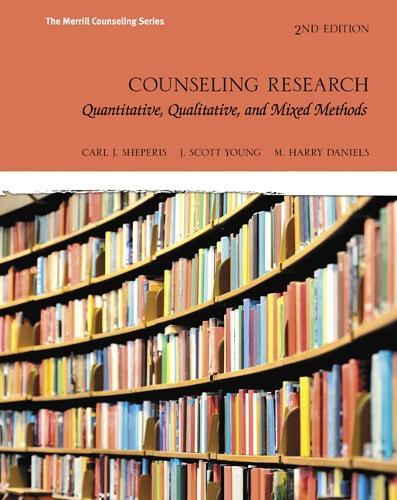
For courses in Research in Counselling. The text introduces reader to the basics of how to do research, from formulating a problem, doing a literature review, selecting a design, collecting and analysing data, through reporting results. It also provides readers with the information they need to become intelligent consumers of published research. Covering a broad range of quantitative, qualitative, and mixed methods designs, as well as action research and program evaluation, the text presents the most common types of research used in the field of counselling.
Full Product Details
Author: Carl Sheperis ,
J. Young ,
M. Daniels ,
M. Daniels
Publisher: Pearson Education (US)
Imprint: Pearson
Edition: 2nd edition
Dimensions:
Width: 20.80cm
, Height: 1.90cm
, Length: 26.10cm
Weight: 0.900kg
ISBN: 9780134025094
ISBN 10: 0134025091
Pages: 432
Publication Date: 03 March 2016
Audience:
College/higher education
,
Postgraduate, Research & Scholarly
Replaced By: 9780137848881
Format: Hardback
Publisher's Status: Active
Availability: Out of stock

The supplier is temporarily out of stock of this item. It will be ordered for you on backorder and shipped when it becomes available.
Reviews
From reviews of the text: “The content is strong and clearly explained. . . . This is the best [counseling research text] I have seen.” —Monica Osburn, UNC-Pembroke and Webster “The writing style is one of the best features of this text. The authors do a phenomenal job at describing research methods at a level that will appeal to counselling students. —Angela Sikorski, Texas A&M University, Texarkana “I feel [the writing] is a strength of the text. The majority of my students report it is easy to follow and understand, even those with limited research knowledge. . . . I have been using this text for the last two years and have found it the most effective in teaching students counseling research. The reasons for this, is it is not written above their current level of understanding and it does give applicable examples to the counseling profession. So often I find counseling students viewing research methods courses as courses they must just ‘get through’ and not ones that will help them in their future careers. This book . . . does help students understand how this knowledge can benefit them in their future practice. —Ryan Melton, Portland State University “Strengths [include that it is] easy for students to understand; relates to the counseling profession; [and] contains examples of counseling-related research studies.” —Dr. Judy Shipp, University of Illinois, Springfield “The book is very clear and concise, and it is an easy text for the students to understand. The many examples used throughout the text and sample paper are great resources for the students. . . . It is relevant to counseling students, it has information required by CACREP, and it is a comprehensive research textbook that is easy for students to follow. The examples given are superb and help students achieve course objectives.” —Lakitta D. Johnson, Jackson State University
From reviews of the text: The content is strong and clearly explained... This is the best [counseling research text] I have seen. -Monica Osburn, UNC-Pembroke and Webster The writing style is one of the best features of this text. The authors do a phenomenal job at describing research methods at a level that will appeal to counselling students. -Angela Sikorski, Texas A&M University, Texarkana I feel [the writing] is a strength of the text. The majority of my students report it is easy to follow and understand, even those with limited research knowledge... I have been using this text for the last two years and have found it the most effective in teaching students counseling research. The reasons for this, is it is not written above their current level of understanding and it does give applicable examples to the counseling profession. So often I find counseling students viewing research methods courses as courses they must just 'get through' and not ones that will help them in their future careers. This book ... does help students understand how this knowledge can benefit them in their future practice. -Ryan Melton, Portland State University Strengths [include that it is] easy for students to understand; relates to the counseling profession; [and] contains examples of counseling-related research studies. -Dr. Judy Shipp, University of Illinois, Springfield The book is very clear and concise, and it is an easy text for the students to understand. The many examples used throughout the text and sample paper are great resources for the students... It is relevant to counseling students, it has information required by CACREP, and it is a comprehensive research textbook that is easy for students to follow. The examples given are superb and help students achieve course objectives. -Lakitta D. Johnson, Jackson State University
Author Information
Dr. Carl J. Sheperis, PhD, NCC, LPC, ACS, is chair of the Counseling and Special Populations Department at Lamar University. He has more than 25 years of clinical experience in the assessment and treatment of behavioural disorders and psychopathology in infancy and childhood. Dr. Sheperis teaches graduate courses in assessment, research, and statistics. Dr. Sheperis has received numerous awards for his work. He is the author of several textbooks on mental health counseling, assessment, child and adolescent issues, online counselor education, and violence prevention. He currently serves as a member of the Board of Directors for the National Board for Certified Counselors. J. Scott Young is the chair of the Department of Counseling and Educational Development at the University of North Carolina at Greensboro. Dr. Young believes that to be an effective educator of counsellors one must also be an effective practitioner. Subsequently he has been a practicing counsellor and clinical supervisor for over 20 years. Dr. Young is interested in understanding the processes people use to make meaning of their lives and in particular the role that spirituality and religion play in the practice of effective counseling. To this end, he has published numerous articles related to the interface of counseling and spirituality and is the coauthor of Spirituality and Religion in Counseling: A Guide to Competent Practice. Dr. M. Harry Daniels is professor emeritus and former chair of the Department of Counselor Education at the University of Florida. Dr. Daniels uses the scientist-practitioner model as a guide, believing that counsellor educators need to be skilled in both domains. Within this framework, he is interested in knowing how people construct their reality, particularly through the use of imaginative language, and the strategies that they use to regulate their emotional responses to life events. Dr. Daniels is specifically interested in the strategies parents and teachers use to influence children's emotion regulation abilities.