Overview
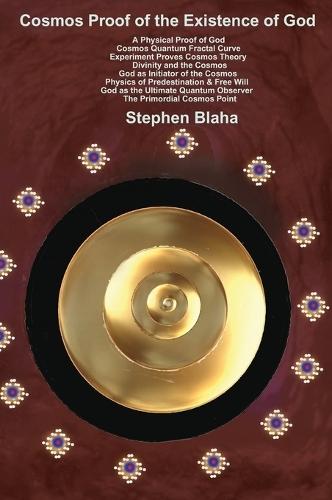
Thomas Aquinas gave two proofs of the existence of God based on Aristotelian Logic. This book presents a proof based on the Physical considerations of Cosmos Theory. It begins with an outline of Cosmos Theory structure and its substantial verification based on known Physics Experiment results in our universe. The book shows Cosmos Theory has a strong experimental basis in known Particle Physics. This basis follows directly from the features of Cosmos Theory. Therefore, despite the view of some that one cannot prove that Cosmos Theory describes known Physics, the book shows a direct connection to known Physical results including the Standard Model of Particles. For our universe, the known results include: the numeric values of all known coupling constants, the set of internal symmetries - the Strong interactions and the ElectroWeak interactions as well as General Relativity, the spectrum of the known fundamental fermions and quark and lepton masses, and, most importantly, the structuring of the internal symmetries and fermion masses into sequences. In addition the parameter n of a Yang-Mills SU(n) is shown to fully determine the corresponding coupling constant for a universe of any dimensions. Similarly the ElectroWeak Weinberg angle is also determined by Cosmos Theory. These features are enhanced by the additional proposed interactions and fermions of the Unified SuperStandard Theory including fermion strata and fermion gambols. Cosmos Theory has spaces that describe other possible universes of 4 or more dimensions. These universes have analogous features. All Physics calculations in these universes are finite - no infinities - due to the author's Two Tier form of Quantum Theory. This book considers features of Parent and child universes such as mass and energy. The book describes the primordial point from which Cosmos Theory springs. Is there anything before the primordial point? The book shows that any proposed prior ""space"" or ""universe"" only leads to an unnecessary eternal recurrence of past ""Cosmoses."" From where does the primordial point arise? The only viable solution is the existence of an Ultimate Quantum Observer and creator: God. This solution eliminates the paradox of the Schrödinger Cat. If no visible observer is present, then God determines the aliveness of the cat. No paradox. So much also for ""One Hand Clapping"" paradoxes. The Cosmos evolves from the primordial point in a manner the author described in previous work and presents here. The book describes aspects of God's Physical roles. In particular it shows that the primeval Cosmos component, the Cosmos Fractal Curve, can be Quantum only because the ultimate Observer is present. The Cosmos Quantum Fractal Curve is derived in detail. This book desiccates the Cosmos components one by one. Realizing that no time exists, it proceeds to couple them instantaneously under the umbrella of the Ultimate Observer. When? Endlessly. It supports the view that the Deity is present in all things and all spaces and times - based on a Physics perspective, The aspects of God's interaction with Reality are described using the author's suggestion that Reality can be ""tweaked"" in such a manner as to conform with Physics Laws, which, after all, He formulated - and yet still accomplish God's work.
Full Product Details
Author: Stephen Blaha
Publisher: Blaha Research
Imprint: Blaha Research
Dimensions:
Width: 17.80cm
, Height: 1.00cm
, Length: 25.40cm
Weight: 0.404kg
ISBN: 9798998607189
Pages: 76
Publication Date: 11 February 2026
Audience:
General/trade
,
General
Format: Hardback
Publisher's Status: Active
Availability: Available To Order

We have confirmation that this item is in stock with the supplier. It will be ordered in for you and dispatched immediately.