Overview
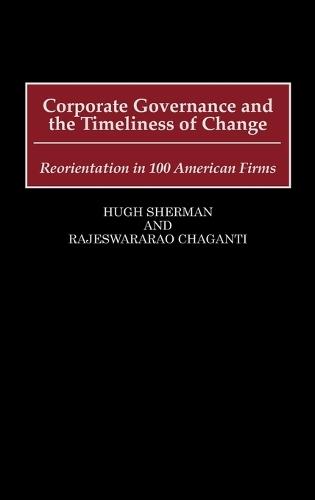
The ability to implement change quickly is crucial to an organizations's success—not only in traditionally sedate industries, but also in today's fast-moving hi-tech ones. Sherman and Chaganti, from their study of 100 American corporations, half in stable industries, half in volatile ones, find that a firm's structure of governance bears heavily on the speed with which the firm can reorient itself. What are the characteristics of firms that change quickly? What inhibits others? And what, precisely, is the impact of a firm's stockholders, board and top management on its ability to adapt? Sherman and Chaganti provide answers to these and other questions, in the first book yet to focus entirely on the determinants of time in corporate reorientations. In order for a firm to develop or sustain a competitive advantage, it must not only adapt correctly to environmental change, but also adapt quickly. This study examines the factors associated with the time a firm takes to initiate reorientation. The results of the research indicate that even in relatively large organizations, reorientations are not rare and occur routinely. Further, deterioration of a firm's financial condition tends to hasten its initiation of reorientation. However, the determinants of time taken to initiate reorientation differ in firms with relatively high prior performance and firms with relatively low prior performance.
Full Product Details
Author: Rajeswarar S. Chaganti ,
Hugh D. Sherman
Publisher: Bloomsbury Publishing Plc
Imprint: Praeger Publishers Inc
Dimensions:
Width: 15.20cm
, Height: 1.40cm
, Length: 22.90cm
Weight: 0.429kg
ISBN: 9781567200874
ISBN 10: 1567200877
Pages: 176
Publication Date: 27 August 1998
Recommended Age: From 7 to 17 years
Audience:
College/higher education
,
Professional and scholarly
,
Undergraduate
,
Postgraduate, Research & Scholarly
Format: Hardback
Publisher's Status: Active
Availability: Manufactured on demand

We will order this item for you from a manufactured on demand supplier.
Reviews
?In this well-written volume, Sherman(Ohio Univ.) and Chaganti (Temple Univ.) examine the changing corporate governance system during the 1980's and early 1990's by studying corporate restructuring in 100 American firms. They successfully explain why some corporations were able to iniate restructuring quickly while others took years to respond. Business students and praticing managers have much to learn from this study because restructuring is a complex process and the current literature that deals with major corporate change is not covered in most textbooks. Upper division undergraduate through professional.?-Choice
"?In this well-written volume, Sherman(Ohio Univ.) and Chaganti (Temple Univ.) examine the changing corporate governance system during the 1980's and early 1990's by studying corporate restructuring in 100 American firms. They successfully explain why some corporations were able to iniate restructuring quickly while others took years to respond. Business students and praticing managers have much to learn from this study because restructuring is a complex process and the current literature that deals with major corporate change is not covered in most textbooks. Upper division undergraduate through professional.?-Choice ""In this well-written volume, Sherman(Ohio Univ.) and Chaganti (Temple Univ.) examine the changing corporate governance system during the 1980's and early 1990's by studying corporate restructuring in 100 American firms. They successfully explain why some corporations were able to iniate restructuring quickly while others took years to respond. Business students and praticing managers have much to learn from this study because restructuring is a complex process and the current literature that deals with major corporate change is not covered in most textbooks. Upper division undergraduate through professional.""-Choice"
Author Information
HUGH SHERMAN is Assistant Professor in the College of Business, Ohio University, where he specializes in strategic management, international business, and entrepreneurship. He has just completed a national study for the U.S. Department of Commerce investigating the impact of business incubators on local communities. Sherman has extensive executive experience in the United State and Europe and is a noted lecturer in executive development programs in Southeast Asia. RAJESWARARAO CHAGANTI is Professor and Chair of the General and Strategic Management Department, School of Business and Management, Temple University. Executive Director of Temple's Institute of Global Management Studies, Chaganti teaches in the areas of strategic management and entrepreneurship and publishes widely in the journals of his fields. He is coauthor of High Performance Management Strategies for Entrpreneurial Companies: Research Findings from Over 500 Firms (Quorum, 1991).