|
|
|||
|
||||
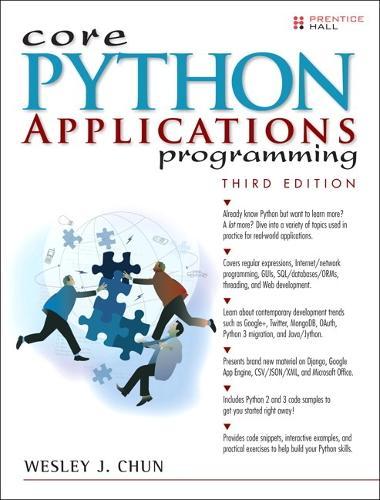
OverviewPython is an agile, robust, and expressive programming language that continues to build momentum. It combines the power of compiled languages with the simplicity and rapid development of scripting languages. In Core Python Applications Programming, Third Edition, leading Python developer and corporate trainer Wesley Chun helps you take your Python knowledge to the next level. This book has everything you need to become a versatile Python developer. You will be introduced to multiple areas of application development and gain knowledge that can be immediately applied to projects, and you will find code samples in both Python 2 and 3, including migration tips if that’s on your roadmap too. Some snippets will even run unmodified on 2.x or 3.x. Full Product DetailsAuthor: Wesley J ChunPublisher: Pearson Education (US) Imprint: Prentice Hall Edition: 3rd edition Dimensions: Width: 18.00cm , Height: 2.70cm , Length: 23.40cm Weight: 1.090kg ISBN: 9780132678209ISBN 10: 0132678209 Pages: 888 Publication Date: 29 March 2012 Audience: Professional and scholarly , Professional & Vocational Format: Paperback Publisher's Status: Out of Print Availability: Awaiting stock Table of ContentsPart I: General Application Topics Chapter 1: Regular Expressions 1.1 Introduction/Motivation 1.2 Special Symbols and Characters 1.3 Regexes and Python 1.4 Some Regex Examples 1.5 A Longer Regex Example 1.6 Exercises Chapter 2: Network Programming 2.1 Introduction 2.2 What Is Client/Server Architecture? 2.3 Sockets: Communication Endpoints 2.4 Network Programming in Python 2.5 The SocketServer Module 2.6 Introduction to the Twisted Framework 2.7 Related Modules 2.8 Exercises Chapter 3: Internet Client Programming 3.1 What Are Internet Clients? 3.2 Transferring Files 3.3 Network News 3.4 E-Mail 3.5 Related Modules 3.6 Exercises Chapter 4: Multithreaded Programming 4.1 Introduction/Motivation 4.2 Threads and Processes 4.3 -Threads and Python 4.4 The thread Module 4.5 The threading Module 4.6 Comparing Single vs. Multithreaded Execution 4.7 Multithreading in Practice 4.8 Producer-Consumer Problem and the Queue/queue Module 4.9 Alternative Considerations to Threads 4.10 Related Modules 4.11 Exercises Chapter 5: GUI Programming 5.1 Introduction 5.2 Tkinter and Python Programming 5.3 Tkinter Examples 5.4 A Brief Tour of Other GUIs 5.5 Related Modules and Other GUIs 5.6 Exercises Chapter 6: Database Programming 6.1 Introduction 6.2 The Python DB-API 6.3 ORMs 6.4 Non-Relational Databases 6.5 Related References 6.6 Exercises Chapter 7: Programming Microsoft Office 7.1 Introduction 7.2 COM Client Programming with Python 7.3 Introductory Examples 7.4 Intermediate Examples 7.5 Related Modules/Packages 7.6 Exercises Chapter 8: Extending Python 8.1 Introduction/Motivation 8.2 Extending Python by Writing Extensions 8.3 Related Topics 8.4 Exercises Part II: Web Development Chapter 9: Web Clients and Servers 9.1 Introduction 9.2 Python Web Client Tools 9.3 Web Clients 9.4 Web (HTTP) Servers 9.5 Related Modules 9.6 Exercises Chapter 10: Web Programming: CGI and WSGI 10.1 Introduction 10.2 Helping Web Servers Process Client Data 10.3 Building CGI Applications 10.4 Using Unicode with CGI 10.5 Advanced CGI 10.6 Introduction to WSGI 10.7 Real-World Web Development 10.8 Related Modules 10.9 Exercises Chapter 11: Web Frameworks: Django 11.1 Introduction 11.2 Web Frameworks 11.3 Introduction to Django 11.4 Projects and Apps 11.5 Your Hello World Application (A Blog) 11.6 Creating a Model to Add Database Service 11.7 The Python Application Shell 11.8 The Django Administration App 11.9 Creating the Blog's User Interface 11.10 Improving the Output 11.11 Working with User Input 11.12 Forms and Model Forms 11.13 More About Views 11.14 Look-and-Feel Improvements 11.15 Unit Testing 11.16 An Intermediate Django App: The Tweet Approver 11.17 Resources 11.18 Conclusion 11.19 Exercises Chapter 12: Cloud Computing: Google App Engine 12.1 Introduction 12.2 What Is Cloud Computing? 12.3 The Sandbox and the App Engine SDK 12.4 Choosing an App Engine Framework 12.5 Python 2.7 Support 12.6 Comparisons to Django 12.7 Morphing Hello World into a Simple Blog 12.8 Adding Memcache Service 12.9 Static Files 12.10 Adding Users Service 12.11 Remote API Shell 12.12 Lightning Round (with Python Code) 12.13 Sending Instant Messages by Using XMPP 12.14 Processing Images 12.15 Task Queues (Unscheduled Tasks) 12.16 Profiling with Appstats 12.17 The URLfetch Service 12.18 Lightning Round (without Python Code) 12.19 Vendor Lock-In 12.20 Resources 12.21 Conclusion 12.22 Exercises Chapter 13: Web Services 13.1 Introduction 13.2 The Yahoo! Finance Stock Quote Server 13.3 Microblogging with Twitter 13.4 Exercises Part III: Supplemental/Experimental Chapter 14: Text Processing 14.1 Comma-Separated Values 14.2 JavaScript Object Notation 14.3 Extensible Markup Language 14.4 References 14.5 Related Modules 14.6 Exercises Chapter 15: Miscellaneous 15.1 Jython 15.2 Google+ 15.3 Exercises Appendix A: Answers to Selected Exercises Appendix B: Reference Tables Appendix C: Python 3: The Evolution of a Programming Language Appendix D: Python 3 Migration with 2.6+ReviewsAuthor InformationWesley J. Chun is the author of the bestselling Core Python titles and the Python Fundamentals LiveLessons companion video. He is coauthor of Python Web Development with Django (withdjango.com), and has written for Linux Journal, CNET, and InformIT. In addition to being an architect and Developer Advocate at Google, he runs CyberWeb (cyberwebconsulting.com), a consulting business specializing in Python engineering and technical training. He has more than twenty-five years of programming, teaching, and writing experience, including more than a decade of Python. While at Yahoo!, he helped create Yahoo! Mail and Yahoo! People Search using Python. He holds degrees in computer science, mathematics, and music from the University of California. Tab Content 6Author Website:Countries AvailableAll regions |
||||