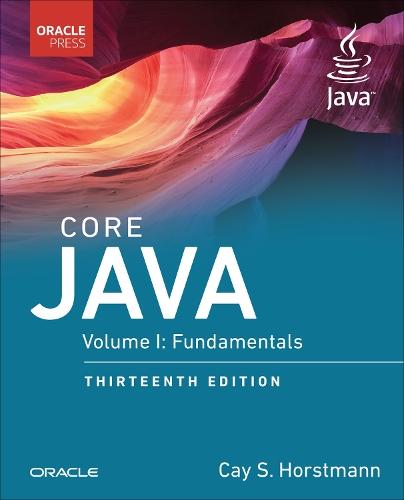
Core Java, Volume I: Fundamentals

Author:   Cay Horstmann
Publisher:   Pearson Education (US)
Edition:   13th edition
ISBN:  

9780135462461


Pages:   840
Publication Date:   06 June 2025
Format:   Paperback
Availability:   In Print   Availability explained
This item will be ordered in for you from one of our suppliers. Upon receipt, we will promptly dispatch it out to you. For in store availability, please contact us.

Our Price $186.27 Quantity:  
Add to Cart

Share |

Core Java, Volume I: Fundamentals


Overview

The Classic Guide to the Java Programming Language--Fully Updated through Java 21 Whatever version of Java you are using, Core Java, Volume I: Fundamentals, Thirteenth Edition, will help you achieve a deep and practical understanding of the language and APIs. With hundreds of realistic examples, Java Champion Cay S. Horstmann demonstrates the most powerful and effective ways to get the job done. Written for experienced programmers looking for in-depth coverage of the Java language and platform, this revised and updated edition continues to be the first choice for serious programmers. The carefully crafted sample programs demonstrate almost every language and library feature, as well as the newest capabilities introduced in Java 21. The examples are purposefully simple to focus on the major points, but, for the most part, they aren't fake and they don't cut corners. They should make good starting points for your own code. This first of two volumes offers a detailed treatment of fundamental Java programming topics, including object-oriented programming, reflection and proxies, interfaces and inner classes, exception handling, generics, collections, lambda expressions, concurrency, annotations, and the Java Platform Module System. Master foundational techniques, idioms, and best practices for writing superior Java code Leverage the power of interfaces, lambda expressions, and inner classes Take advantage of sealed class hierarchies and pattern matching for processing structured data Harden programs through effective exception handling and debugging Write safer, more reusable code with generic programming Improve performance and efficiency with Java's standard collections Explore simple programs with JShell and assemble complex programs with archives and modules Fully utilize multicore processors with Java's powerful concurrency model See Core Java, Volume II: Advanced Features, Thirteenth Edition, for coverage of Java 21 enterprise features, including detailed discussions of networking, security, internationalization, and advanced UI programming. Register your book for convenient access to downloads, updates, and/or corrections as they become available. See inside book for details.

Full Product Details

Author:   Cay Horstmann
Publisher:   Pearson Education (US)
Imprint:   Addison Wesley
Edition:   13th edition
ISBN:  

9780135462461


ISBN 10:   0135462460
Pages:   840
Publication Date:   06 June 2025
Audience:   Professional and scholarly ,  Professional & Vocational
Format:   Paperback
Publisher's Status:   Active
Availability:   In Print   Availability explained
This item will be ordered in for you from one of our suppliers. Upon receipt, we will promptly dispatch it out to you. For in store availability, please contact us.

Table of Contents

Preface xiii Acknowledgments xix Chapter 1: An Introduction to Java 1 1.1 Java as a Programming Platform 1 1.2 The Java ""White Paper"" Buzzwords 2 1.3 Java Applets and the Internet 7 1.4 A Short History of Java 8 1.5 Common Misconceptions about Java 12 Chapter 2: The Java Programming Environment 15 2.1 Installing the Java Development Kit 15 2.2 Using the Command-Line Tools 19 2.3 Using an Integrated Development Environment 24 2.4 JShell 25 Chapter 3: Fundamental Programming Structures in Java 31 3.1 A Simple Java Program 31 3.2 Comments 35 3.3 Data Types 36 3.4 Variables and Constants 43 3.5 Operators 48 3.6 Strings 59 3.7 Input and Output 76 3.8 Control Flow 85 3.9 Big Numbers 107 3.10 Arrays 110 Chapter 4: Objects and Classes 127 4.1 Introduction to Object-Oriented Programming 127 4.2 Using Predefined Classes 132 4.3 Defining Your Own Classes 142 4.4 Static Fields and Methods 157 4.5 Method Parameters 164 4.6 Object Construction 171 4.7 Records 182 4.8 Packages 188 4.9 JAR Files 200 4.10 Documentation Comments 206 4.11 Class Design Hints 214 Chapter 5: Inheritance 217 5.1 Classes, Superclasses, and Subclasses 217 5.2 Object: The Cosmic Superclass 240 5.3 Generic Array Lists 257 5.4 Object Wrappers and Autoboxing 265 5.5 Methods with a Variable Number of Arguments 270 5.6 Abstract Classes 271 5.7 Enumeration Classes 277 5.8 Sealed Classes 282 5.9 Pattern Matching 288 5.10 Reflection 296 5.11 Design Hints for Inheritance 324 Chapter 6: Interfaces, Lambda Expressions, and Inner Classes 327 6.1 Interfaces 327 6.2 Lambda Expressions 354 6.3 Inner Classes 375 6.4 Service Loaders 393 6.5 Proxies 395 Chapter 7: Exceptions, Assertions, and Logging 403 7.1 Dealing with Errors 403 7.2 Catching Exceptions 412 7.3 Tips for Using Exceptions 427 7.4 Using Assertions 431 7.5 Logging 436 7.6 Debugging Tips 452 Chapter 8: Generic Programming 459 8.1 Why Generic Programming? 459 8.2 Defining a Simple Generic Class 462 8.3 Generic Methods 464 8.4 Bounds for Type Variables 465 8.5 Generic Code and the Virtual Machine 468 8.6 Inheritance Rules for Generic Types 474 8.7 Wildcard Types 477 8.8 Restrictions and Limitations 485 8.9 Reflection and Generics 498 Chapter 9: Collections 511 9.1 The Java Collections Framework 511 9.2 Interfaces in the Collections Framework 521 9.3 Concrete Collections 525 9.4 Maps 548 9.5 Copies and Views 562 9.6 Algorithms 574 9.7 Legacy Collections 586 Chapter 10: Concurrency 599 10.1 Running Threads 599 10.2 Thread States 605 10.3 Thread Properties 608 10.4 Coordinating Tasks 618 10.5 Synchronization 635 10.6 Thread-Safe Collections 667 10.7 Asynchronous Computations 685 10.8 Processes 702 Chapter 11: Annotations 711 11.1 Using Annotations 711 11.2 Defining Annotations 717 11.3 Annotations in the Java API 720 11.4 Processing Annotations at Runtime 725 11.5 Source-Level Annotation Processing 729 11.6 Bytecode Engineering 736 Chapter 12: The Java Platform Module System 747 12.1 The Module Concept 747 12.2 Naming Modules 748 12.3 The Modular ""Hello, World!"" Program 749 12.4 Requiring Modules 751 12.5 Exporting Packages 753 12.6 Modular JARs 757 12.7 Modules and Reflective Access 759 12.8 Automatic Modules 762 12.9 The Unnamed Module 764 12.10 Command-Line Flags for Migration 765 12.11 Transitive and Static Requirements 766 12.12 Qualified Exporting and Opening 768 12.13 Service Loading 769 12.14 Tools for Working with Modules 772 Appendix 775 Index 781

Reviews

Author Information

Cay S. Horstmann is the author of Modern JavaScript for the Impatient (2020), Core Java for the Impatient, Third Edition (2022), Scala for the Impatient, Second Edition (2016), and Java SE 8 for the Really Impatient (2014), all from Addison-Wesley. He has written more than a dozen other books for professional programmers and computer science students. He is an emeritus professor of computer science at San Jose State University and a Java Champion.

Tab Content 6

Author Website:  

Countries Available

All regions
Latest Reading Guide

RGFEB26


Shopping Cart
Your cart is empty
Shopping cart
Mailing List