Overview
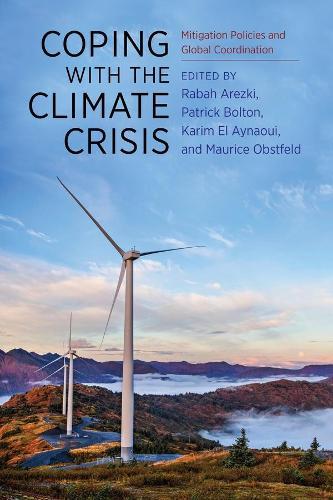
Reducing carbon emissions is the most complex political and economic problem humanity has ever confronted. Coping with the Climate Crisis brings together leading experts from academia and policy circles to explore issues related to the implementation of the COP21 Paris Agreement and the challenges of accelerating the transition toward sustainable development. The book synthesizes the key insights that emerge from the latest research in climate-change economics in an accessible and useful guide for policy makers and researchers. Contributors consider a wide range of issues, including the economic implications and realities of shifting away from fossil fuels, the role of financial markets in incentivizing development and construction of sustainable infrastructure, the challenges of evaluating the well-being of future generations, the risk associated with uncertainty surrounding the pace of climate change, and how to make climate agreements enforceable. They demonstrate the need for a carbon tax, considering the issues of efficiently pricing carbon as well as the role of supply-side policies on fossil fuels. Through a range of perspectives from academic economists and practitioners in the public and private sectors who work either at the country level or under the auspices of multilateral organizations, Coping with the Climate Crisis outlines what it will take to achieve a viable, global climate-stabilization path.
Full Product Details
Author: Rabah Arezki ,
Patrick Bolton (Columbia Business School) ,
Karim El Aynaoui ,
Maurice Obstfeld
Publisher: Columbia University Press
Imprint: Columbia University Press
ISBN: 9780231187565
ISBN 10: 0231187564
Pages: 232
Publication Date: 03 July 2018
Audience:
Professional and scholarly
,
Professional & Vocational
Format: Hardback
Publisher's Status: Active
Availability: Manufactured on demand

We will order this item for you from a manufactured on demand supplier.
Language: English
Reviews
Bringing together contributions from some of the world's foremost economic practitioners and theorists, this accessible book will be useful to both policy makers and academics wishing to understand the frontier of climate change economics and the possible future of climate policy around the globe.--Ben Groom, London School of Economics Strongly endorses it as a reference for scholars and policy makers.--Choice Whether you believe in the science or not or care about future generations or not, climate change is already affecting your welfare. Coping with the Climate Crisis demonstrates that the world is moving rapidly from identifying climate-change problems to implementing solutions. The authors articulate how our economies must evolve and our institutions strengthen in resolve and focus. A must-read for all consumers, investors, businesses, and policy makers globally--skeptical or otherwise.--Adrian Orr, governor, Reserve Bank of New Zealand, and CEO, New Zealand Superannuation Fund The Paris Agreement will only find its way into the history books if we manage to implement it. Coping with the Climate Crisis looks at precisely that topic, making the latest economic research on climate change user friendly for policy makers.--Klaas Knot, president, De Nederlandsche Bank
Bringing together contributions from some of the world's foremost economic practitioners and theorists, this accessible book will be useful to both policy makers and academics wishing to understand the frontier of climate change economics and the possible future of climate policy around the globe.--Ben Groom, London School of Economics
Bringing together contributions from some of the world's foremost economic practitioners and theorists, this accessible book will be useful to both policy makers and academics wishing to understand the frontier of climate change economics and the possible future of climate policy around the globe.--Ben Groom, London School of Economics Whether you believe in the science or not or care about future generations or not, climate change is already affecting your welfare. Coping with the Climate Crisis demonstrates that the world is moving rapidly from identifying climate-change problems to implementing solutions. The authors articulate how our economies must evolve and our institutions strengthen in resolve and focus. A must-read for all consumers, investors, businesses, and policy makers globally--skeptical or otherwise.--Adrian Orr, governor, Reserve Bank of New Zealand, and CEO, New Zealand Superannuation Fund The Paris Agreement will only find its way into the history books if we manage to implement it. Coping with the Climate Crisis looks at precisely that topic, making the latest economic research on climate change user friendly for policy makers.--Klaas Knot, president, De Nederlandsche Bank
Author Information
Rabah Arezki is the chief economist of the World Bank’s Middle East and North Africa Region and a senior fellow at Harvard’s Kennedy School of Government. He was the chief of the commodities unit in the IMF’s research department. He has written on energy, commodities, development, and international economics. Patrick Bolton is the Barbara and David Zalaznick Professor of Business at Columbia University. His books include Contract Theory (2005) and Sovereign Wealth Funds and Long-Term Investing (Columbia, 2011). Karim El Aynaoui is dean of the Faculty of Economics and Social Sciences of the Mohammed VI Polytechnic University. He is also managing director of OCP Policy Center. Maurice Obstfeld is economic counselor and director of research at the International Monetary Fund and Class of 1958 Professor of Economics at the University of California, Berkeley. He was a member of President Obama’s Council of Economic Advisers and is coauthor of International Economics (11th edition, 2018) and Foundations of International Macroeconomics (1996).