|
|
|||
|
||||
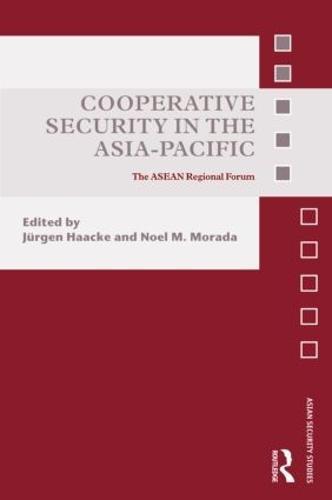
OverviewFull Product DetailsAuthor: Jürgen Haacke (London School of Economics and Political Science, University of London, UK) , Noel Morada (University of Queensland)Publisher: Taylor & Francis Ltd Imprint: Routledge Dimensions: Width: 15.60cm , Height: 1.80cm , Length: 23.40cm Weight: 0.710kg ISBN: 9780415460521ISBN 10: 0415460522 Pages: 280 Publication Date: 04 December 2009 Audience: College/higher education , Professional and scholarly , Tertiary & Higher Education , Professional & Vocational Format: Hardback Publisher's Status: Active Availability: In Print This item will be ordered in for you from one of our suppliers. Upon receipt, we will promptly dispatch it out to you. For in store availability, please contact us. Table of Contents1. The ASEAN Regional Forum and Cooperative Security: Introduction Jürgen Haacke and Noel M. Morada 2. The ASEAN Regional Forum: Origins and Evolution Noel M. Morada 3. The United States and the ASEAN Regional Forum: A Delicate Balancing Act Brad Glosserman 4. China’s Membership of the ARF and the Emergence of an East Asian Diplomatic and Security Culture Christopher R. Hughes 5. Japan and the ASEAN Regional Forum: From Enthusiasm to Disappointment Takeshi Yuzawa 6. Australia-Japan-U.S. Trilateral Strategic Dialogue and the ARF: Extended Bilateralism or A New Minilateral Option? Kuniko Ashizawa 7. The Accidental Driver: ASEAN in the ARF Rizal Sukma 8. The ASEAN Regional Forum and Transnational Challenges: Little Collective Securitization, Some Practical Cooperation Jürgen Haacke 9. The ASEAN Regional Forum and Counter-Terrorism Noel M. Morada 10. Maritime Security and the ARF: Why the Focus on Dialogue Rather than Action? JN Mak 11. Securitisation Practices in Indonesia and the Philippines and their Impact on the Management of Security Challenges in ASEAN and the ARF David A. Boyd and Jörn Dosch 12. The ARF and Cooperative Security: More of the Same? Jürgen Haacke and Noel M. MoradaReviews'It is full of empirical detail and sophisticated analysis of the complex security environment of the Asia-Pacific region. The book's main strength is its readability: jargon expressions are explained well and the authors make the effort to ensure that their main points are understood. The ordering of the chapters also allows people without a background on the ARF to understand the context around which the discussions in the more complex chapters revolve ... the book is an outstanding addition to the literature on the ARF and security co-operation' - Austrian Journal of South-East Asian Studies (ASEAS), 3 (2) 2010, 290-291 'It is full of empirical detail and sophisticated analysis of the complex security environment of the Asia-Pacific region. The book’s main strength is its readability: jargon expressions are explained well and the authors make the effort to ensure that their main points are understood. The ordering of the chapters also allows people without a background on the ARF to understand the context around which the discussions in the more complex chapters revolve ... the book is an outstanding addition to the literature on the ARF and security co-operation' - Austrian Journal of South-East Asian Studies (ASEAS), 3 (2) 2010, 290-291 Author InformationJurgen Haacke is Senior Lecturer at the Department of International Relations, London School of Economics and Political Science. He is the author of ASEAN's Diplomatic and Security Culture: Origins, Development and Prospects (2003) and Myanmar's Foreign Policy: Domestic Influences and International Implications (2006). Noel M. Morada is Professor of Political Science at the University of the Philippines Diliman, Quezon City. His publications and research interests focus on ASEAN, the ARF, the responsibility to protect (R2P), and human development and human security issues in Southeast Asia. Tab Content 6Author Website:Countries AvailableAll regions |
||||