Overview
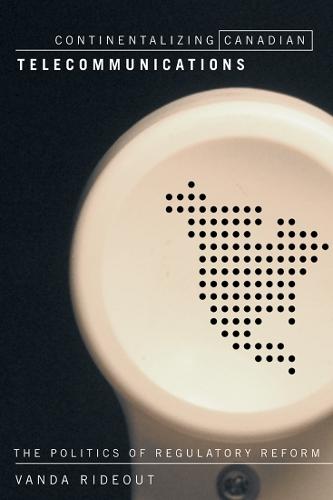
In Continentalizing Canadian Telecommunications Vanda Rideout examines active political resistance to the radical, neo-liberal transformation of Canadian telecommunications that has been orchestrated by the federal government, big business, and their powerful lobbyists over the last two decades. Rideout focuses on the protection of the public interest, a crucial element neglected by most recent studies, and shows that although alliances have been formed between labour, consumers, and public interest activists, significant disagreements over issues such as free trade, long distance and local competition, and a targeted subsidy program for very low-income Canadians have meant that this united front has not been able to counter the forces of the new neo-liberal telecommunication policy regime. Continentalizing Canadian Telecommunications details the complex relationships between the various corporate and government interests, shows how the changes they brought about have locked Canada's telecommunications system into the orbit of the US system, and discusses the implications this has for Canadians.
Full Product Details
Author: Vanda Rideout ,
Vanda Rideout
Publisher: McGill-Queen's University Press
Imprint: McGill-Queen's University Press
Dimensions:
Width: 15.20cm
, Height: 1.80cm
, Length: 22.90cm
Weight: 0.432kg
ISBN: 9780773524521
ISBN 10: 0773524525
Pages: 280
Publication Date: 04 July 2003
Audience:
Professional and scholarly
,
Professional & Vocational
Format: Paperback
Publisher's Status: Active
Availability: Out of stock

The supplier is temporarily out of stock of this item. It will be ordered for you on backorder and shipped when it becomes available.
Reviews
"""The author does an excellent job of mapping out the policy networks, alliances, research institutions, and conceptual shifts, looking at the transformation of the role of the Canadian state in telecommunications policy, how this role expanded from the late 1940s onwards, and the strong role played by government in ushering in a neo-liberal telecommunications order during the 1980s and 1990s."" Dwayne Winseck, School of Journalism and Communication, Carleton University"
""The author does an excellent job of mapping out the policy networks, alliances, research institutions, and conceptual shifts, looking at the transformation of the role of the Canadian state in telecommunications policy, how this role expanded from the late 1940s onwards, and the strong role played by government in ushering in a neo-liberal telecommunications order during the 1980s and 1990s."" Dwayne Winseck, School of Journalism and Communication, Carleton University
The author does an excellent job of mapping out the policy networks, alliances, research institutions, and conceptual shifts, looking at the transformation of the role of the Canadian state in telecommunications policy, how this role expanded from the late 1940s onwards, and the strong role played by government in ushering in a neo-liberal telecommunications order during the 1980s and 1990s. Dwayne Winseck, School of Journalism and Communication, Carleton University