Overview
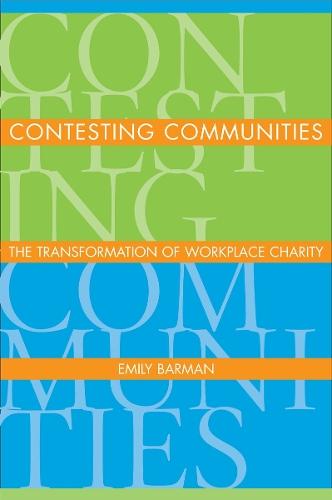
Is ""community"" in America in decline? If so, does this mean that charitable giving in the United States is also in decline? In this innovative and original work, Emily Barman offers new insights into this important issue. Analyzing workplace charity in different cities across the United States, Contesting Communities shows that while traditional notions of community might be in decline, new types and visions of community have emerged. Barman traces how these different ""communities"" take the form of organizational competition between the United Way and new alternative fundraisers over workplace contributions. Deftly blending sociological theory of organizations with archival research, interviews with nonprofit leaders, and original survey data, Contesting Communities ultimately shows that the meaning of community occurs almost incidentally to the wishes of those who give and the needs of those who receive.
Full Product Details
Author: Emily Barman
Publisher: Stanford University Press
Imprint: Stanford University Press
Edition: New edition
Dimensions:
Width: 15.20cm
, Height: 1.10cm
, Length: 22.90cm
Weight: 0.290kg
ISBN: 9780804754491
ISBN 10: 0804754497
Pages: 208
Publication Date: 20 June 2006
Audience:
College/higher education
,
Professional and scholarly
,
Undergraduate
,
Postgraduate, Research & Scholarly
Format: Paperback
Publisher's Status: Active
Availability: In Print

This item will be ordered in for you from one of our suppliers. Upon receipt, we will promptly dispatch it out to you. For in store availability, please contact us.
Reviews
In Contesting Communities: The Transformation of Workplace Charity, Emily Barman adds to the debate on defining 'community' by investigating how conceptions of community manifest themselves in an arena little researched by social scientists, namely: charitable donation campaigns in the workplace The book makes a valuable contribution to the understanding of both the evolving meaning of community and the field of workplace charity in the United States. -<Journal of Sociology and Social Welfare Contesting Communities is a valuable and original contribution to community studies, to organizational analysis, and to the literature of the nonprofit sector. Although theoretically sophisticated, it is written with a clarity that will make it useful to readers across the social disciplines and in the world of practice. --Peter Dobkin Hall, American Journal of Sociology Barman provides novel commentary on the changing nature and meaning of philanthropy and community, as well as the impact of corporate gatekeepers thereon. This book is essential reading for anyone interested in voluntarism, philanthropy, social capital, and organizational behavior. --Jason Kaufman, Harvard University Given the broad contemporary interest in philanthropy and voluntarism, Emily Barman's book on the United Way and the emergence of alternative fundraising organizations as competitors to the United Way is especially timely. Barman's incisive investigation of the increasingly competitive environment of workplace charity is a major contribution to our understanding of the social, political, and economic changes underway in local communities throughout the United States. --Steven Rathgeb Smith, University of Washington
This book is essential reading for anyone interested in voluntarism, philanthropy, social capital, and organizational behavior. - Jason Kaufman, Harvard University Given the broad contemporary interest in philanthropy and voluntarism, Emily Barman's book on the United Way and the emergence of alternative fundraising organizations as competitors to the United Way is especially timely. - Steven Rathgeb Smith, University of Washington
Author Information
Emily Barman is Assistant Professor of Sociology at Boston University.