Overview
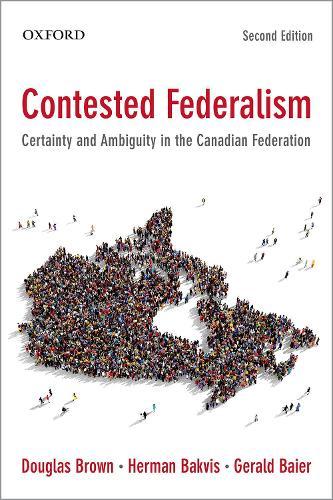
The most comprehensive and critical look at Canadian federalismThis restructured and thoroughly updated exploration of Canadian federalism explores the tensions and conflicts within Canada's governance system and the adaptations required for federalism to work. Focusing on three areas - basic federal and intergovernmental structure; the constitutional and institutional framework of the federation; and federal governance - this text is an engaging and balanced treatment of federalism in Canada.
Full Product Details
Author: Douglas Brown (Associate Professor, Department of Political Science, Associate Professor, Department of Political Science, St Francis Xavier University) , Herman Bakvis (Professor Emeritus, School of Public Administration, Professor Emeritus, School of Public Administration, University of Victoria) , Gerald Baier (Associate Professor, Department of Political Science, Associate Professor, Department of Political Science, University of British Columbia)
Publisher: Oxford University Press, Canada
Imprint: Oxford University Press, Canada
Edition: 2nd Revised edition
Dimensions:
Width: 15.20cm
, Height: 1.60cm
, Length: 22.80cm
Weight: 0.436kg
ISBN: 9780195445909
ISBN 10: 0195445902
Pages: 320
Publication Date: 20 June 2019
Audience:
Professional and scholarly
,
College/higher education
,
Professional & Vocational
,
Postgraduate, Research & Scholarly
Format: Paperback
Publisher's Status: Active
Availability: To order 
Stock availability from the supplier is unknown. We will order it for you and ship this item to you once it is received by us.
Table of Contents
"Note: Each chapter includes: - Learning Objectives - Summary (all chapters except Conclusion) - Questions for Critical Thought - Notes - References Introduction 1. Understanding Federalism and Intergovernmental Relations - The Origins of Federalism - Institutional and Societal Views of Federalism - The Institutions of Federalism - Executive Federalism - Competing Canadian Conceptions of Federalism - Comparative Federalism and Multilevel-Governance - Why Study Federalism? 2. The Economic, Social, and Institutional Bases of Canadian Federalism - Origins - Economy and Geography - Two Special Cases of Diversity and Asymmetry: Quebec and Indigenous Peoples 3. The Constitution and Constitutional Change - Canada's Constitutional Development - Confederation and the British North America Act, 1867 - Constitutional Change - Post-Charlottetown Constitutional Politics 4. Judicial Review and Dispute Resolution - Judicial Review and the Division of Powers - Dispute Resolution 5. Executive Federalism: Back to the Future? - Introduction - Why Executive Federalism? - The Settings of Executive Federalism - Multilateralism, Bilateralism, and Unilateralism - First Ministers' Conferences and First Ministers' Meetings (FMCs/FMMs) - Premiers and the Council of the Federation - Ministerial Councils and Civil Society - Meetings of Officials - Intergovernmental Agencies, the Intragovernmental Dimension and Trust Ties - Regional Bodies - Multilateralism, Bilateralism, and Unilateralism 6. Fiscal Relations: Basic Principles and Current Issues - The Functions, Principles, and Dynamics of Fiscal Federalism - The Structure of Fiscal Relations in Canada - Changing Objectives and Outcomes, 1945-2018 - Transfers for Social Programs: The Evolution of the CHT/CST - Equalization: Still the Glue that Binds the Federation? 7. The Social Union - Introduction - Social Union and the Federal Spending Power - Child Care and the Children's Benefit - Canada/Quebec Pension Plan Reform - Joint-Decision Federalism in Action - Health Care: From Unilateralism, to Multilateralism, to Bilateralism 8. The Economic Union and Economic Policy - The Economic Union - Macroeconomic Management - National versus Regional Economic Development - Globalization, Free Trade, and Competitiveness 9. The Environmental Union - Federalism and the Environment in Canada - Intergovernmental Cooperation and Competition - The Case of Climate Change Policy 10. Local Government and Federalism - Cities and Local Government - What Local Government Does, and How - Provincial-Local Relations - The Federal Role - Assessing the Intergovernmental System: Is There a Need for Tri-Level Relations? 11. Indigenous Peoples and Federalism - From Colonialism to Indigenous Nationalism - The RCAP Model and Its Critics - Emerging Models of Indigenous Governance and Intergovernmental Relations 12. Quebec and the Future of Canadian Federalism NEW - Introduction - The Quiet Revolution - The ""French Fact"" and Federal Politics - The Sovereigntist Movement and Constitutional Politics - Harper's ""Open Federalism"" and Quebec Conclusion: Ambivalent Federalism - The Deep Pathways of Canadian Federalism - Continuity and Change: Intergovernmental Outcomes Since 1970 - Challenges Ahead Index"
Reviews
"""[This book] covers every salient aspect of the study of federalism in Canada, and does an excellent job at linking theory and concepts to recent developments in Canadian political life. It is very accessible and virtually jargon-free, and ensures that students are able to grasp certain concepts that may be new to them."" --Raffaele Iacovino, Carleton University ""The book provides a thorough, readable and up-to-date overview of major themes in Canadian federalism. It reflects the breadth, depth and diversity of expertise of its capable authors. It comes highly recommended."" --Kyle Hanniman, Queen's University"
The book provides a thorough, readable and up-to-date overview of major themes in Canadian federalism. It reflects the breadth, depth and diversity of expertise of its capable authors. It comes highly recommended. * Kyle Hanniman, Queen's University * [This book] covers every salient aspect of the study of federalism in Canada, and does an excellent job at linking theory and concepts to recent developments in Canadian political life. It is very accessible and virtually jargon-free, and ensures that students are able to grasp certain concepts that may be new to them. * Raffaele Iacovino, Carleton University *
Author Information
Douglas Brown is an associate professor in the Department of Political Science at St Francis Xavier University. He has served as a government consultant for over 20 years, working, for example, with the Intergovernmental Affairs Secretariat and the Government of Newfoundland and Labrador. Professor Brown's research areas include intergovernmental relations, globalization and federalism, and economic and fiscal trade policy. He is the author and editor of over 30 publications related to Canadian and comparative federalism. Herman Bakvis is Professor Emeritus at the School of Public Administration at the University of Victoria, where he has been since 2005. Prior to this, he spent 26 years at Dalhousie University in the Department of Political Science and School of Public Administration. Professor Bakvis also has been involved in applied policy research for departments and agencies such as Human Resources Development Canada and The Treasury Board Secretariat, as well as with Royal Commissions such as the Royal Commission on Electoral Reform and Party Financing. He has co-authored two OUP Canada titles: Canadian Federalism, 1e, 2e, and 3e (OUP Canada, 2001, 2007, 2012) and Contested Federalism (OUP Canada, 2008). Gerald Baier is an associate professor in the Department of Political Science at the University of British Columbia. His research focuses on the constitution, federalism, and public law, and is currently researching the institutional character and processes of the Supreme Court of Canada.
Tab Content 6
Author Website:
Countries Available
All regions
|