Overview
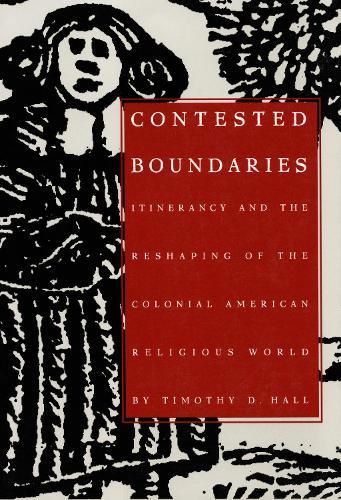
The First Great Awakening in eighteenth-century America challenged the institutional structures and raised the consciousness of colonial Americans. These revivals gave rise to the practice of itinerancy in which ministers and laypeople left their own communities to preach across the countryside. In Contested Boundaries, Timothy D. Hall argues that the Awakening was largely defined by the ensuing debate over itinerancy. Drawing on recent scholarship in cultural and social anthropology, cultural studies, and eighteenth-century religion, he reveals at the center of this debate the itinerant preacher as a catalyst for dramatic change in the religious practice and social order of the New World. This book expands our understanding of evangelical itinerancy in the 1740s by viewing it within the context of Britain’s expanding commercial empire. As pro- and anti-revivalists tried to shape a burgeoning transatlantic consumer society, the itinerancy of the Great Awakening appears here as a forceful challenge to contemporary assumptions about the place of individuals within their social world and the role of educated leaders as regulators of communication, order, and change. The most celebrated of these itinerants was George Whitefield, an English minister who made unprecedented tours through the colonies. According to Hall, the activities of the itinerants, including Whitefield, encouraged in the colonists an openness beyond local boundaries to an expanding array of choices for belief and behavior in an increasingly mobile and pluralistic society. In the process, it forged a new model of the church and its social world. As a response to and a source of dynamic social change, itinerancy in Hall’s powerful account provides a prism for viewing anew the worldly and otherworldly transformations of colonial society. Contested Boundaries will be of interest to students and scholars of colonial American history, religious studies, and cultural and social anthropology.
Full Product Details
Author: Timothy D. Hall
Publisher: Duke University Press
Imprint: Duke University Press
Weight: 0.590kg
ISBN: 9780822315117
ISBN 10: 0822315114
Pages: 208
Publication Date: 20 December 1994
Audience:
College/higher education
,
General/trade
,
Undergraduate
,
General
Format: Hardback
Publisher's Status: Active
Availability: In Print

This item will be ordered in for you from one of our suppliers. Upon receipt, we will promptly dispatch it out to you. For in store availability, please contact us.
Reviews
Vitally fresh ... an impressive book. The sophistication of the theoretical and historiographical introduction promises the reader that historical inquiry and interpretation of the first order await. It is a thrilling study. -Samuel S. Hill, University of Florida Contested Boundaries makes a telling and timely argument. It opens up rich new insights into eighteenth-century Protestantism and the changing colonial mindset in the face of escalating populations, increased multiculturalism, improved modes of travel, rising rates of literacy, strengthened transatlantic commerce, and the arduous, extended transition from subsistence to markets. -Peter H. Wood, Duke University
As Timothy Hall argues in an elegant new study on itinerancy and religious culture in early America, [itinerant preachers] brought more than the gospel to their audiences as they journeyed from one end of colonial America to the other. . . . Hall's volume is a worthy addition to the religious and cultural history of early America. Moreover, this book makes contributions to the debate on the relationship between religious revivals and the American Revolution and to the question of colonial identity and the emergence of nationalism as colonists contested the boundaries of empire. <br>--Georgia Historical Quarterly
Contested Boundaries makes a telling and timely argument. It opens up rich new insights into eighteenth-century Protestantism and the changing colonial mindset in the face of escalating populations, increased multiculturalism, improved modes of travel, rising rates of literacy, strengthened transatlantic commerce, and the arduous, extended transition from subsistence to markets. --Peter H. Wood, Duke University
Author Information
Timothy D. Hall is Assistant Professor of Early American History at Central Michigan University.