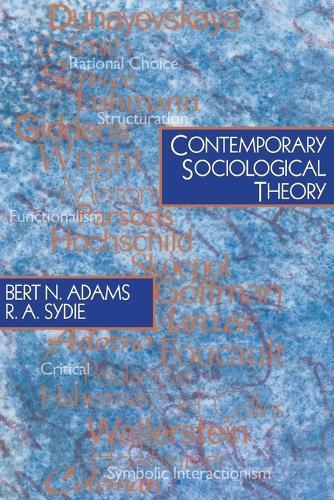
Overview
""The strengths of this text are the breadth of theories covered; the integration of gender-related topics¾ family, work, religion; the use of substantial quotes from primary texts; the consistent inclusion of methodological issues.…I have no doubt that it will find a solid position in the field of theory texts."" --Kathleen Slobin, North Dakota State University A concise, yet surprisingly comprehensive theory text, given the range of ideas, historical context, and theorists discussed. Unlike other books of the type, Contemporary Sociological Theory focuses on how the pivotal theories contributed not only to the development of the field, but also to the evolution of ideas concerning social life.
Full Product Details
Author: Bert N. Adams , R. A. Sydie
Publisher: SAGE Publications Inc
Imprint: SAGE Publications Inc
Dimensions:
Width: 16.10cm
, Height: 1.40cm
, Length: 23.40cm
Weight: 0.450kg
ISBN: 9780761987819
ISBN 10: 0761987819
Pages: 304
Publication Date: 15 March 2002
Audience:
College/higher education
,
Professional and scholarly
,
Undergraduate
,
Postgraduate, Research & Scholarly
Format: Paperback
Publisher's Status: Out of Print
Availability: Out of print, replaced by POD 
We will order this item for you from a manufatured on demand supplier.
Table of Contents
Preface A Note to Students 1. Introduction to Contemporary Sociological Theory Nineteenth-Century Sociological Theory Dominant Theories and Ideologies Radical Theory and Ideology Early-Twentieth-Century Sociological Theory Sociological Theory by the 1930s SECTION I. TWENTIETH-CENTURY FUNCTIONALISM AND BEYOND 2. Twentieth-Century Functionalism Talcott Parsons (1902-1979) Robert K. Merton (1910- ) Final Thoughts References 3. Systems, Structuration, and Modernity Niklas Luhmann (1927-1998) Anthony Giddens (1938- ) Final Thoughts References SECTION II. CRITICISM, MARXISM, AND CHANGE 4. Critical Theory The Institute of Social Research Jurgen Habermas (1929- ) Final Thoughts References 5. Marxism Since 1930 Marxism from 1930 to 1980 Marxism Now: Erik Olin Wright (1947- ) Final Thoughts References 6. Sociocultural Change: Evolution, World System, and Revolution Twentieth-Century Evolutionism: Elman Service (1915- ) World System Theory: Immanuel Wallerstein (1930- ) Revolution: Theda Skocpol (1947- ) Final Thoughts References SECTION III. TRANSITIONS AND CHALLENGES 7. Mid-Twentieth-Century Sociology Ideological Disputes Facts and Values Macro/Micro Perspectives Feminism and Feminist Sociological Theory Race and Colonialism Final Thoughts References 8. Symbolic Interactionism The Interactionist Tradition Herbert Blumer (1900-1987) Erving Goffman (1922-1982) Arlie Russell Hochschild (1940- ) Final Thoughts References 9. Rational Choice and Exchange James S. Coleman, (1926-1995) Final Thoughts References 10. Feminist Sociological Theory Sociology and Feminism Dorothy E. Smith (1926- ) Patricia Hill Collins (1948- ) Final Thoughts References 11. Knowledge, Truth, and Power Michel Foucault (1926-1984) Final Thoughts References 12. Final Thoughts on Contemporary Sociological Theory Sociological Theory Since 1930 The Future of Society The Future of Sociological Theory References Credits Index
Reviews
The strengths of this text are the breadth of theories covered; the integration of gender-related topics family, work, religion; the use of substantial quotes from primary texts; the consistent inclusion of methodological issues.!I have no doubt that it will find a solid position in the field of theory texts. -- Kathleen Slobin
The strengths of this text are the breadth of theories covered; the integration of gender-related topics3/4 family, work, religion; the use of substantial quotes from primary texts; the consistent inclusion of methodological issues....I have no doubt that it will find a solid position in the field of theory texts. -- Kathleen Slobin
Author Information
Bert N. Adams (Ph.D., University of North Carolina) is Emeritus Professor of Sociology at the University of Wisconsin at Madison. He is a former President and currently a Fellow of the National Council on Family Relations. He has taught sociological theory extensively, both in East Africa and at the University of Wisconsin, and also teaches and writes on the sociology of the family. He is the author of several books, including the introductory textbook THE FAMILY: A SOCIOLOGICAL INTERPRETATION, 5TH EDITION (Harcourt Brace 1995) and SOCIOLOGICAL THEORY (Pine Forge Press 2001). With David M. Klein, he served as co-editor of the Understanding Families Series with Sage, which produced 20 books between 1995 and 2002. He is well connected with family sociologists throughout the world. R. A. Sydie has been professor of sociology at the University of Alberta in Edmonton for the past 30 years and is the current chair of the department of sociology. Her research interests include sociological theory, art and culture, and gender studies. Professor Sydie is the author of Natural Women, Cultured Men. Her latest research project involves a historical examination of sociological work on love and eroticism.
Tab Content 6
Author Website:
Countries Available
All regions
|