|
Overview
Full Product Details
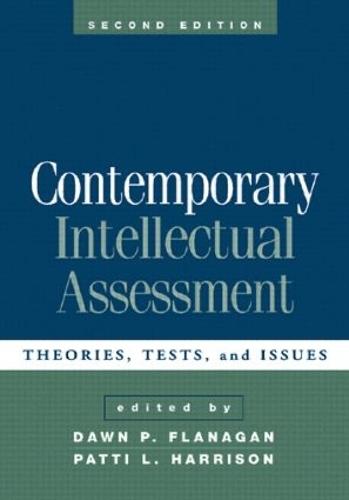
Author: Dawn P. Flanagan , Patti L. Harrison
Publisher: Guilford Publications
Imprint: Guilford Publications
Edition: 2nd edition
Dimensions:
Width: 17.80cm
, Height: 4.20cm
, Length: 25.40cm
Weight: 1.334kg
ISBN: 9781593851255
ISBN 10: 1593851251
Pages: 667
Publication Date: 25 April 2005
Audience:
General/trade
,
College/higher education
,
General
,
Tertiary & Higher Education
Replaced By: 9781609189952
Format: Hardback
Publisher's Status: Out of Print
Availability: Awaiting stock 
Table of Contents
Part I: The Origins of Intellectual Assessment. Wasserman, Tulsky, The History of Intelligence Testing. Kamphaus, Pierce Winsor, Rowe, Kim, History of Intelligence Test Interpretation. Part II: Contemporary and Emerging Theoretical Perspectives. Horn, Blankson, Foundations for Better Understanding of Cognitive Abilities. Carroll, The Three-Stratum Theory of Cognitive Abilities. Chen, Gardner, Assessment Based on Multiple-Intelligences Theory. Sternberg, The Triarchic Theory of Successful Intelligence. Naglieri, Das, Planning, Attention, Simultaneous, Successive Theory: A Revision of the Concept of Intelligence. McGrew, The Cattell-Horn-Carroll Theory of Cognitive Abilities: Past, Present, and Future. Part III: Contemporary and Emerging Interpretive Approaches. Alfonso, Flanagan, Radwan,The Impact of the Cattell-Horn-Carroll Theory on Test Development and Interpretation of Cognitive and Academic Abilities. Floyd, Information-Processing Approaches to Interpretation of Contemporary Intellectual Assessment Instruments. Ortiz, Ochoa, Advances in Cognitive Assessment of Culturally and Linguistically Diverse Individuals: A Nondiscriminatory Interpretive Approach. Watkins, Glutting, Youngstrom, Issues in Subtest Profile Analysis. Mather, Wendling, Linking Cognitive Assessment Results to Academic Interventions for Students with Learning Disabilities. Part IV: New and Revised Intelligence Batteries. Zhu, Weiss, The Wechsler Scales. Roid, Pomplun, Interpreting the Stanford-Binet Intelligence Scales, Fifth Edition. Kaufman, Kaufman, Kaufman-Singer, Kaufman, The Kaufman Assessment Battery for Children-Second Edition and the Kaufman Adolescent and Adult Intelligence Test. Schrank, The Woodcock-Johnson III Tests of Cognitive Ability. Elliott, The Differential Ability Scales. McCallum, Bracken, The Universal Nonverbal Intelligence Test: A Multidimensional Measure of Intelligence. Naglieri, The Cognitive Assessment System. Reynolds, Kamphaus, Introduction to the Reynolds Intellectual Assessment Scales and the Reynolds Intellectual Screening Test. Part V: Use of Intelligence Tests in Different Populations. Ford, Dahinten, The Use of Intelligence Tests in the Assessment of Preschoolers. McIntosh, Dixon, Use of Intelligence Tests in the Identification of Giftedness. Mascolo, Flanagan, Psychoeducational Assessment and Learning Disability Diagnosis. Ortiz, Dynda, The Use of Intelligence Tests with Culturally and Linguistically Diverse Populations. Braden, Athanasiou, A Comparative Review of Nonverbal Measures of Intelligence. Part VI: Emerging Issues and New Directions in Intellectual Assessment. Keith, Using Confirmatory Factor Analysis to Aid in Understanding the Constructs Measured by Intelligence Tests. Braden, Niebling, Using the Joint Test Standards to Evaluate the Validity Evidence for Intelligence Tests. Brown-Chidsey, Intelligence Tests in an Era of Standards-Based Educational Reform.
Reviews
'Finally there is a book that brings together the history of intellectual assessment, the contemporary theories of intelligence, and state-of-the-art information about the prac tice of intellectual assessment. This book is essential reading for psychologists of all sorts who are interested in intelligence... This is one of the best edited volumes I have ever encountered, and I have placed it on the most-important-books shelf of my personal, professional library.' - G. Michael Pressley 'Here in one location is a comprehensive set of the most impressive papers I've read on new ways of thinking about and measuring intelligence... Must reading for anyone engaged in the assessment of human cognitive abilities.' - James E. Ysseldyke, PhD
Truly an exceptional contribution. This volume should be a required text for all students of intellectual assessment. It provides comprehensive coverage of all of the major theories and tests in the area of intellectual assessment, along with wonderfully detailed chapters on such issues as interpretation, validity, and the role of intellectual assessment in the context of standards-based educational reforms. Contributors have been selected from the best and most highly respected scholars in the area of intelligence and cognition, and their well-written chapters seamlessly integrate theory and practice. If I were to purchase only one professional book for my library this year, it would be this essential work. --George W. Hynd, EdD, School of Education, Purdue University <br> I have used the first edition of Contemporary Intellectual Assessment for years, and have looked forward with anticipation to this revision. The changes in the field of intellectual assessment since the advent
Truly an exceptional contribution. This volume should be a required text for all students of intellectual assessment. It provides comprehensive coverage of all of the major theories and tests in the area of intellectual assessment, along with wonderfully detailed chapters on such issues as interpretation, validity, and the role of intellectual assessment in the context of standards-based educational reforms. Contributors have been selected from the best and most highly respected scholars in the area of intelligence and cognition, and their well-written chapters seamlessly integrate theory and practice. If I were to purchase only one professional book for my library this year, it would be this essential work. --George W. Hynd, EdD, School of Education, Purdue University <br> I have used the first edition of Contemporary Intellectual Assessment for years, and have looked forward with anticipation to this revision. The changes in the field of intellectual assessment since the advent of Cattell-Horn-Carroll (CHC) theory have been rapid and profound, and an up-to-date guidebook is a must. This book will be invaluable for anyone teaching intellectual assessment at the graduate level, and will also be a useful overview for practitioners who completed their training before the recent revolutionary changes in intellectual assessment. For school practitioners, the chapter outlining a model of nondiscriminatory assessment for culturally and linguistically diverse students, and the one linking cognitive assessment to interventions, will be particularly valuable. --Catherine A. Fiorello, PhD, School Psychology Program, Temple University <br> With new and thoroughly revised chapters that addressissues like LD identification and profile analysis, and populations like preschoolers, the gifted, and the culturally and linguistically diverse, the second edition of Contemporary Intellectual Assessment is a significant improvement over the already outstanding first edition. The contributing authors are leading experts in the field. This research-based but practical text will be useful to practitioners and trainers alike, and is destined to become the gold standard text for courses in intellectual assessment. --Edward M. Levinson, EdD, Department of Educational and School Psychology, Indiana University of Pennsylvania <br> In the past decade, knowledge about intelligence and its assessment has moved at a rapid pace. Older theories are being reexamined with modern methods in cognitive psychology, neural science, and statistics, and new theories are vying to take their place. This excellent second edition provides a comprehensive, state-of-the-art overview of the theory and practice of intellectual assessment--past, present, and future. The chapters, written by many of the leading researchers in the field, cover a wide range of important topics, including the history of tests and their interpretation, the structure of human cognitive abilities, contemporary theory, new and emerging tests, current issues, and future directions. This book is 'must' reading for anyone interested in intelligence and its assessment. It will be an invaluable resource for scholars, practitioners, and students new to the field. --John H. Kranzler, PhD, College of Education, University of Florida<br>
Author Information
Dawn P. Flanagan, PhD, is Professor of Psychology at St. John's University in New York. She writes and conducts research on such topics as the structure of intelligence, psychoeducational assessment, learning disabilities evaluation and diagnosis, and professional issues in school psychology. Dr. Flanagan's articles and chapters on these topics appear in school and clinical psychology journals and books. She is senior author of The Wechsler Intelligence Scales and Gf-Gc Theory: A Contemporary Approach to Interpretation, Essentials of Cross-Battery Assessment, The Achievement Test Desk Reference (ATDR): Comprehensive Assessment of Learning Disabilities, Diagnosing Learning Disability in Adulthood, and Essentials of WISC-IV Assessment; coauthor of The Intelligence Test Desk Reference (ITDR): Gf-Gc Cross-Battery Assessment and Essentials of WJ III Cognitive Assessment; and coeditor of Clinical Use and Interpretation of the WJ III. Dr. Flanagan is a Fellow of the American Psychological Association and Diplomate of the American Board of Psychological Specialties, as well as a past recipient of the APA's Lightner Whitmer Award. Patti L. Harrison, PhD, is Professor in the School Psychology Program and Associate Dean of the Graduate School at the University of Alabama. She has conducted research on intelligence, adaptive behavior, and preschool assessment. Dr. Harrison's articles and chapters on assessment topics appear in school and clinical psychology and special education journals and texts, and she has presented over 100 refereed and invited presentations on these topics at conferences of professional organizations in psychology and education. She was Editor of School Psychology Review and has been an editorial board member for several school psychology and related journals, including School Psychology Quarterly, the Journal of School Psychology, the Journal of Psychoeducational Assessment, the American Journal on Mental Retardation, and Diagnostique.
Tab Content 6
Author Website:
Countries Available
All regions
|