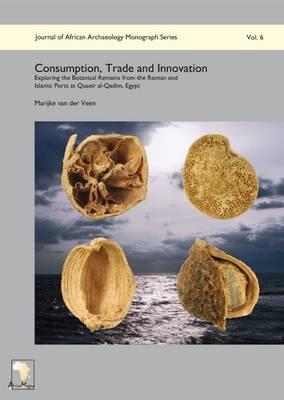
Consumption, Trade and Innovation: Exploring the Botanical Remains from the Roman and Islamic Ports at Quseir Al-Qadim, Egypt

Author:   Marijke van der Veen
Publisher:   Africa Magna Verlag
Volume:   6
ISBN:  

9783937248233


Pages:   320
Publication Date:   15 March 2011
Format:   Hardback
Availability:   Not yet available   Availability explained
This item is yet to be released. You can pre-order this item and we will dispatch it to you upon its release.

Our Price $232.32 Quantity:  
Add to Cart

Share |

Consumption, Trade and Innovation: Exploring the Botanical Remains from the Roman and Islamic Ports at Quseir Al-Qadim, Egypt


Overview

Full Product Details

Author:   Marijke van der Veen
Publisher:   Africa Magna Verlag
Imprint:   Africa Magna Verlag
Volume:   6
Dimensions:   Width: 21.30cm , Height: 2.40cm , Length: 30.20cm
Weight:   1.640kg
ISBN:  

9783937248233


ISBN 10:   3937248234
Pages:   320
Publication Date:   15 March 2011
Audience:   College/higher education ,  Postgraduate, Research & Scholarly
Format:   Hardback
Publisher's Status:   Active
Availability:   Not yet available   Availability explained
This item is yet to be released. You can pre-order this item and we will dispatch it to you upon its release.

Table of Contents

Foreword and Acknowledgements; Chronology Table; 1 INTRODUCTION; 1.1 Aims and Research Questions; 1.2 The Indian Ocean Trade; Roman period trade; Islamic period trade; 1.3 Quseir al-Qadim - Myos Hormos/Kusayr; 1.4 Data Collection and Methods; Sampling strategy; Identification; Quantification and data presentation; Preservation; 1.5 Chronology (Marijke van der Veen and Derek Hamilton); Dating the Islamic assemblage - ceramics, coins and texts; Dating the Islamic assemblage - radiocarbon dates; Chronology of the Islamic assemblage; Summary; 1.6 Contexts and Botanical Dataset; Contextual information - Roman; Contextual information - Islamic; The botanical assemblage; 2 SPICES - CULINARY AND MEDICINAL COMMODITIES (Marijke van der Veen, Alison Cox & Jacob Morales); 2.1 Introduction; 2.2 Spices at the Ports Pepper; Rice; Coconut; Mung bean; Myrobalans; Ginger; Turmeric; Cardamom; Fagara; Betelnut; Summary: patterns of trade at the ports; 2.3 The Luxury of Long-Distance Trade; Spices as preservatives; Spices as commodities; Spices as articles of desire; 3 SUMMER CROPS - FROM TRADE TO INNOVATION (Marijke van der Veen & Jacob Morales); 3.1 Introduction; 3.2 Summer Crops at the Ports; Rice; Citrus fruits; Cotton; Sugar cane; Aubergine; Taro; Banana; Sorghum; Pearl millet; Cowpea; Watermelon; Summary; 3.3 Dispersal of Summer Crops into the Islamic World; Pre-Islamic dispersal; Islamic-period dispersal; Patterns of dispersal; 3.4 Agricultural Innovation; Types of agricultural innovation; Nature of agricultural innovation; Agricultural innovation in Egypt; COLOUR PLATES; 4 FOOD AND FOODWAYS - PATTERNS OF EVERYDAY LIFE (Marijke van der Veen, Alison Cox & Jacob Morales); 4.1 Introduction; 4.2 Food Consumption at the Ports; Cereals; Pulses; Fruits; Nuts; Oilseeds; Vegetables; Herbs and spices; Others; Preservation - desiccation versus carbonization; Summary; 4.3 Animals, Fodder and Dung; 4.4 Identifying Foodways; Watermelon - fruit flesh versus seeds; Citrus fruits - rind versus juice; Grapes and pomegranates - fresh versus dried fruits; Pulses - cooked dish versus snack food; Aubergine - overcoming bitterness; Others; 4.5 Spatial Distribution of Waste Disposal; Cereals - food versus fodder; Food in the Roman port (1st-early-3rd centuries AD); Food in the Islamic port (mid-11th-13th centuries AD); Food in the Late Islamic port (14th and 15th centuries AD); 4.6 Patterns of Everyday Life; Nutrition and health; Eating as practice; 5 WOODWORKING AND FIREWOOD - RESOURCE EXPLOITATION (Marijke van der Veen, Rowena Gale & Dirk A bel); 5.1 Introduction; 5.2 Maritime Artefacts; Roman ship-rigging artefacts; Islamic ship timbers; Pegs and wood shavings; 5.3 Everyday Objects; Individual artefact classes; Summary; 5.4 Firewood; 5.5 Changing Resource Exploitation; Ship-building; Wood selection in everyday objects; Firewood; 6 MYOS HORMOS AND KUSAYR - DIFFERENT WORLDS; 6.1 Commodities and Trade; 6.2 Agricultural Crops and Innovation; 6.3 Food and Consumption; 6.4 Myos Hormos and Kusayr - Different Worlds; Appendices; List of figures; List of Tables; List of colour plates; List of Appendices; Bibliography; Index

Reviews

[This book] combines analyses of plant remains and texts with sociological and anthropological approaches, and for this reason it is set to become a classic in the archaeological literature Anna Maria Mercuri, Universita di Modena e Reggio Emilia, Italy (Antiquity 87 (335), March 2013). -- This contribution offers a fascinating analysis of cultural borrowing with a spotlight on the importance of food and fuel in the dynamics of political and economic geography, national power, and foreign influence Dorothea Bedigian, Missouri Botanical Garden, USA (Economic Botany 66 (2), 2012). -- Although technical site reports of this kind are usually published for the use of specialists [...], this book is organized and written in such a way that it can be profitably and enjoyably read by economists, historians, and archaeologists with an interest in the development of the spice trade in the classical and medieval periods [...]. James L. Boone, University of New Mexico, USA (The Journal of Economic History 72 (2), 2012). -- Rarely do scholars 'spice up' their research monographs with the type of prose that invites the general reader to come along and enjoy the culinary tour. Marijke van der Veen has done so in her exemplary publication of the botanical remains from ...Quseir al-Qadim, a bustling port of the Roman and Islamic period on Egypt's Red Sea coast. Monica L. Smith, University of California, USA (Gastronomica: The Journal of Food and Culture 12 (3), 2012). -- [This book] will serve as a highly useful device for archaeobotanists, archaeologists and ancient historians investigating both the Roman and Islamic civilizations of the Near East. Ahmed G. Fahmy, University of Helwan, Egypt (Journal of African Archaeology 9 (2) 2011).


Author Information

Marijke van der Veen is Professor of Archaeology at the University of Leicester. Her research focuses on ancient agriculture and the archaeology of food, with a specialization in archaeobotany. Current research projects include a reconstruction of foodways and the development of horticulture in north-west Europe. She is author of Crop Husbandry Regimes (1992), and editor of The Exploitation of Plant Resources in Ancient Africa (1999), Luxury Foods (2003), Garden Agriculture (2005) and Agricultural Innovation (2010), the latter three issues of the journal World Archaeology.

Tab Content 6

Author Website:  

Countries Available

All regions
Latest Reading Guide

April RG 26_2


Shopping Cart
Your cart is empty
Shopping cart
Mailing List