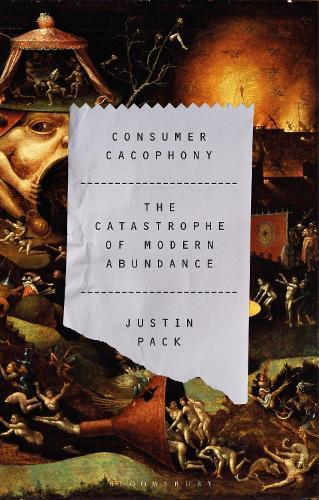
Full Product Details
Author: Dr Justin Pack (California State University, Stanislaus, USA)
Publisher: Bloomsbury Publishing PLC
Imprint: Bloomsbury Academic
Dimensions:
Width: 13.80cm
, Height: 2.00cm
, Length: 21.00cm
Weight: 0.260kg
ISBN: 9781350500938
ISBN 10: 1350500933
Pages: 208
Publication Date: 19 February 2026
Audience:
Professional and scholarly
,
Professional & Vocational
Format: Paperback
Publisher's Status: Active
Availability: Not yet available

This item is yet to be released. You can pre-order this item and we will dispatch it to you upon its release.
Reviews
In this exciting work, Justin Pack takes on a key problem of modern life: the problem of too much. Drawing on thinkers and social theorists as diverse as Nancy Fraser, Zygmunt Bauman, and José Ortega y Gasset, he presents a compelling case that “cacophonous capitalism” produces a “nova effect” with proliferating mountains of goods, information, perspectives, and worlds lacking any significant core meaning or organizing idea. Nonetheless, at the heart of the “supernova” of fragments, bits, and pieces there lies a logic: the meritocratic, money-driven ideal of homo economicus, in which a market theology sanctifies and moralizes production, accumulation, and consumption. At the core of our present environmental and social crisis, he suggests, is a culture in which the old God has given way to the new, a permissive market god willing to permit and promote experimentation, play, and even transgression so long as its fundamental logics of production, accumulation, and consumption are allowed to reign supreme and remain effectively unchallenged. What is needed, he argues, both politically and academically, is slow, patient narrative work that is able to exercise centripetal force, organizing and integrating the incoherent and exploding multiplicity of identities, perspectives, and worlds into an alternative culture able to overcome the destructive machinery of cacophonous capitalism. * Brandon Absher is Professor of Philosophy at D'Youville University in Buffalo, NY and author of The Rise of Neoliberal Philosophy (2023) * Justin Pack revives the problem of cacophony in an age that hides the exhaustion of overproduction in plain sight and repackages it as liberation. In response, Consumer Cacophony attunes us to the need to counter cacophony by engaging in cultural work that shapes our world around questions of value. * Dr Jeffrey Champlin, Director of the Learning Commons, Bard College Berlin, Germany *
In this exciting work, Justin Pack takes on a key problem of modern life: the problem of too much. Drawing on thinkers and social theorists as diverse as Nancy Fraser, Zygmunt Bauman, and José Ortega y Gasset, he presents a compelling case that “cacophonous capitalism” produces a “nova effect” with proliferating mountains of goods, information, perspectives, and worlds lacking any significant core meaning or organizing idea. Nonetheless, at the heart of the “supernova” of fragments, bits, and pieces there lies a logic: the meritocratic, money-driven ideal of homo economicus, in which a market theology sanctifies and moralizes production, accumulation, and consumption. At the core of our present environmental and social crisis, he suggests, is a culture in which the old God has given way to the new, a permissive market god willing to permit and promote experimentation, play, and even transgression so long as its fundamental logics of production, accumulation, and consumption are allowed to reign supreme and remain effectively unchallenged. What is needed, he argues, both politically and academically, is slow, patient narrative work that is able to exercise centripetal force, organizing and integrating the incoherent and exploding multiplicity of identities, perspectives, and worlds into an alternative culture able to overcome the destructive machinery of cacophonous capitalism. * Brandon Absher is Professor of Philosophy at D'Youville University in Buffalo, NY and author of The Rise of Neoliberal Philosophy (2023) *
Author Information
Justin Pack is a Lecturer at California State University, Stanislaus, USA. He studies thoughtlessness and has written books on thoughtlessness in higher education, thoughtlessness and the environmental crisis, thoughtlessness and money, and meritocracy and conservative Christianity.