Overview
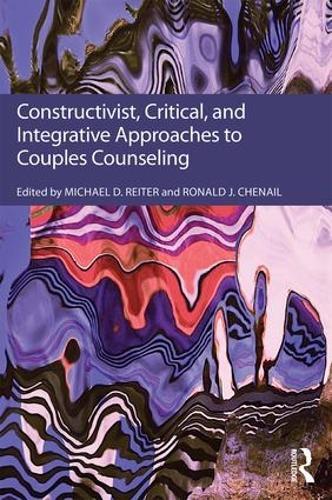
Couples counseling is distinct from individual and family therapy and, while ideas from these other formats may be overlapping, applying theoretical concepts to couples has distinctive challenges. Constructivist, Critical, and Integrative Approaches to Couples Counseling is unique in that it addresses how to conceptualize various theories around a single case. By discussing only one case, the reader is more readily able to compare and contrast the theoretical ideas of each theory, as well as the pragmatics of techniques. Five theories are discussed around four consistent parts: history, theory of problem formation, theory of problem resolution, and case transcript. This book follows the same format as its companion Behavioral, Humanistic-Existential, and Psychodynamic Approaches to Couples Counseling.
Full Product Details
Author: Michael D. Reiter (Nova Southeastern University, USA) ,
Ronald J. Chenail (Nova Southeastern University, Florida, USA)
Publisher: Taylor & Francis Ltd
Imprint: Routledge
Weight: 0.300kg
ISBN: 9781138233980
ISBN 10: 1138233986
Pages: 198
Publication Date: 24 February 2017
Audience:
College/higher education
,
Professional and scholarly
,
Postgraduate, Research & Scholarly
,
Professional & Vocational
Format: Paperback
Publisher's Status: Active
Availability: In Print

This item will be ordered in for you from one of our suppliers. Upon receipt, we will promptly dispatch it out to you. For in store availability, please contact us.
Reviews
Our therapeutic models are the maps that guide the complex clinical dilemmas that confront us when we work with couples. These maps are our lenses and ears. Without unnecessary jargon, Reiner and Chenail's team of authors give us, in turn, a map of contemporary therapeutic maps. Those learning how we think and make decisions about the couples and their stories will find this book a rare find. It will help me be clear and concise with my students, interns, and supervisees, attempting to learn the couple therapy craft. -Gonzalo Bacigalupe, EdD, MPH, professor of counseling psychology, College of Education and Human Development, University of Massachusetts Boston This text is cleverly written and incredibly helpful for those seeking to better differentiate between five compelling couples' theories. The use of a single-case threaded throughout the text is a masterful way of helping readers to compare and contrast the subtle and bold differences that exist between them. It is a critical read for those planning to work with couples in clinical practice. -Jennifer Hodgson, PhD, LMFT, professor, program director, Medical Family Therapy Doctoral Program, Department of Human Development & Family Science, East Carolina University In this volume, Reiter and Chenail have brought family therapy theory into the 21st century. This well-written, highly-relevant text is a staple for any couple and family therapist's bookshelf. Designed to be of interest to new professionals, this volume provides all readers (even seasoned therapists) with unique insights, fresh perspectives, and incredible detail in its presentation of concepts. It provides rich examples of application offered by prominent family therapy scholars and is an important resource for any clinician. -Katherine M. Hertlein, PhD, LMFT, professor, program director, Marriage and Family Therapy Program, University of Nevada, Las Vegas
Our therapeutic models are the maps that guide the complex clinical dilemmas that confront us when we work with couples. These maps are our lenses and ears. Without unnecessary jargon, Reiner and Chenail's team of authors give us, in turn, a map of contemporary therapeutic maps. Those learning how we think and make decisions about the couples and their stories will find this book a rare find. It will help me be clear and concise with my students, interns, and supervisees, attempting to learn the couple therapy craft. -Gonzalo Bacigalupe, EdD, MPH, professor of counseling psychology, College of Education and Human Development, University of Massachusetts Boston This text is cleverly written and incredibly helpful for those seeking to better differentiate between five compelling couples' theories. The use of a single-case threaded throughout the text is a masterful way of helping readers to compare and contrast the subtle and bold differences that exist between them. It is a critical read for those planning to work with couples in clinical practice. -Jennifer Hodgson, PhD, LMFT, professor, program director, Medical Family Therapy Doctoral Program, Department of Human Development & Family Science, East Carolina University In this volume, Reiter and Chenail have brought family therapy theory into the 21st century. This well-written, highly-relevant text is a staple for any couple and family therapist's bookshelf. Designed to be of interest to new professionals, this volume provides all readers (even seasoned therapists) with unique insights, fresh perspectives, and incredible detail in its presentation of concepts. It provides rich examples of application offered by prominent family therapy scholars and is an important resource for any clinician. -Katherine M. Hertlein, PhD, LMFT, professor, program director, Marriage and Family Therapy Program, University of Nevada, Las Vegas
Our therapeutic models are the maps that guide the complex clinical dilemmas that confront us when we work with couples. These maps are our lenses and ears. Without unnecessary jargon, Reiner and Chenail s team of authors give us, in turn, a map of contemporary therapeutic maps. Those learning how we think and make decisions about the couples and their stories will find this book a rare find. It will help me be clear and concise with my students, interns, and supervisees, attempting to learn the couple therapy craft. <strong>Gonzalo Bacigalupe, EdD, MPH</strong>, professor of counseling psychology, College of Education and Human Development, University of Massachusetts Boston</p> This text is cleverly written and incredibly helpful for those seeking to better differentiate between five compelling couples theories. The use of a single-case threaded throughout the text is a masterful way of helping readers to compare and contrast the subtle and bold differences that exist between them. It is a critical read for those planning to work with couples in clinical practice. <strong>Jennifer Hodgson, PhD, LMFT</strong>, professor, program director, Medical Family Therapy Doctoral Program, Department of Human Development & Family Science, East Carolina University</p> In this volume, Reiter and Chenail have brought family therapy theory into the 21st century. This well-written, highly-relevant text is a staple for any couple and family therapist's bookshelf. Designed to be of interest to new professionals, this volume provides all readers (even seasoned therapists) with unique insights, fresh perspectives, and incredible detail in its presentation of concepts. It provides rich examples of application offered by prominent family therapy scholars and is an important resource for any clinician. <strong>Katherine M. Hertlein, PhD, LMFT</strong>, professor, program director, Marriage and Family Therapy Program, University of Nevada, Las Vegas
“Our therapeutic models are the maps that guide the complex clinical dilemmas that confront us when we work with couples. These maps are our lenses and ears. Without unnecessary jargon, Reiner and Chenail’s team of authors give us, in turn, a map of contemporary therapeutic maps. Those learning how we think and make decisions about the couples and their stories will find this book a rare find. It will help me be clear and concise with my students, interns, and supervisees, attempting to learn the couple therapy craft.”—Gonzalo Bacigalupe, EdD, MPH, professor of counseling psychology, College of Education and Human Development, University of Massachusetts Boston “This text is cleverly written and incredibly helpful for those seeking to better differentiate between five compelling couples’ theories. The use of a single-case threaded throughout the text is a masterful way of helping readers to compare and contrast the subtle and bold differences that exist between them. It is a critical read for those planning to work with couples in clinical practice.”—Jennifer Hodgson, PhD, LMFT, professor, program director, Medical Family Therapy Doctoral Program, Department of Human Development & Family Science, East Carolina University “In this volume, Reiter and Chenail have brought family therapy theory into the 21st century. This well-written, highly-relevant text is a staple for any couple and family therapist's bookshelf. Designed to be of interest to new professionals, this volume provides all readers (even seasoned therapists) with unique insights, fresh perspectives, and incredible detail in its presentation of concepts. It provides rich examples of application offered by prominent family therapy scholars and is an important resource for any clinician.”—Katherine M. Hertlein, PhD, LMFT, professor, program director, Marriage and Family Therapy Program, University of Nevada, Las Vegas
Author Information
Michael D. Reiter, PhD, LMFT, is a professor in the Department of Family Therapy at Nova Southeastern University. Ronald J. Chenail, PhD, is associate provost and professor in the Department of Family Therapy at Nova Southeastern University. He also served as editor‐in‐chief of the Journal of Marital and Family Therapy, the flagship research journal of the American Association for Marriage and Family Therapy (AAMFT).