Awards
- Winner of Winner, 2015 Robert Jervis and Paul Schroeder Best.
Overview
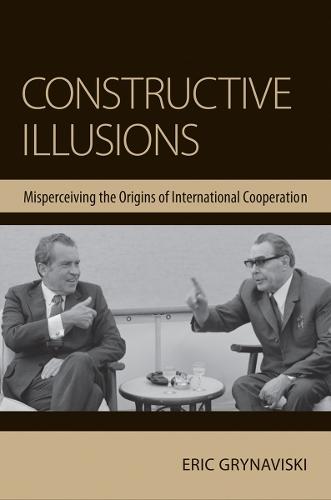
Are the best international agreements products of mutual understanding? The conventional wisdom in economics, sociology, and political science is that accurate perceptions of others' interests, beliefs, and ideologies promote cooperation. Obstacles to international cooperation therefore emerge from misperception and misunderstanding. In Constructive Illusions, Eric Grynaviski challenges this conventional wisdom by arguing that when nations wrongly believe they share a mutual understanding, international cooperation is actually more likely, and more productive, than if they had a genuine understanding of each other's position. Mutual understanding can lead to breakdowns in cooperation by revealing intractable conflicts of interest, identity, and ideology. Incorrectly assuming a mutual understanding exists, in contrast, can enhance cooperation by making actors confident that collaborative ventures are in both parties' best interest and that both parties have a reliable understanding of the terms of cooperation. Grynaviski shows how such constructive misunderstandings allowed for cooperation between the United States and the Soviet Union between 1972 and 1979. During detente, the superpowers reached more than 150 agreements, established standing consultative committees, regularly held high-level summit meetings, and engaged in global crisis management. The turn from enmity to cooperation was so stark that many observers predicted a permanent end to the Cold War. Why did the superpowers move from confrontation to cooperation? Grynaviski's theory of the role of misunderstanding in cooperation provides an explanation that is significantly different from liberal institutionalist and constructivist approaches. This book's central claim is that states can form what French president Valery Giscard d'Estaing called ""a superb agreement based on complete misunderstanding.""
Full Product Details
Author: Eric Grynaviski
Publisher: Cornell University Press
Imprint: Cornell University Press
Dimensions:
Width: 15.20cm
, Height: 1.90cm
, Length: 22.90cm
Weight: 0.454kg
ISBN: 9780801452062
ISBN 10: 0801452066
Pages: 224
Publication Date: 21 August 2014
Audience:
General/trade
,
General
Format: Hardback
Publisher's Status: Active
Availability: To order

Stock availability from the supplier is unknown. We will order it for you and ship this item to you once it is received by us.
Reviews
"""In Constructive Illusions, Eric Grynaviski presents fresh, new interpretations of some well-known events in the U.S.-Soviet detente relationship of the 1970s, based on the release of formerly classified documents. He also provides a very good, thought-provoking critique of constructivism and offers a new typology of different types of misperception.""-Deborah Welch Larson, UCLA, author of Anatomy of Mistrust ""Constructive Illusions is well written and will especially appeal to theorists of international relations. Students of Soviet-American relations and Cold War history will also find much of interest here. Eric Grynaviski adds important nuances and twists to the standard portrayals of detente.""-Jeffrey T. Checkel, Simon Fraser University, author of Ideas and International Political Change"
In Constructive Illusions, Eric Grynaviski presents fresh, new interpretations of some well-known events in the U.S.-Soviet detente relationship of the 1970s, based on the release of formerly classified documents. He also provides a very good, thought-provoking critique of constructivism and offers a new typology of different types of misperception. -Deborah Welch Larson, UCLA, author of Anatomy of Mistrust Constructive Illusions is well written and will especially appeal to theorists of international relations. Students of Soviet-American relations and Cold War history will also find much of interest here. Eric Grynaviski adds important nuances and twists to the standard portrayals of detente. -Jeffrey T. Checkel, Simon Fraser University, author of Ideas and International Political Change
""In Constructive Illusions, Eric Grynaviski presents fresh, new interpretations of some well-known events in the U.S.-Soviet detente relationship of the 1970s, based on the release of formerly classified documents. He also provides a very good, thought-provoking critique of constructivism and offers a new typology of different types of misperception.""-Deborah Welch Larson, UCLA, author of Anatomy of Mistrust ""Constructive Illusions is well written and will especially appeal to theorists of international relations. Students of Soviet-American relations and Cold War history will also find much of interest here. Eric Grynaviski adds important nuances and twists to the standard portrayals of detente.""-Jeffrey T. Checkel, Simon Fraser University, author of Ideas and International Political Change
Author Information
Eric Grynaviski is Assistant Professor of Political Science and International Affairs at George Washington University.