Overview
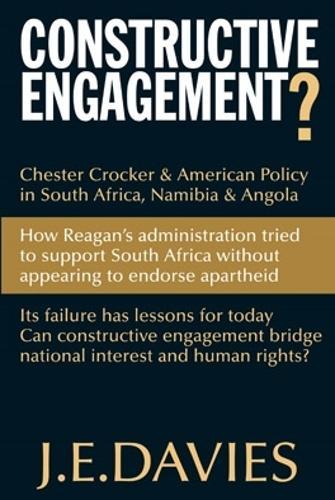
The notion of engagement represents an indispensable tool in a foreign policy practitioner's armory. The idea of constructive engagement is forwarded by governments as a method whereby pressure can be brought to bear on countries to improve their record on human rights, while diplomatic and economic contracts can be maintained. But does this approach succeed? To answer this question Davies offers a critical evaluation of one of the best-known examples of constructive engagement—the Reagan administration's policy toward South Africa. Chester Crocker was appointed as Reagan's assistant secretary of state for African affairs in 1981. Crocker maintained that unvarying hostile rhetoric leveled at the apartheid regime in South Africa only served to increase Pretoria's mistrust and dislike of Washington and hardened Pretoria's intransigence. Crocker asserted that an open dialogue, together with a reduction of punitive measures, such as export restrictions, would gain the confidence of Pretoria, enabling Washington to influence South Africa toward a gradual change away from apartheid. This book aims to determine how successful Crocker's constructive engagement policy was in South Africa and the neighboring states of Namibia and Angola. In this timely and brilliant study, Davies examines the implications for current applications of constructive engagement as a tool of foreign policy.
Full Product Details
Author: J. E. Davies
Publisher: Ohio University Press
Imprint: Ohio University Press
Dimensions:
Width: 15.50cm
, Height: 2.20cm
, Length: 23.50cm
Weight: 0.499kg
ISBN: 9780821417812
ISBN 10: 0821417819
Pages: 256
Publication Date: 01 October 2007
Audience:
Professional and scholarly
,
Professional & Vocational
Format: Hardback
Publisher's Status: Active
Availability: In Print

This item will be ordered in for you from one of our suppliers. Upon receipt, we will promptly dispatch it out to you. For in store availability, please contact us.
Reviews
Davies contends that constructive engagement was a failure because Cold War concerns overrode the explicit goal of ending apartheid in South Africa.... A well-written, thoroughly documented case study of US foreign policy. CHOICE The failure of constructive engagement is revealed quite early on in the book, when the author points out how remarkable it was that Pretoria's admission that it was not prepared to play the reciprocal role demanded by constructive engagement the reform of apartheid and the release of Namibia in exchange for respectability as a U.S. ally in the Cold Warhad no apparent impact on Crocker's policy. H-SAfrica Davies contends that constructive engagement was a failure because Cold War concerns overrode the explicit goal of ending apartheid in South Africa.... A well-written, thoroughly documented case study of US foreign policy. -- CHOICE The failure of constructive engagement is revealed quite early on in the book, when the author points out how 'remarkable' it was that Pretoria's admission that it was 'not prepared to play the reciprocal role demanded by constructive engagement'--the reform of apartheid and the release of Namibia in exchange for 'respectability' as a U.S. ally in the Cold War--had 'no apparent impact' on Crocker's policy. -- H-SAfrica
The failure of constructive engagement is revealed quite early on in the book, when the author points out how 'remarkable' it was that Pretoria's admission that it was 'not prepared to play the reciprocal role demanded by constructive engagement'-the reform of apartheid and the release of Namibia in exchange for 'respectability' as a U.S. ally in the Cold War-had 'no apparent impact' on Crocker's policy. Davies contends that constructive engagement was a failure because Cold War concerns overrode the explicit goal of ending apartheid in South Africa.... A well-written, thoroughly documented case study of US foreign policy.
Davies contends that constructive engagement was a failure because Cold War concerns overrode the explicit goal of ending apartheid in South Africa.... A well-written, thoroughly documented case study of US foreign policy. -- CHOICE
Author Information
J. E. Davies taught international relations at the University of Wales, Swansea, and is now a freelance writer living in Wales.