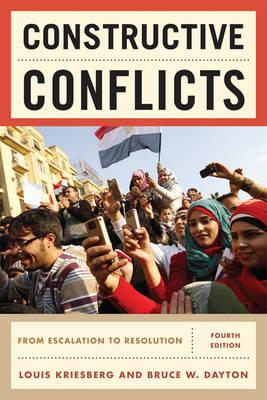
Overview
This comprehensive and highly regarded book provides a framework for analyzing diverse social conflicts. The fourth edition of Constructive Conflicts maintains the book's synthesis of theories about conflict, with key updates throughout. These include a more reader-friendly first chapter, new examples such as the Arab Spring, expanded discussions of recovery from violence and oppression, of reconciliation, and of moral concerns, and new discussions of social media and other ways conflicts are waged. Constructive Conflicts draws from relevant academic disciplines and empirical analyses of diverse conflicts to discuss the emergence, escalation, de-escalation, transformation, and settlement of conflicts. Throughout, the authors examine the strategies that partisans and intermediaries can use to minimize the destructiveness of conflicts and foster constructive ways to wage and resolve them.
Full Product Details
Author: Louis Kriesberg ,
Bruce W. Dayton
Publisher: Bloomsbury Publishing Plc
Imprint: Rowman & Littlefield
Edition: 4th Revised edition
Dimensions:
Width: 15.60cm
, Height: 2.20cm
, Length: 23.10cm
Weight: 0.590kg
ISBN: 9781442206847
ISBN 10: 1442206845
Pages: 428
Publication Date: 09 December 2011
Audience:
College/higher education
,
Tertiary & Higher Education
Format: Paperback
Publisher's Status: Out of Print
Availability: Awaiting stock

Reviews
The fourth edition of Kriesberg and Dayton's classic study of social conflicts includes a rich array of relevant case material and an updated overview of changing conflict dynamics including the tools and strategies available to today's practitioners. This sweeping and comprehensive study explores conflict phenomena from every possible angle, with particular attention to the origins and cycles of the most destructive conflicts and the variety of roads available for conflict termination. Its lucid and accessible presentation make the volume well-suited as a core text for coursework in conflict resolution as well as a practitioners' handbook of the ways in which conflict parties, as well as third parties, can deal with conflict constructively. -- Chester A. Crocker, James R. Schlesinger Professor of Strategic Studies, Edmund A. Walsh School of Foreign Service, Georgetown University The mass protests, resulting violence and intergroup tensions within communities around the world this past year have made this fourth edition of Constructive Conflicts an urgently needed addition to dispute resolution literature. The authors have reshaped the relevant theory and rigorous analysis of past editions, building in the learning from recent events and situations. The result is successful, with the objective of improving the understanding and decisions of political leaders, non-governmental actors, academics and students of conflict management. Of special interest is the new Chapter 10, which recognizes that 'the 'end, of conflict simply marks its transformation from one state to another.' It identifies the outcome conditions, conflict sequences and post-agreement consequences that shape the new post-conflict relationships, and offers key guides to help decision makers and practitioners in designing a more constructive future for disputing parties. Conflict management practitioners will want this book as a handy reference on their bookshelf to help frame strategies that will assure better outcomes for their clients. -- John Murray, senior consultant, CMPartners, LLC Any doubt about the social nature of conflict will be dispelled by Constructive Conflicts. The fourth edition gives us an updated version of Louis Kriesberg's landmark work, placing social conflict in multiple contexts of history, politics and institutional dynamics. Professor Kriesberg's new collaboration with Bruce Dayton adds freshness to a book that counts among the foundational classics of the field. -- Beth Roy, peace and conflict studies, University of California, Berkeley Bringing together an accurate understanding of conflict and its resolution is a feast of significant proportions. Louis Kriesberg has improved on his already excellent volume. His grasp of established research and new understandings is superb, and the book is a must read for any scholar and student in the emerging field of conflict resolution. -- Andrea Bartoli, Drucie French Cumbie Chair of Conflict Analysis and Resolution, George Mason University I wish I had had this book when I began my study of social conflict. -- Gene Sharp, senior scholar and founder, Albert Einstein Institution Kriesberg and Dayton have done it again! Very rich, very social, very constructive, deep and broad; a MUST in the field of conflict transformation! -- Johan Galtung, professor of peace studies; founder, TRANSCEND: A Network for Conflict Transformation By Peaceful Means
The fourth edition of Kriesberg and Dayton's classic study of social conflicts includes a rich array of relevant case material and an updated overview of changing conflict dynamics including the tools and strategies available to today's practitioners. This sweeping and comprehensive study explores conflict phenomena from every possible angle, with particular attention to the origins and cycles of the most destructive conflicts and the variety of roads available for conflict termination. Its lucid and accessible presentation make the volume well-suited as a core text for coursework in conflict resolution as well as a practitioners' handbook of the ways in which conflict parties, as well as third parties, can deal with conflict constructively.--Crocker, Chester A.
Author Information
Louis Kriesberg is professor emeritus of sociology and Maxwell Professor Emeritus of Social Conflict Studies at Syracuse University. He is the founding director of the Program on the Analysis and Resolution of Conflicts and past president of the Society for the Study of Social Problems. Bruce W. Dayton is associate professor of conflict transformation and the executive director of the CONTACT Peacebuilding Program at the School for International Training.