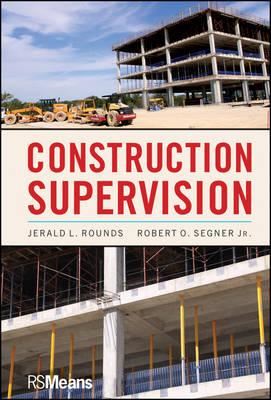
Construction Supervision

Author:   Jerald L. Rounds ,  Robert O. Segner
Publisher:   R.S. Means Company Ltd
ISBN:  

9780470614969


Pages:   464
Publication Date:   01 April 2011
Format:   Hardback
Availability:   Out of stock   Availability explained
The supplier is temporarily out of stock of this item. It will be ordered for you on backorder and shipped when it becomes available.

Our Price $178.95 Quantity:  
Add to Cart

Share |

Construction Supervision


Overview

This book covers all supervisory situations one is likely to encounter on a commercial, industrial, or institutional construction project. The book is based upon a very successful Electrical Project Supervision (EPS) training program developed by Rounds and Segner for the National Electrical Contractor?s Association and licensed to several organizations representing other construction sectors. This program has been delivered for over a decade and continues to be delivered to thousands of construction supervisors each year. The program content has consistently received outstanding reviews and evaluations in numerous different venues.

Full Product Details

Author:   Jerald L. Rounds ,  Robert O. Segner
Publisher:   R.S. Means Company Ltd
Imprint:   R.S. Means Company Ltd
Dimensions:   Width: 15.80cm , Height: 3.10cm , Length: 23.10cm
Weight:   0.748kg
ISBN:  

9780470614969


ISBN 10:   047061496
Pages:   464
Publication Date:   01 April 2011
Audience:   Professional and scholarly ,  Professional & Vocational
Format:   Hardback
Publisher's Status:   Active
Availability:   Out of stock   Availability explained
The supplier is temporarily out of stock of this item. It will be ordered for you on backorder and shipped when it becomes available.

Table of Contents

Preface xix The Role of the Supervisor xix Intended Audience xx The Book’s Structure and Organization xxi Making the Most of the Book xxii Acknowledgements xxiii Section I: Setting the Stage 1 Chapter 1: Overview of the Construction Industry 3 Introduction 3 Construction Volume and Impact on Society 4 Profit, Profitability, and the Supervisor’s Impact 5 Competition, Risk, and Construction Company Failure 6 Definitions and Roles of Construction Team Members 8 Becoming an Effective Supervisor 12 Summary 12 Chapter 2: Supervision and the Supervisor 15 Introduction 15 Definition of Supervisor 15 The Supervisor’s Functional Role in a Construction Company 16 The Supervisor as Manager 17 Transition to Management 18 Attributes of Successful Supervisors 21 Levels of Supervision—Career Paths 23 Summary 24 Section II: Soft Skills 27 Chapter 3: Oral Communication 29 Introduction 29 Defining Communication 29 Characteristics of Communication in Construction 30 Improving One-on-One Oral Communication Skills 31 Techniques for Improving the Effectiveness of Oral Communication 35 Active Listening 37 Customer Relations 40 Who Is the Customer? 40 Respecting the Customer 41 The Art of Negotiation 41 Summary 44 Chapter 4: Written Communication and Documentation 47 Introduction 47 Why Write the Message? 48 The Functions of Job Site Documentation 48 Improving Written Communication and Documentation 49 Job Site Communication and Documentation 50 Company Office Communication and Documentation 58 Communications and Documentation Developed Outside the Company 70 Organizing Construction Documents 71 Obtaining Information and Documentation 71 Summary 73 Chapter 5: Team Building and Maintenance 75 Introduction 75 The Critical Need for Effective Construction Teams 76 The Construction Team 78 Team Characteristics 79 Team Formation 82 Maintaining Team Effectiveness 83 Practical Team Building 85 Summary 87 Chapter 6: Maintaining the Relationship Between The Employee and the Employer 89 Introduction 89 Evaluating Performance 90 Diversity and Discrimination 101 Harassment 105 Summary 108 Chapter 7: Managing the Human Resource 111 Introduction 111 The Supervisor as a Leader 112 Styles of Leadership 114 Elements of Motivation 120 Manager, Learn to Better Understand Yourself as Well as Those around You 132 Summary 135 Chapter 8: Risk Management and Problem Solving 137 Introduction 137 Identifying and Dealing with Risk 137 Managing Risk 141 Problem Solving 142 Summary 151 Section III: Technical Skills 153 Chapter 9: Safety 155 Introduction 155 Accidents, Incidents, and Safety Risk 156 The Importance of a Construction Safety Program 156 The Supervisor’s Safety Responsibilities and Activities 158 Creating a Safe Work Environment by Removing Job Hazards 159 Developing a Mentality of Safety 163 Effectively Dealing with Safety Events 166 Summary 167 Chapter 10: The Contract as a Management Tool 169 Introduction 169 A Practical Understanding of the Contract 170 Required Elements for an Enforceable Contract 172 Components of the Construction Contract 173 Contract Couplets 174 Reading the Contract 176 Using the Contract 178 Summary 181 Chapter 11: Managing Physical Resources 185 Introduction 185 Managing Manpower 185 Managing Materials 189 Managing Tools and Equipment 194 Managing the Construction Site 195 Cash as a Resource 197 Managing Time on a Construction Project 199 Summary 199 Chapter 12: Managing Costs: Understanding the Estimate 201 Introduction 201 The Estimate 201 Types of Estimates 202 Truisms Regarding the Estimate 203 Preparing the Estimate 204 The Detailed Estimate 205 Preparing the Detailed Estimate 206 Finalizing and Submitting the Estimate 217 Summary 218 Chapter 13: Managing Costs Control 221 Elements of Cost Introduction 221 The System Is a Cycle 221 The Project Budget and the Project Labor Budget 225 Labor Cost Reports 228 The Cycle Continues 233 Project Review 234 Summary 235 Chapter 14: Managing Time on a Construction Project 237 Introduction 237 Scheduling Defined 238 The Schedule as a Planning Tool 239 Importance of the Schedule 239 Types of Schedules 240 The Critical Path Method (CPM) 252 Development of a Network Schedule and the Critical Path 256 Basic Truisms with Regard to the Critical Path 274 Network Schedule Updates 274 Short-Interval Schedules 275 Summary 277 Chapter 15: Managing Production 279 Introduction 279 Understanding Production and Productivity 280 Improving Production 281 Improving Production in an Ongoing Activity 282 Designing a More Efficient Task 289 Improving Construction Operations 292 Summary 299 Section IV: Project Supervision 301 Chapter 16: Project Organization 303 Introduction 303 Types of Projects 303 Other Classifications—Types of Contractors 304 Project Delivery Methods 305 Types of Construction Contracts 314 Forms of Construction Contract Award 316 Other Forms of Contracts 327 Project Organization and Relationships 327 Subcontractor’s Project Organization 331 Summary 331 Chapter 17: Mobilization 335 Introduction 335 Handoff from Preconstruction to Construction—Handoff Meetings 335 Preconstruction Conference 336 Setting Up the Site 338 Setting Up the Field Office 339 Establishing Field Procedures 341 Project Objectives 341 Summary 343 Chapter 18: Ongoing Operations 345 Introduction 345 Documenting 346 Reporting 349 Retainage 360 Meetings 360 Changes in the Work 362 Quality, Quality Assurance, and Quality Control 363 Summary 367 Chapter 19: Closeout of Field Operations 369 Introduction 369 Project Cleanup 370 The Commissioning Process 370 Developing Final Documentation 373 Closing Out Subcontractors and Suppliers 376 Final Request for Payment 377 The Certificate of Occupancy 377 Certificate of Substantial Completion 378 Project Review 379 Summary 380 Chapter 20: the Supervisor’s Continuing Development 383 Introduction 383 Change in the Construction Industry 383 Recruiting and Preparing Construction Supervisors 389 Staying Ahead of the Curve 390 Summary 394 Appendix 1: Consensusdocs 750: Standard Form Of Agreement Between Contractor And Subcontractor 397 Appendix 2: Simple Filing System 431 Index 433

Reviews

Author Information

Jerald L. Rounds, PhD, PE, is Associated General Contractors Endowed Chair in Construction Management and Construction Engineering at the University of New Mexico. As a certified Class ""A"" construction superintendent in Denver, he served as project manager on a number of commercial building projects prior to more than thirty years as a construction educator. Concurrently, he has developed numerous training programs in project management and supervision for the construction industry. Most recently, he codeveloped the NECA Electrical Project Supervision training program with Robert Segner, with whom he has conducted ""train the trainer"" sessions for the past decade. Robert O. Segner Jr. is a professor of construction science in the College of Architecture at Texas A&M University. He followed years of construction practice with four decades in construction higher education. He has served as president of the American Council for Construction Education. Segner codeveloped the NECA Electrical Project Supervision training program with Jerald Rounds and has conducted ""train the trainer"" sessions for the past decade. He has developed and taught numerous other continuing education programs.

Tab Content 6

Author Website:  

Countries Available

All regions
Latest Reading Guide

MRGC26


Shopping Cart
Your cart is empty
Shopping cart
Mailing List