Overview
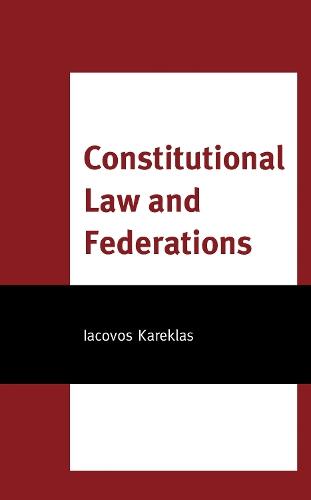
Constitutional Law and Federations provides a concise overview of the British occupation of Cyprus(1878-1959), the efforts of the Greek Cypriots for independence, and the structure and peculiarities of the current Cyprus Constitution. Federal states and the concept of federalism worldwide and, in every era, have come into being because of important political and security reasons dictating or necessitating the creation of such governmental organizations. The bi-zonal federation envisaged for Cyprus, in the Accords of 1977 and 1979 is not in compliance with these prerequisites. According to objective legal norms, bi-communal and bi-zonal federation flagrantly violates international law and is incompatible with the notion of human rights with regard to Cyprus. A federation modelled on the United States of America federal Constitution could, indeed, provide an ideal framework for settling the Cyprus problem and safeguarding the protection of basic human rights and constitutional freedoms for all sections of the population on the island. This book will be of interest to scholars and students of constitutional law, international law and international relations as well as diplomats, who deal not only with the Cyprus issue but also with related regional and international issues.
Full Product Details
Author: Iacovos Kareklas
Publisher: Bloomsbury Publishing Plc
Imprint: Lexington Books
Dimensions:
Width: 16.10cm
, Height: 2.30cm
, Length: 22.70cm
Weight: 0.617kg
ISBN: 9781793642738
ISBN 10: 1793642737
Pages: 234
Publication Date: 18 October 2021
Audience:
Professional and scholarly
,
Professional & Vocational
Format: Hardback
Publisher's Status: Active
Availability: Manufactured on demand

We will order this item for you from a manufactured on demand supplier.
Reviews
Constitutional Law and Federations is a solid addition and valuable contribution to the many studies of the Cyprus issue. It not only contributes to the literature of constitutional theory, but also combines elements of legal history, especially that of ancient Greek law. This combination is one of the strongest features of this research. The author Kareklas, from the first lines of his work presents his proposition that the model of the United States Federal Constitution should provide the basis on which the Cyprus problem could be settled. This proposition constitutes a major contribution of this work. The book is the product of complete and exhaustive research, which stands out for its clarity. It is a well-documented, comprehensive, reliable, and serious scientific work. It is also structured in a logical manner with an excellent style of writing. All these reasons provide the book with the benefit of a wide readership. It will be of interest to non-experts on public law as well as the academic community. -- Sofia Adam, Hellenic Open University
Author Information
Iacovos Kareklas, expert in constitutional law, international law and philosophy of law, is Visiting Fellow of Pembroke College in the University of Oxford.